
What at first glance seems to be the most cost-effective T-shirt print can actually cost your brand the most - the loss of a professional image. Logos cracking after the third wash or colors that have lost 20% of their saturation after just one month are details that undermine trust and nullify the investment in consistent visual identity.
We know that the dilemma of DTF vs DTG printing is more than a technical puzzle; it's a strategic decision that determines how your brand will be perceived on a daily basis. You want to be sure that your workwear is a showcase of quality, and your logo remains sharp and saturated, regardless of whether it's on a cotton polo shirt or a technical polyester T-shirt. The concern about durability and precision is fully justified, because these are what build professionalism.
That's why we've prepared this comprehensive summary for 2026, which will clear up your doubts. In this article, we'll walk you through the key differences between these two leading digital printing technologies. We'll compare their durability in wash tests, the precision of color reproduction from the Pantone palette, cost-effectiveness for different print runs, and behavior on various material compositions, so that your choice is a 100% conscious investment in an image that will last for years.
Key Takeaways
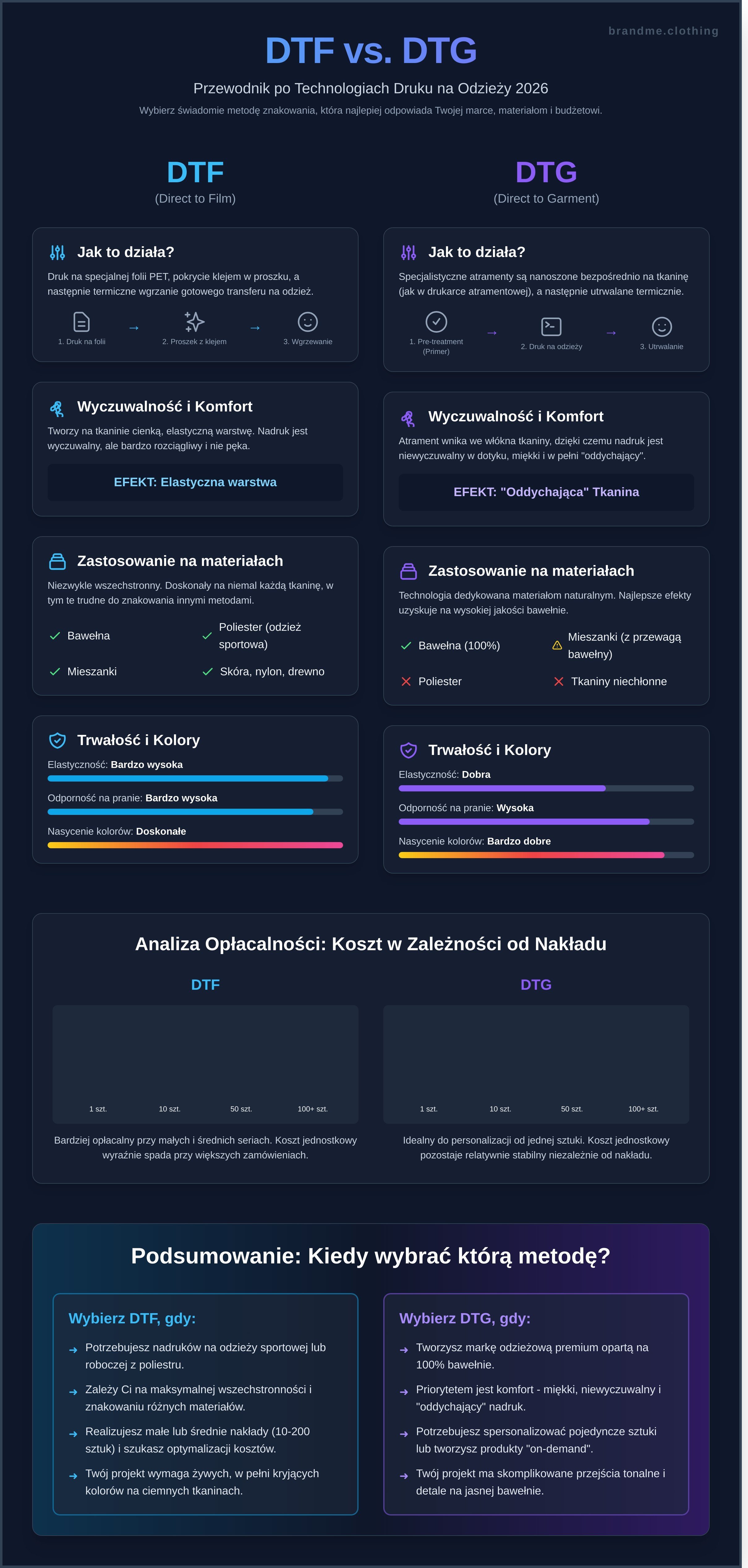
- Learn how to "feel" the difference between prints. DTG is imperceptible and "breathable," ideal for premium cotton, while DTF creates a palpable, flexible layer perfect for polyester.
- Match the technique to the material, not the other way around. Discover why fabric composition is a key factor in choosing between versatile DTF and specialized DTG.
- Understand how cost analysis for DTF vs DTG printing affects the budget. Find out which method is more cost-effective for customizing a single item, and which scales better for larger orders.
- Invest in durability that will withstand hundreds of washes. Learn about the strength test results of both technologies and choose a solution that will ensure a professional look for your brand for years to come.
What are DTF and DTG printing? Understanding the fundamentals of digital marking
In a world where personalization has become key to building brand identity, apparel marking technologies are experiencing a true revolution. Just a decade ago, screen printing dominated - a technique excellent for mass production, but inflexible and costly for small print runs. The need for quick execution of single, unique designs gave rise to digital printing. Two technologies took the lead: DTG (Direct to Garment) and DTF (Direct to Film). Understanding their mechanisms is crucial to consciously choosing the solution that will best "dress" your brand.
The transition from analog to digital "on-demand" methods is not just a change in technology. It's a fundamental shift in production philosophy. Instead of stocking hundreds of identical T-shirts, companies can now produce exactly what they need, even a single piece. Market analysts, such as those from Verified Market Research, predict that the global digital textile printing market will reach over 8 billion dollars by 2027. This shows that the future belongs to personalization, and the key question is: DTF vs DTG printing - which method will better meet your needs?
DTG mechanism: Direct printing into the fiber structure
DTG is the digital evolution of an inkjet printer, transferred from the world of paper to textiles. Imagine a precise print head that, instead of on paper, applies specialized, water-based pigment inks directly onto a cotton T-shirt. However, to achieve vibrant, saturated colors, especially on dark materials, pre-processing is essential. A special primer is sprayed onto the fabric, creating an perfectly smooth surface and preventing the white ink from soaking too deeply into the fibers. After the graphic is printed, the whole thing is thermally fixed in a press or heating tunnel at about 160-170°C, which permanently bonds the pigment to the cotton. The result? A soft-touch, "breathable" print that becomes an integral part of the fabric.
DTF mechanism: Transfer precision from a sheet
DTF is a real breakthrough in marking, eliminating many of its predecessor's limitations. The process begins not on the garment, but on a special PET transfer film. A printer applies the design in a mirror image onto it, and then covers the still wet ink with fine polymer powder - a thermoplastic adhesive in granule form. The powder adheres only to the printed areas. Then the film is briefly heated, which turns the powder into a uniform, flexible adhesive layer. This innovative method, described in detail on the DTF printing Wikipedia page, eliminates the need for chemical treatment of the material. The ready transfer can be heat-pressed onto almost any material - cotton, polyester, blends, and even leather or wood - using a standard heat press. This versatility opens up completely new possibilities.
Key technical differences: How does technology affect look and feel?
Choosing between DTF and DTG digital printing is much more than a matter of cost or production speed. It's a strategic decision that directly defines how a customer will perceive and feel your product. Printing technology shapes color saturation, detail precision, and, equally importantly, the hand-feel of the material. Understanding these subtleties allows for conscious brand building of a premium image.
Print Aesthetics and Hand-feel
The fundamental difference in print feel results from the application process itself. In DTG (Direct to Garment) technology, water-based ink is injected directly into the cotton fibers, becoming an integral part of the fabric. The result? The print is virtually imperceptible to the touch, soft, and fully "breathable." This solution is ideal for apparel brands focused on comfort and naturalness, especially for premium T-shirts with a weight of over 180 g/m².
In contrast, DTF (Direct to Film) technology involves applying graphics to a special transfer film, covering it with powder adhesive, and then heat-pressing it onto the material. This creates a thin, flexible layer on the fabric surface. This "film" effect has its pros and cons. On a light cotton T-shirt, it may be perceived as less luxurious, but for sportswear or workwear, its flexibility and durability are unmatched. DTF print works with the fabric, stretching without cracking by as much as 30-40%, as confirmed by technical apparel manufacturers analyzing the advantages and applications of DTF in demanding conditions.
Color Fidelity and Gradients
Both technologies use the CMYK color palette with additional white ink (CMYK+W), which allows for printing full-color photographs and complex graphics. However, how these colors appear on the final product differs significantly. A key factor in the DTF vs DTG printing debate is the medium onto which the ink is applied.
In DTG, the ink soaks into the material fibers. On fabrics with a lower weight (e.g., 150 g/m²) or a looser weave, this can lead to a subtle decrease in color saturation, as the pigment disperses within the cotton structure. This problem is minimized by using a white underbase on dark materials, but the final effect is always, to some extent, dependent on the quality of the garment itself.
DTF eliminates this variable. Printing occurs on a perfectly smooth film, guaranteeing 100% repeatability and maximum color saturation, regardless of whether we are marking a cotton T-shirt, a polyester hoodie, or a nylon jacket. White ink creates a perfectly opaque barrier, ensuring that colors are vibrant and consistent with the digital design. This precision means that DTF often handles thin lines and fine details better, which might be slightly blurred in DTG. Choosing the right technique is a decision that defines quality. Consult your project with our experts to ensure that the final result fully reflects your brand's vision.
Durability and substrates: What to print on and how long will it last?
Even the most spectacular graphic design loses value if the print cracks or fades after a few washes. Choosing the right marking technology is an investment in your brand's durability and image. It is in this area that the key differences in the DTF vs DTG printing debate are most clearly visible. The decision on the printing technique is inextricably linked to the material on which it is to be placed, and the expected product lifespan.
Material Compatibility: Where DTG reigns and where DTF takes the lead?
DTG (Direct to Garment) technology is the undisputed king of natural fibers. Its water-based inks bond best with cotton, which is why at least 80% cotton content is required for optimal, vibrant colors and a soft feel. The higher the cotton content, the better and more durable the effect. This is an ideal solution for classic premium T-shirts and sweatshirts.
DTF (Direct to Film) opens up completely different possibilities. This method has almost no material limitations. By applying the design to a special transfer film and then heat-pressing it onto the fabric, DTF works perfectly on:
- Polyester and nylon: sportswear, softshell jackets, workwear.
- Cotton-polyester blends: popular sweatshirts and T-shirts that pose a challenge for DTG.
- Other materials: cotton bags, caps, and even leather or denim.
What's more, the flexibility of transfer film application allows for precise marking of hard-to-reach areas such as collars, sleeves, or zipper areas, where direct DTG printing would be technically impossible.
Durability in everyday use: How many washes will your print withstand?
The key to the longevity of a print is proper care. Although both technologies offer high quality, DTF shows slightly greater mechanical resistance. The print creates a thin, flexible, and cohesive layer on the material that works with the fabric, minimizing the risk of cracking or peeling. This flexibility is crucial, as experts confirm. A detailed technical comparison of DTF and DTG published by the industry portal WhatTheyThink, highlights this advantage, pointing to the lack of need for pre-treatment of synthetic materials, which is a barrier for DTG.
To maximize the lifespan of digitally printed clothing, follow a few simple rules:
- Wash garments inside out.
- Set the washing temperature to a maximum of 30-40°C.
- Avoid strong detergents and bleaches.
- Choose low spin speeds (up to 800 rpm).
- Never iron directly over the print.
Industry durability tests show that high-quality DTF prints retain over 95% color saturation even after 50-60 wash cycles. This is a standard that, according to forecasts, will become an absolute norm by 2026 for outdoor and workwear, where resistance to abrasion and weather conditions is a priority.
The weight of the material is also significant. Thicker fabrics (above 180 g/m²) provide a more stable and smoother surface, which translates into better detail reproduction and color intensity in both technologies. Thinner materials may be less resistant to intensive use, and in the case of DTG, there is a risk of slight ink bleed-through.
The choice of material itself is also a strategic image decision. While cotton and polyester are standard in promotional clothing, there is growing interest in premium materials, such as natural wool, which inherently communicate brand values. As inspiration from the international market, where craftsmanship and naturalness are key, you can learn more about Himalayan Wool.
Cost-effectiveness analysis: When to choose DTF and when DTG for corporate orders?
The decision to choose a marking technology is a strategic step that affects your budget, lead time, and the final image of your brand. Both DTF and DTG eliminate one of the biggest entry barriers known from screen printing: expensive setup costs. In digital printing, you don't pay for screens or stencils, which makes personalization accessible even for a single item. This is the foundation of modern merch, allowing for flexibility and testing designs without tying up capital in large print runs.
What about speed? For an order of 50 cotton T-shirts with the same design, the DTG process is marginally faster. The printer applies ink directly to the garment, which, after curing, completes the process. DTF requires an additional step - heat-pressing the finished transfer onto the material. However, the time difference is so small that other factors become crucial. It's also worth looking at ecology: both methods use significantly less water than traditional techniques. DTG, thanks to water-based inks, generates minimal waste. DTF uses PET film, but modern production processes aim to minimize and recycle it.
Business scenarios for your company
The choice between DTF vs DTG printing depends on the specific application. For one-time event apparel, where maximum wearing comfort is important, DTG is unrivaled. The print is imperceptible to the touch and fully breathable. For company hoodies or workwear, where durability is a priority, DTF wins due to its flexibility and wash resistance (up to 50 cycles without losing quality). In the dropshipping model, both technologies work well, but DTF offers a logistical advantage - transfers can be prepared in advance and applied to various products (caps, bags, polyester) as orders come in.
And speaking of investing in your team, it's worth remembering that brand care is not only about high-quality clothing, but also about supporting employee well-being. More and more companies are using tools such as mindfulness training, which build stress resilience and improve concentration. As inspiration in this area, it is worth checking the resources offered by gom.info.pl.
Scaling production and unit price
Where does the cost-effectiveness of digital printing end? Typically, for print runs exceeding 100-150 pieces of a single design, screen printing becomes more economical. Below this threshold, DTF and DTG reign supreme. It's worth remembering that in DTG technology, the cost of printing is directly proportional to the size of the graphic and ink consumption - a large, colorful design on the back will be more expensive than a minimalist logo on the chest. However, the biggest advantage of digital printing is cost optimization for mixed orders. An order of 50 T-shirts in 5 different sizes and 3 colors does not generate any additional fees. This is the flexibility your company needs to dynamically respond to market needs.
Choosing the right method is key to the success of your project. Instead of guessing, consult with our experts to precisely match the technology to your goals.
Branding at Brandme: Why we combine both methods for your success?
At Brandme, we don't believe in one-size-fits-all solutions. We understand that every brand, every project, and every batch of apparel has its unique specifics. That's why, instead of promoting one technology over another, we approach each order as a strategic challenge. The key to a perfect product lies in the conscious choice between DTF vs DTG printing, and often in their intelligent combination. Our goal is not just to print, but to dress your brand in quality that speaks for itself.
Our philosophy is based on precisely matching the technique to the material, print run, and graphic complexity. You don't have to be an expert – that's what we're here for. We analyze your project and advise which method will provide the best visual effect and highest durability. Production entirely localized in Poland gives us full control over the process and allows for flexibility that you won't find with intermediaries. From prototype to production counted in thousands of pieces, we are your partner in building a strong visual identity.
To ensure perfect reproduction of your vision, proper file preparation is crucial. Our graphic design team is ready to assist you with this, but here are some basic rules:
- File format: We achieve the best results with vector files (AI, EPS, PDF) or high-resolution raster files (PNG, TIFF).
- Resolution: The absolute minimum is 300 DPI at a 1:1 scale. This guarantees sharp edges and clear details.
- Background: Print files should have a transparent background unless the background is an integral part of the design.
- Colorimetry: We work in the CMYK color space, but RGB files are automatically converted while maintaining maximum color fidelity.
Every file is verified by our specialists before printing. If we notice potential issues, we will contact you to find the best solution together.
Brandme Quality Standards
Quality is fundamental to us. That's why we exclusively use OEKO-TEX ECO PASSPORT certified water-based inks for all our prints. This means they are 100% skin-safe, even for infants, and free from harmful chemicals. Our quality control is multi-stage – it begins in our sewing room, continues through the verification of each print, and extends to the careful packaging of finished products. This ensures that you receive premium apparel that will last for years.
In 2023, we completed a project for the Polish technology startup "CodeWave," which wanted to create an exclusive collection of 300 sweatshirts for its employees and key clients. The challenge was to combine complex, multi-color graphics on the back with a precise logo on the chest. We employed a hybrid strategy: DTG printing for photorealistic graphics on cotton sweatshirts and DTF for a perfectly opaque, durable logo. The result? A collection that enhanced the company's image as a modern, detail-oriented employer.
Start collaborating with professionals
Your project deserves the best execution. Contact us for a free quote and professional technical advice. Our team will help you choose the right apparel, labeling technique, and personalization options, such as individual jacquard labels, woven tags, or eco-friendly packaging. We understand that deciding between DTF and DTG printing can be complex, which is why we are here to guide you through the entire process, from concept to delivery of the finished product. Invest in quality that builds your company's image.
Create company apparel that sets your brand apart
DTF or DTG? Choose the technology that will build your future
The choice between DTF and DTG printing is not about identifying one universally better method. It's a strategic decision that defines the appearance, durability, and character of your apparel. DTG remains unrivaled for photorealistic graphics on cotton, offering unparalleled print softness. DTF, on the other hand, opens the door to labeling almost any material, from polyester to caps and backpacks, ensuring flexibility and impressive durability.
At Brandme, we don't force you into compromises. We understand that every brand and every project has unique needs. That's why our modern machine park, equipped with DTF, DTG, computer embroidery, and screen printing technologies, allows us to select the tool perfectly suited to your vision. We fulfill orders starting from just 1 piece, producing in Poland exclusively with certified fabrics. You don't have to be an expert – that's what we're here for.
See how precisely we can dress your brand in quality. Request a free quote for apparel branding at Brandme and let our specialists propose a solution that best tells the story of your success. Start building your advantage today.
DTF and DTG Printing – Frequently Asked Questions
Is DTF printing better than DTG?
There is no single answer – the choice depends on the design and material. DTF printing is more versatile, ideal for cotton, polyester, and blends, offering excellent durability. DTG, on the other hand, provides unparalleled softness to the touch and breathability, as the ink penetrates the fabric fibers. When analyzing the issue of DTF vs. DTG printing, matching the technology to the purpose is crucial. For workwear, we recommend DTF, and for premium 100% cotton T-shirts – DTG.
Does DTF print crack after washing?
Professionally executed DTF prints do not crack and maintain full flexibility. Our products withstand at least 40-50 washes at temperatures up to 40°C when following the care label instructions. The key to such durability is the use of certified inks and adhesive, as well as precise thermal application. This ensures that the print becomes an integral, stretchable part of the garment, not just a stiff, superficial layer.
Which printing method is cheaper for small orders?
For orders of 1 to 10 pieces, DTF printing is usually more cost-effective. This technology does not require time-consuming material preparation (pre-treatment), which lowers the unit cost for very small quantities. The price difference can range from 10% to 15% in favor of DTF compared to DTG for single items. However, both methods are designed for short runs, eliminating the setup costs associated with screen printing.
Can I iron clothes with DTF or DTG prints?
Yes, clothes with both types of prints can be safely ironed, but a few rules must be observed. Always iron the garment inside out, never directly over the print. Set the iron to a low or medium temperature, not exceeding 150°C, and turn off the steam function. This will preserve the intensity of colors and the flexibility of the graphic for much longer, protecting your investment in your brand's image.
Can DTG printing be used on black T-shirts?
Of course, DTG technology was created for printing on dark and colored cotton fabrics. This process involves applying a special white underbase layer directly to the T-shirt. Only then are the actual colors applied to this perfectly opaque base. This ensures full color saturation, which looks spectacular and is fully visible even on deep black material.
How to prepare a graphic file for digital printing?
For the best quality, submit the file in PNG format with a transparent background. Make sure the graphic has a resolution of at least 300 DPI and is saved at the target print size (1:1 scale). Although we prefer files in the CMYK color space, we can easily handle RGB files, professionally converting them before printing. A correctly prepared file is the foundation of precise printing.
Does DTF print "breathe" the same as DTG?
No, DTG print has much better breathability. In the DTG method, water-based ink penetrates directly into the structure of cotton fibers, so the material remains fully breathable. DTF, on the other hand, creates a thin, flexible layer on the fabric surface, which restricts air circulation. For large, full graphics on summer or sportswear, the breathability advantage of DTG is clearly noticeable.
Which method better reproduces small texts and details?
Both technologies guarantee high precision, but DTF often has a slight advantage with extremely small elements. Printing on transfer film prevents even minimal ink penetration into the material fibers, allowing for perfectly sharp edges with fonts just a few millimeters in size. Therefore, for complex logos with very fine text, DTF is an unrivaled solution.