

Choosing between loopback and brushed sweat fabric is not just a technical detail; it is a strategic decision that defines the DNA of your clothing brand. Often, it is this very choice that determines whether a customer returns for another product or feels disappointed after the first wash. Understanding how loopback versus brushed knit affects the final effect of a project allows you to avoid the most common mistakes, such as unsightly fabric pilling or non-durable prints. In 2026, as OEKO-TEX standards have become even more rigorous, an informed choice of certified materials with a high weight of 340-400 GSM becomes the foundation for building a premium image.
You will surely agree that the biggest challenge is creating clothes that retain their structure and softness over many seasons. This guide will help you precisely match the type of sweat fabric to the season and the planned branding technique, regardless of whether you opt for minimalist embroidery or event merch. You will learn why production in Poland and the option of personalization starting from a single piece are the keys to the success of a modern brand. We will analyze the specific properties of both types of knit, their resistance to wear and tear, and their impact on the aesthetics of popular oversize and boxy cuts, so that your collection delights with quality from the first touch.
Key Takeaways
- You will understand how loopback and brushed knit differ in terms of weave construction and how this choice translates into the final look and prestige of your sweatshirt collection.
- You will learn why brushed knit of the same weight feels thicker and warmer than loopback, which will allow you to better match the material to the season.
- You will get to know the principles of selecting branding techniques, such as computer embroidery or screen printing, to ensure maximum durability and aesthetics of the decorations on the chosen type of sweat fabric.
- You will learn how to build a premium brand based on production in Poland, utilizing the flexibility of orders from a single piece and certified OEKO-TEX materials.
- You will receive specific tips on which material to choose for streetwear projects, and which for customers looking for lightweight, year-round lifestyle clothing.
What are loopback and brushed knit? Definitions and construction
Distinguishing between these two types of materials is the foundation of premium clothing design. Although they may look identical from the outside, their internal structure and finishing process determine the comfort of wear and product durability. Understanding how loopback versus brushed knit affects the final quality of a sweatshirt allows you to avoid mistakes at the collection planning stage. The choice of weave is not just a matter of aesthetics; it is a decision about the garment's purpose, its thermal properties, and the way it drapes on the silhouette.
Construction of loopback sweat fabric – why is it so popular?
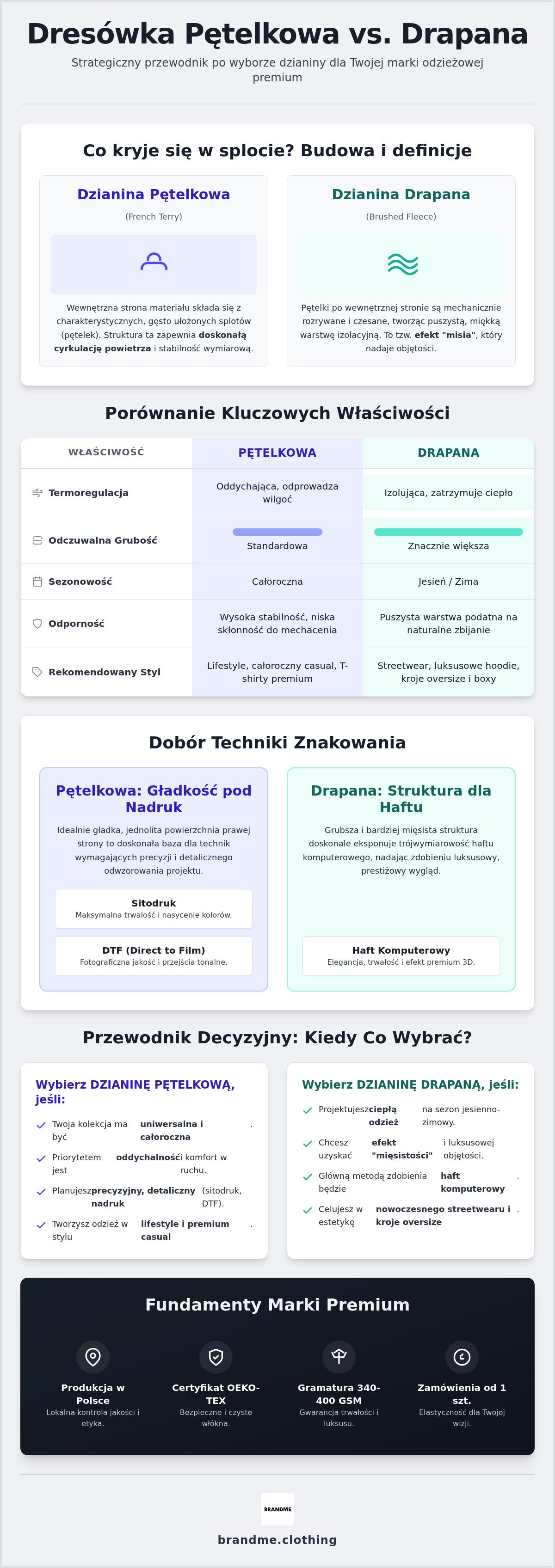
Loopback knit, better known as French Terry, is characterized by a specific double-sided structure. The right side of the material is smooth and uniform, making it an ideal base for precise branding techniques such as screen printing or DTF. The left side consists of distinct, densely arranged loops. The definition of loopback knit (French terry) indicates that this technique ensures excellent air circulation and high hygroscopicity. It is a year-round material that works great in lighter hoodies and high-weight Premium T-shirt products. Loopback is stable, less prone to deformation, and provides a so-called cool hand feel, which is appreciated by brands focusing on lifestyle style and casual clothing.
The secret of brushed knit – how is "soft fleece" created?
Brushed knit starts its production process exactly the same way as loopback. The key change occurs at an additional finishing stage, involving mechanical brushing of the left side of the material with special brushes. This process tears the loops, creating a fluffy, soft insulating layer. This characteristic fuzz not only drastically increases thermal comfort but also gives the material the desired volume. Brushed sweatshirts seem much thicker and meatier even at the same weight as loopback versions. At Brandme, we use this finish in models such as oversize hoodies to achieve the effect of a stiff, luxurious drape of the material, which is a hallmark of modern streetwear.
Material composition plays a key role here in maintaining quality. Although in the premium segment we strive for the highest possible cotton content, a small addition of polyester in brushed knit helps maintain the structure of the fuzz and prevents it from matting excessively after many washes. In 2026, in accordance with new OEKO-TEX guidelines, our Polish sewing factory with 14 years of experience places even greater emphasis on the purity and safety of fibers. The choice between loopback and brushed is in practice a decision about the character of your brand: from breathable, technical classics to heavy, winter luxury that envelops the user in softness.
Technical properties and comfort: Loopback vs Brushed
Many designers make the mistake of evaluating material quality solely through the prism of weight. In reality, how loopback versus brushed knit behaves in daily use depends on its internal structure. The most striking difference is the perceived thickness. Although both types can have an identical weight, for example 320 g/m2, brushed knit will always seem thicker and meatier. This results from the brushing process, which increases fiber volume, creating an air barrier. Loopback, on the other hand, is more compact and flat, which translates into better dimensional stability and a lower tendency to stretch at the elbows or knees.
Another aspect is thermoregulation. Loopback knit (loopback) is a master of breathability. Its structure allows the skin to breathe, efficiently wicking moisture to the outside, which makes it an ideal choice for intensive use. The brushed version, in turn, focuses on insulation. The fuzz on the left side traps heat against the body, which is crucial on colder days. However, it is worth remembering the issue of pilling. High-quality cotton used at Brandme minimizes this risk, but by nature, it is smooth loopback that is more resistant to external friction than fluffy fuzz, which after many washes can undergo natural matting.
When to choose loopback sweat fabric?
This is the best choice for brands aiming for year-round and lifestyle collections. Thanks to its lightness, loopback drapes perfectly on the silhouette without visually adding kilograms. It is irreplaceable in sports designs and as event merch that is intended to be worn both indoors and outdoors. If your project assumes a fitted cut or is to serve as a layer under a jacket, loopback will provide the necessary freedom of movement and comfort without overheating the body.
Advantages of brushed sweat fabric in the premium segment
If your goal is to create a prestigious "heavyweight" collection, brushed knit has no equal. In 2026, the European premium market is clearly leaning towards weights in the range of 340-400 GSM, which in the brushed version gives the effect of a luxurious, stiff form. Such material fits perfectly with oversize cuts, where a specific, geometric shape of the garment counts. Softness upon first contact builds immediate customer trust in the brand's quality. When planning an autumn drop, it is worth checking our ready-made models, such as a hoodie with a thick weave that combines thermal insulation with modern aesthetics.
The final decision should also take into account the product life cycle. Loopback knit usually handles very frequent washing at high temperatures better, retaining the original weave structure. Brushed knit requires a bit more care, but rewards with exceptional comfort, which for many users is synonymous with top-shelf clothing. By choosing OEKO-TEX certified materials produced in Poland, you can be sure that regardless of the type of weave, you are providing a safe and durable product.
Clothing branding vs type of knit – Embroidery, screen printing, or DTF?
The decision to choose a decoration technique must be closely correlated with the type of substrate. How loopback versus brushed knit interacts with an embroidery needle or screen printing ink determines the prestigious look of your brand. Mismatched choices can result in material puckering, print cracking, or unsightly fiber show-through the graphics. At Brandme, every project starts with an analysis of the weave structure to ensure maximum durability of personalization. Understanding how loopback versus brushed knit reacts to temperature during print setting allows us to deliver products resistant to cracking and fading.
Embroidery on brushed knit – prestige and stability
Heavyweight brushed sweat fabric is the best foundation for computer embroidery. Its dense, meaty structure perfectly stabilizes stitches, which prevents threads from sinking deep into the material. As a result, logos retain sharp contours and the desired three-dimensional character. A thicker layer of material also minimizes the risk of the knit puckering around the decoration, which can be problematic with very light weaves. By choosing computer embroidery at Brandme, you gain the certainty that the decoration will survive hundreds of wash cycles without losing its form. This is a solution especially recommended for premium brands and corporate clothing, where durability and elegance are a priority.
Digital prints on loopback – precision and colors
Loopback knit, thanks to its smooth outer layer, constitutes an ideal canvas for intricate details. Screen printing on loopback allows for obtaining perfectly sharp edges and deep color saturation. This results from the fact that the ink is applied on a uniform surface without encountering resistance from loose fibers. For smaller orders or projects executed from a single piece, the DTF (Direct to Film) technique on loopback eliminates the risk of so-called fibrillation. This is a phenomenon where tiny fuzz hairs poke through the ink layer, which can ruin the visual effect on brushed knits.
When designing a sweatshirt with a print, it is worth remembering a few rules for matching the technique to the material:
- Computer embroidery: Unbeatable on 340-400 GSM brushed knit.
- Screen printing: Highest precision on smooth loopback sweat fabric for large quantities.
- DTF/DTG: Best effects on loopback, although with proper preparation (primer) it also looks great on brushed.
Loopback wins with its predictability and surface stability. Regardless of the chosen path, our Polish sewing factory offers technical consulting that allows you to avoid technological traps. We help create concert merch or clothing for clothing brands at the highest world level, ensuring that every graphic is as durable as the material itself.
How to choose the right material for your collection? A decision guide
The choice between loopback and brushed knit is not just a matter of aesthetics; it is a business decision affecting your margin and brand positioning. You must know that brushed knit requires an additional production stage, which slightly affects its cost, but drastically increases the so-called perceived value of the product. In turn, loopback sweat fabric is a safe choice for year-round collections. It allows for building customer loyalty among those looking for durable, stable, and easy-to-care-for clothing. A good strategy often involves mixing both types within a single line to satisfy the needs of different target groups.
Remember the purpose of the clothing. If your customers are mainly active people, loopback wins with its breathability. However, if you are aiming for the quiet luxury segment or heavy streetwear, 340-400 GSM brushed knit will be unrivaled. At Brandme, we produce clothing exclusively in Poland, utilizing the 14 years of experience of the Unicat sewing factory. Thanks to this, you can be sure that regardless of the chosen weave, the material is OEKO-TEX certified and will retain its structure even with intensive use.
Checklist for an event agency manager
When planning merch for mass events, you must consider logistics and the conditions on-site. For events taking place in the summer or in indoor halls, choose loopback sweat fabric. It is lighter, easier to pack, and provides better thermal comfort in crowds. Reserve brushed knit for VIP projects and limited series. Such a high-weight gadget builds brand prestige and is associated with a premium product that stays with the recipient for years. You can find more about solutions for your industry on the page: Clothing for event agencies.
Strategy for clothing brands (Streetwear)
Modern streetwear is dominated by boxy and drop shoulder cuts. To achieve this characteristic, stiff shape, you must opt for brushed knit. It is what gives the sweatshirt the appropriate volume that loopback cannot provide at the same material weight. An ideal example is our Hoodie Oversize Medium Light Brushed Black model, which combines the softness of the internal fuzz with a raw, urban look. Such a sweatshirt is the foundation for building a brand image that makes no compromises regarding quality and style.
An effective clothing brand is not afraid to test different solutions. Because we fulfill orders starting from a single piece, you can check both types of materials before releasing the full collection. This eliminates warehouse risk and allows for the precise alignment of the offer with market expectations. Plan your collection with a Polish premium producer and create clothes that will become the business card of your enterprise.
Premium clothing production at Brandme – Your vision, our fabrics
The choice between loopback and brushed knit is only the beginning of the journey to creating an iconic product. At Brandme, we are not just a contractor; we become your strategic partner in building visual identity. Our Polish sewing factory, Unicat, brings 14 years of experience in tailoring craft, which translates into the absolute repeatability of every stitch. Whether you are designing a limited streetwear drop or corporate clothing for a large corporation, we ensure standards that withstand the test of time and intensive use.
We understand the dynamic nature of modern business, which is why we have abolished entry barriers. Fulfilling orders starting from 1 piece allows you to test the market, check new cuts, and decoration techniques without warehouse risk. Our process is comprehensive: from the preparation of a professional prototype, through precise sewing, to advanced branding and shipping of the finished product. We control every stage of production in Poland, which gives us the certainty that the final product will meet your most rigorous quality requirements.
Why does the quality of knit at Brandme make a difference?
The foundation of our clothes is OEKO-TEX Standard 100 certified materials. In 2026, after the introduction of even stricter standards regarding chemical substances and microplastics, our attention to composition purity has become a key asset. We use an enzyming process that removes protruding fibers, giving the knit exceptional smoothness and drastically reducing pilling. A key parameter for us is dimensional stability. We design our bases so that loopback versus brushed knit retains its original shape and size even after repeated industrial washing, which is a common problem with cheap substitutes. Check the details of our offer: Production from scratch in our sewing factory.
Re-branding and label personalization
Your brand deserves a setting that highlights its uniqueness. We offer a comprehensive White Label service that allows you to transform our premium bases into your proprietary product. We are not limited only to printing. We sew in jacquard labels, personalize neck tapes, and attach hangtags that build a professional image in the eyes of the end customer. The precision with which we approach details makes Brandme clothing an integral part of your marketing strategy. Learn how to start cooperation: How to order a sample and production. With us, the process of creating your own clothing brand is simple, predictable, and free from quality compromises.
Build the foundation of your brand on proven solutions
An informed choice between loopback and brushed jersey is a strategic step in building the prestige of your collection. Loopback fabric guarantees lightness and breathability, perfect for year-round wear, while the brushed version provides luxurious warmth and a structured form that defines modern streetwear. Remember that embroidery durability and print color saturation depend directly on base quality, which is why choosing certified, high-GSM materials is crucial for end-customer satisfaction.
At Brandme, we combine artisanal precision with business flexibility. Our production is 100% based in Poland, and the lack of MOQ allows you to order from as little as 1 piece and test new designs without unnecessary financial risk. We deliver selected models in as little as 24 hours, allowing you to maintain the necessary momentum in developing your brand. Create your premium collection with Brandme and check out our offer for brands. Your vision deserves quality that lasts for years and builds your audience's trust.
Frequently Asked Questions (FAQ)
Which fabric is warmer: loopback or brushed jersey?
Brushed jersey is warmer due to the process of mechanically brushing the inner side of the fabric. The resulting fluffy nap creates a thermal insulation barrier that effectively retains heat close to the body. The difference between loopback and brushed jersey is that the loopback structure better wicks moisture and provides air circulation, making it cooler. Choosing brushed fleece guarantees thermal comfort in the autumn-winter season, while loopback is ideal for year-round and sports collections.
Is brushed jersey more prone to pilling?
Brushed jersey has a natural tendency to pill due to the loose fibers forming the nap. At Brandme, we minimize this phenomenon by using high-quality cotton subjected to an enzymatic process. This makes the material surface smooth and resistant to pilling. It is worth remembering that proper care and washing inside out significantly extend the hoodie's aesthetic appearance. Choosing between loopback and brushed jersey is a choice between the absolute smoothness of the loop and the exceptional softness of the brushed side, which maintains durability when high-quality yarn is used.
What GSM should I choose for a premium hoodie?
To achieve a premium hoodie effect in 2026, we recommend a GSM (grams per square meter) between 340 and 400. This material weight provides the desired heavyweight effect, meaning a stiff and substantial drape on the silhouette. Lower weights, in the 280-320 GSM range, are suitable for lighter lifestyle products, but the 340+ category defines modern streetwear standards. By choosing this thickness in our Polish sewing facility, you gain certainty that the product will be stable, durable, and retain its prestigious shape after many washes.
Is printing on brushed jersey as durable as on loopback?
Print durability on both types of jersey is comparable, provided the appropriate technology is used. On loopback jersey, the print sits perfectly flat, which favors detailed screen printing. In the case of brushed fleece, it is crucial to prevent the nap fibers from poking through the graphic. We use special underbases or DTF technology, which creates a durable layer on the material surface. A properly executed print on brushed jersey is just as resistant to washing and cracking as decoration on classic loopback in our premium bases.
Does loopback jersey shrink in the wash?
Every cotton jersey exhibits natural shrinkage, but at Brandme, we use thermally stabilized materials. The standard shrinkage of our certified OEKO-TEX fabrics is usually between 3% and 5%, which is a safe and predictable result. To maintain the original dimensions of the garment, follow the washing instructions, usually up to 40 degrees Celsius. Thanks to production in Poland and strict quality control, the hoodies we provide retain their cut and proportions, which is the foundation for building a premium clothing brand.
Which type of jersey is better for computer embroidery?
Computer embroidery looks best on heavy-weight brushed jersey. The dense weave of this material provides a stable base for the embroidery needle, preventing the fabric from puckering around the logo. The nap on the underside additionally stabilizes the stitches, giving the embroidery a three-dimensional and prestigious character. Loopback jersey is also suitable for embroidery, but it requires the use of additional stabilizers to prevent the threads from sinking into the loop structure. For designs with large, dense embroidery, brushed fleece is simply unrivaled.
Can I order a single hoodie made of brushed jersey at Brandme?
Yes, at Brandme you can order a hoodie from any fabric, including brushed, starting from just one piece. No minimum order quantity (MOQ) is one of our key values, which allows brands to test prototypes and introduce limited series without risk. You can create a single sample to check how your graphic looks on heavy-weight material. This flexibility makes us an ideal partner for startup clothing brands, marketing agencies, and individual clients seeking premium quality.
What is the difference between jersey with elastane and 100% cotton jersey?
Jersey with the addition of elastane, usually around 5%, is stretchier and returns to its original shape faster. As a result, garments fit the silhouette better and are less prone to stretching out at the elbows. Conversely, 100% cotton jersey is characterized by a so-called dry, stiffer hand-feel, which is highly valued in classic streetwear. The choice depends on the desired effect: elastane provides greater freedom of movement and modern comfort, while pure cotton emphasizes the traditional, raw character of the clothing produced in our sewing facility.

Article by
Konrad Nosek
Entrepreneur and expert in clothing production and building clothing brands. For over 14 years, he has been developing the Unicat sewing facility, executing comprehensive production for Polish and foreign brands, including Dzik, OSHEE, and Relab. He specializes in designing production processes, material selection, garment branding, and implementing collections from concept to finished product.
He is also the creator of the BrandMe brand, which enables brands, companies, and creators to order high-quality clothing with full personalization - even starting from a single piece. In his articles, he shares practical knowledge regarding clothing production, building your own brand, branding technology, as well as trends in the fashion and merch industry.