

Did you know that choosing the thickest material on the market can be as big a mistake as ordering thin clothes that will lose their shape after a few washes? In 2026, when EU regulations place great emphasis on durability and introduce a ban on destroying unsold textiles, quality ceases to be a choice and becomes an obligation. We understand your concern about receiving products that resemble thin rags. After all, you want your team to wear clothing that genuinely builds the authority and professionalism of your company.
The right cotton weight in corporate hoodies is the foundation on which the entire visual identity of your brand rests. In this article, you will learn how to precisely interpret material parameters to order hoodies that impress with their durability and style. We will explain the differences between 280g and 340g weight and advise on how to choose the fabric thickness for a specific season and chosen branding technique. Prepare for a dose of concrete knowledge that will turn ordinary merch into a powerful branding tool, building the prestige of your business every day.
Key Takeaways
- You will understand that cotton weight in corporate hoodies is not just a number, but a key indicator of durability, which in 2026 directly impacts how your brand is perceived by customers.
- You will learn to match material thickness to the season and team needs, consciously choosing between lightweight models and luxurious heavyweight options.
- You will discover the difference between mere weight and actual weave quality, learning why combed cotton is fundamental to maintaining garment shape.
- You will find out how to precisely select the grammage for your chosen branding technique so that the logo remains intact and aesthetic for years of use.
- You will learn why opting for Polish production of custom hoodies helps avoid the risk of receiving low-quality clothing from an unverified source.
What does cotton weight mean in corporate hoodies? Definition and significance
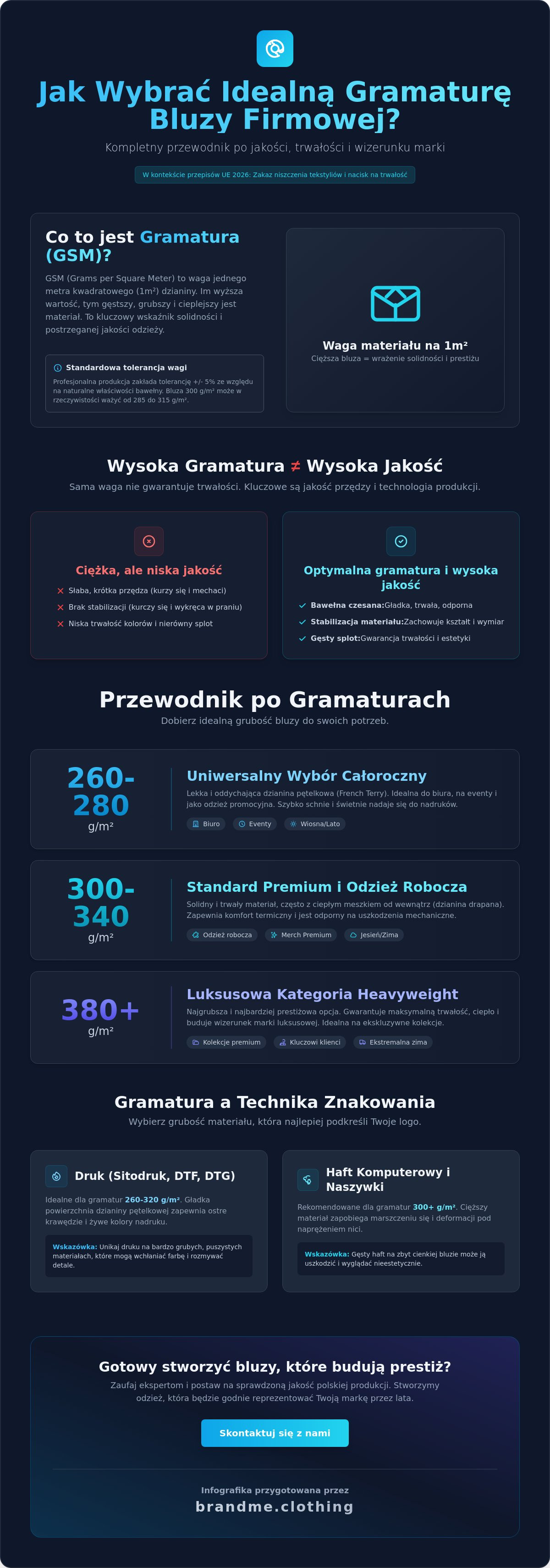
Weight (grammage) is a parameter that determines whether your employees will receive a solid work tool or a disposable product. In the simplest terms, grammage (GSM - grams per square meter) is the weight of one square meter of knitted fabric expressed in grams. The higher the value, the denser and usually thicker the material. In 2026, market standards have clearly shifted towards higher values. Companies are moving away from thin, transparent materials towards solid products that will withstand years of intensive use.
The weight of the material directly translates into how your brand is perceived by customers and business partners. A heavier hoodie is associated with solidity, security, and prestige. This is the psychology of touch. When a customer receives a product with a specific weight, they subconsciously attribute characteristics such as stability and high quality of services to your company. The cotton weight in corporate hoodies also affects thermal insulation. Higher-weight models better protect against cold, making them an ideal choice for outdoor wear or for working in air-conditioned offices and halls.
How to read parameters on labels and in offers?
Understanding the label is fundamental to a successful purchase. You must know that sweatshirts are always knit fabric, not woven. Knit fabric is elastic, made of loops, and provides the freedom of movement that employees expect. It is worth remembering that GSM specifies the weight of the fabric per square meter, which is crucial for determining the thickness of the clothing. In professional garment production, a weight tolerance of +/- 5% is standard. This results from the natural properties of cotton fibers and dyeing processes, which can slightly alter the final mass of the product. If you order a 300g hoodie, its actual weight may fluctuate between 285g and 315g, which is a completely natural phenomenon.
Why is weight not everything?
A high number on paper does not always mean a luxurious product. The final weight depends on the raw material composition. A hoodie made of 100% cotton will have a different structure and feel than a model with 20% polyester blend at the same grammage. Polyester is often added to increase mechanical strength and facilitate moisture wicking. A crucial process is also material stabilization. It is this process that ensures the hoodie will not shrink or twist at the seams after the first wash. Remember, even the heaviest material will fail if made from low-quality yarn. In the following sections, we will explain why the type of cotton is as important as its weight.
If you are looking for solutions that combine all these parameters into a finished product, check out our offer for corporate hoodies. We focus on materials that undergo rigorous quality control even before the sewing stage.
Overview of standard weights: From light hoodies to heavyweight premium
Choosing the right material thickness is a strategic decision that goes beyond simply ordering clothing. Properly selected cotton weight in corporate hoodies allows for cost optimization while maintaining the highest image standards. In 2026, as the market strongly shifts towards "slow fashion," matching the fabric weight to its specific purpose becomes crucial. We are no longer looking for clothes for just one season. We are looking for durability that will withstand years of intensive use and dozens of washing cycles.
Analyzing the list of the most popular grammages used in corporate clothing with a logo, it's worth noting that a heavier product is not always the only right solution. The purchase cost depends not only on the weight but primarily on the quality of the yarn and the finishing technology. Sometimes a lighter hoodie made of combed cotton can be more expensive and more durable than a heavy model made of low-quality raw material. The choice must be conscious.
260-280 g/m² – Universal year-round choice
This is the most popular range for French Terry hoodies. They are ideal for office work, where the temperature is stable. Their main advantage is lightness and excellent breathability. In 2026, natural, breathable fibers are the standard, and this weight range perfectly fits this trend. French Terry fabric dries quickly and works well with most printing techniques. It's a safe choice for large event and promotional orders.
300-340 g/m² – Premium standard and workwear
When you need something more substantial, choose hoodies with "brushed cotton". This weight range provides high thermal comfort, which will be appreciated by logistics or construction workers. Material of this density best maintains its shape. It does not stretch excessively and provides an ideal base for 2026 season hits, namely precise computer embroidery. It is an investment in prestige that pays off through team satisfaction and a impeccable appearance for a long time.
Above 360 g/m² – Heavyweight Trend and Oversized Hoodies
The creative industry and modern startups are increasingly turning to heavyweight solutions. Thick, substantial materials give an immediate impression of luxury at the first touch. It is this "handfeel" that creates distance between your brand and the competition. Why does the creative industry choose oversized hoodies of such high weight? Because the stiffness of the thick material allows for a modern, architectural form of clothing, which is currently at the top of streetwear trends. If you want your merch to be worn with pride after work hours, this is the direction for you.
Looking for the perfect balance between weight and functionality? Check out our selected models and see how tactile quality changes brand perception.
Quality vs. Weight – Debunking common myths
The belief that the higher the cotton weight in corporate hoodies, the better the product, is one of the most common purchasing mistakes. In reality, weight is just a physical parameter that is easy to manipulate. Cheap knitwear often contains a large admixture of polyester. It is heavier than cotton, so it artificially inflates the product's mass. Such material may be 340g, but it will be stiff, unpleasant to the touch, and will quickly start to show an unsightly sheen. True quality lies in the fiber structure, not just its mass.
The type of weave also determines how we perceive the thickness of a garment. A fleece hoodie, or the popular "brushed" type, weighing 300g, seems much thicker than a loopback hoodie of the same mass. This illusion results from the brushing process on the reverse side of the fabric, which increases its volume and fluffiness. If you care about stability and a professional look, it's worth paying attention to dense weaves. They are smooth, hold their shape well, and best withstand intensive use in the office or a logistics hall.
Combed vs. carded cotton
Choosing the yarn is the moment you decide on the durability of your company's image. Carded cotton is cheaper but contains short fibers that eventually come to the surface, creating unsightly pills. Combed cotton undergoes a process of eliminating these weak elements, resulting in a material of exceptional smoothness and durability. Combed cotton provides a smoother surface for branding compared to standard carded cotton. This means prints are sharper, and embroidery needles do not damage the knit structure.
Color fastness and shrinkage
Why do some clothes lose their shape or color after the first wash? The answer lies in advanced finishing processes. Professional production includes enzyme treatment, which removes micro-hairs responsible for pilling. Siliconization, in turn, gives the knit fabric a noble softness and prevents excessive shrinkage. A 280g hoodie made from high-quality yarn will withstand significantly more washing cycles than a 340g model made from cheap, raw cotton. In 2026, certifications such as Oeko-Tex Standard 100 are an absolute foundation. They guarantee that the clothing is free from harmful chemicals, which is crucial for the comfort and health of your team.
How to choose the right weight for logo branding?
Choosing a decoration technique without considering the material's weight is the quickest way to an image failure. The cotton weight in corporate hoodies determines how the knitwear will react to thousands of needle stitches or the high temperature of a heat press. Each method has its specific technical requirements. Ignoring them means that even a brilliant graphic design will lose value when the material starts to wrinkle unsightly or the print begins to crack after a few washes. Professional branding for companies always starts with an analysis of the substrate.
Stability is the foundation. The heavier and denser the weave, the lower the risk of deformation during the production process. In 2026, personalization that lasts for years, not just one event season, is becoming the standard. Therefore, the choice of technique must consider the knitwear's structure. The smooth surface of combed cotton is a paradise for printers, while loose loopback weaves require a completely different technological approach.
Computer embroidery and fabric thickness
Prestigious computer embroidery is the most demanding technique in terms of material stability. To avoid the effect of the fabric wrinkling around the logo, we recommend using hoodies with a grammage above 280g/m2. With thinner products, the tension of the embroidery threads often proves stronger than the strength of the weave, leading to permanent distortions. At Brandme, for higher grammages, we use additional reinforcements made of interfacing or hydrofoil. This solution guarantees that the needle does not slip, and the logo maintains perfect proportions and sharp edges even on very thick, substantial heavyweight hoodies.
DTF prints and screen printing on different weights
DTF (Direct to Film) technology has become extremely popular in 2026 due to its versatility. It works perfectly on any type of cotton, regardless of its thickness. The print is flexible and works with the material, which is crucial for lighter office hoodies. Screen printing on thick hoodies with internal brushing (the so-called "fleece") requires immense precision during heating. Thick material releases moisture longer and absorbs heat differently, which directly affects the durability of the paint's bond with the fiber. Remember that too large and stiff a print on a thin hoodie will make the garment fit poorly on the body, creating unnatural creases.
Do you want to be sure that your logo will look perfect on the chosen material? Order samples of our hoodies and consult your technique choice with our experts to avoid costly mistakes.
Hoodie production at Brandme: Your partner in creating quality merch
In 2026, when EU regulations concerning textile durability and the ban on destroying unsold clothing become a reality, choosing a local partner is not just a matter of logistics. It's a strategic business decision. Opting for Polish custom hoodie production allows for full control over every stage of product creation. At BrandMe, we are not just a manufacturer. We are a consultant who understands that corporate clothing is the foundation of your visual identity. Our experience allows us to eliminate errors already at the design stage, which saves your time and budget.
The appropriate cotton weight in corporate hoodies is our starting point for discussing your image. We offer access to selected fabrics with proven parameters that genuinely meet the needs of modern business. We operate flexibly, enabling personalization from as little as one piece. This is an ideal solution for both dynamic startups and large corporations needing unique gifts for key partners. Our technological consulting ensures that the chosen weight will perfectly align with your business goal and planned branding technique.
Our approach to materials
Quality begins with raw materials. We use only certified fabrics from trusted Polish and European suppliers. Each batch of material is verified for color stability and shrinkage to ensure that the final product will be identical to your order. Quality control at BrandMe covers every step: from precise cutting, through sewing with strong threads, to final packaging. We design for durability. Our hoodies are worn for years, not just seasons, which directly aligns with sustainable development trends and builds authentic trust in your brand.
- Use of combed cotton with low shrinkage.
- Oeko-Tex Standard 100 certificates guaranteeing skin safety.
- Reinforced seams and material stabilization to prevent hoodies from twisting.
- Precise finishing of ribbing and details that emphasize prestige.
Start building your company's image
Theory is only half the battle. True quality must be felt. We encourage you to order material samples so you can personally experience the difference between 280g and 340g weights. The order fulfillment process at BrandMe is simple and transparent. After establishing the fabric parameters and branding technique, we prepare a visualization, and upon your acceptance, we proceed with production. The entire process is monitored by your dedicated account manager, who ensures timeliness and compliance with the design.
Don't wait for market changes, get ahead of them. Configure your ideal corporate hoodie today and feel the difference that professionally selected weight makes!
Build your brand's prestige with premium quality clothing
Consciously choosing the right fabric weight is an investment that pays off in the loyalty of your team and an impeccable company image for years to come. Remember that the cotton weight of company hoodies is not just a technical parameter, but the foundation of your communication with the environment. In 2026, when the market values durability and responsible production, certified Oeko-Tex fabrics become the only right choice for brands that care about every detail.
At Brandme, we understand that corporate apparel must combine uncompromising aesthetics with everyday functionality. Our production in Poland ensures full transparency and the highest precision of execution, and the ability to fulfill orders from just one piece provides the freedom that modern business needs. Do not seek savings where your brand's authority is at stake. Choose solutions that will stand the test of time and remain a showcase of your professionalism in every respect.
Want to feel the tactile quality we wrote about? Check out our offer and order top-quality company hoodies. Together, we will create merchandise that your team will wear with genuine pride.
Frequently Asked Questions (FAQ)
What hoodie weight is best for winter?
The best choice for winter months are hoodies with a weight of 300 to 340 g/m2 with a brushed inner finish. Such a fabric creates an effective thermal insulation barrier that retains heat close to the body even in very low temperatures. Brushed variants are exceptionally fluffy, making them an ideal solution for field workers and teams operating in unheated warehouses.
Is a 280g hoodie see-through?
High-quality 280g fabric is not see-through and is a market standard for professional office and event wear. If the material is densely woven from combed cotton, it provides full coverage and an aesthetic look without the risk of transparency. This problem usually concerns low-budget products with a loose weave, where the low fiber density affects the material's transparency.
Does high fabric weight mean the hoodie will shrink in the wash?
No, a high cotton weight in company hoodies is not directly related to their shrinkage. The dimensional stability of the garment is determined by the fabric stabilization process and the quality of the yarn used, not its weight per square meter. Professional clothing undergoes enzymatic and siliconizing processes that minimize shrinkage, ensuring the product retains its shape.
What printing method is best for thick 340g hoodies?
For thick 340g hoodies, computer embroidery and modern DTF technology work best. The high density of the material provides a stable foundation that prevents the fabric from puckering under the influence of dense embroidery stitches. DTF printing, in turn, perfectly blends into the thick structure of the material, ensuring durability and color saturation even with intensive use.
Does fabric weight affect the price of branding?
The material's weight itself does not directly change the branding price list, but it determines the choice of the most effective technique. Very thick materials may require denser embroidery, which slightly affects the cost due to a larger number of stitches. At Brandme, we always adapt the personalization method so that the logo looks prestigious, taking into account the specifics of the fabric weight you choose.
What fabric weight to choose for oversized hoodies?
For trendy oversized styles, a fabric weight of 360-400 g/m2 is the best solution. Heavyweight materials are stiffer, which allows for maintaining the characteristic, architectural cut of the garment without a sagging effect. Thinner fabrics with a loose cut may drape unesthetically on the figure, losing their modern, streetwear character.
Do polyester hoodies have a different fabric weight than 100% cotton ones?
The GSM value defines the weight per square meter, so 300g of cotton weighs the same as 300g of a blend, but they differ in volume. Polyester is a denser fiber, which is why hoodies with its blend can feel thinner while maintaining the same fabric weight as cotton models. Pure cotton of the identical weight will usually be fluffier and more breathable during a long workday.
What is the difference between the fabric weight of loopback hoodies and those with a brushed inner side?
Loopback hoodies (French Terry) have a smooth interior, which makes them feel lighter and more breathable at 280g. Brushed hoodies undergo a mechanical fiber pulling process, which drastically increases their volume and softness. Although both versions may have the same weight on the tag, the brushed variant will always feel like a significantly thicker product.