

Choosing the most expensive embellishment technique doesn't guarantee your corporate apparel will retain a prestigious look after a year of intensive wear. You probably know that feeling of uncertainty, wondering if the chosen design won't start cracking after a few washes, or if stiff embroidery won't cause unsightly puckering of thin fabric on the chest. These are natural concerns for anyone who values quality and wants to avoid a reputational blunder when building their brand's visual identity.
In this guide, we'll explain what will work better for your specific project: embroidery or print on a sweatshirt. You'll learn which technique best captures your brand's character, ensuring durability and aesthetics for years to come. We'll analyze specific parameters, from fabric weight to the complexity of a colorful logo, so you can make an informed decision based on facts, not guesswork. We'll examine how modern marking technologies in 2026 allow for a premium effect even with orders of a single item. This will enable you to create merch that genuinely increases the market value of your products, giving you the opportunity to test a sample batch without unnecessary financial risk.
Key Takeaways
- You will learn how the choice of marking technique influences your brand's positioning and why, in 2026, execution quality is a crucial element of marketing.
- Discover the advantages of computer embroidery as the most durable and exclusive branding method, ideal for premium, heavy-weight apparel.
- Explore the possibilities of modern DTF and DTG prints, which allow for precise reproduction of multi-color graphics while maintaining full flexibility.
- Understand when to resolve the dilemma of embroidery or print on a sweatshirt in favor of a specific technology, considering budget and logo complexity.
- See how Polish production and full customization, including white label services, help build a unique visual identity for your brand.
Embroidery or print on a sweatshirt – why marking technique defines your brand?
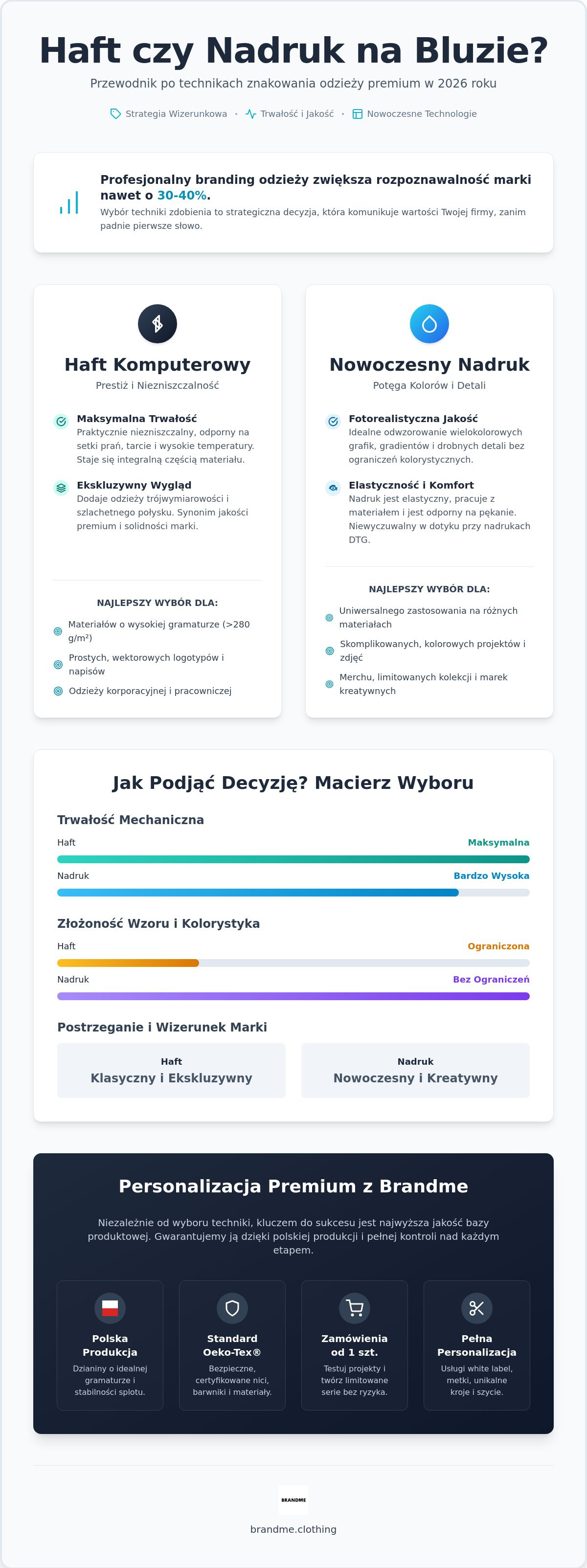
In 2026, corporate apparel is no longer just a wardrobe item for employees; it has become a powerful medium for visual identity. Statistics show that professional apparel branding can increase brand recognition by as much as 30-40%, making it one of the most effective offline marketing tools. The choice of a specific embellishment method is not merely a technical matter. It's a strategic decision that determines how customers and business partners perceive your professionalism. The dilemma of embroidery or print on a sweatshirt is one faced by every modern company that cares about a consistent image.
The key to success in the premium segment is understanding that even the most advanced marking will lose value if the product base is of low quality. At Brandme, we place great emphasis on ensuring that our knitted fabrics are sourced from Polish production, which guarantees appropriate weight and weave stability. It is precisely the fabric density that determines whether the chosen logo will look impeccable for years or deform after a few wash cycles. The choice of embellishment technique forms the foundation of your image strategy, because the details of the finish communicate brand values even before the first dialogue begins.
Computer embroidery vs. print – the first clash
For many looking for quick answers, the distinction is simple: embroidery is associated with luxury, and print with modern graphics. The reality, however, is more complex. Computer embroidery, whose fascinating history and techniques go back centuries, is now primarily associated with indestructibility. It is an ideal solution for logos with fewer colors that need to withstand extreme conditions of use. Modern digital printing, such as DTF (Direct to Film), on the other hand, offers unprecedented design freedom, allowing for the transfer of complex tonal transitions and fine details.
When deciding on a specific solution, it's worth considering the following aspects:
- Mechanical durability: Embroidery is practically indestructible, while modern prints offer flexibility and crack resistance.
- Pattern complexity: Complex, multi-colored graphics look best in the form of digital prints.
- Safety and standards: The use of dyes and threads with Oeko-Tex certification is a standard in 2026 that builds trust among conscious consumers.
For a dynamically developing clothing brand, it is crucial to match the technique to the character of the collection. While classic hoodies with embroidery evoke associations with tradition and solidity, limited series with large, colorful graphics made using the DTF method emphasize a modern and creative business profile.
Computer embroidery: When prestige and indestructibility are priorities?
Computer embroidery is synonymous with longevity in the world of professional branding. By choosing this method, you opt for an embellishment that becomes an integral part of the material, not just a layer on its surface. In the premium industry, embroidery is considered the most exclusive form of marking because it adds dimensionality and a noble sheen to clothing. Often, the dilemma of whether to choose embroidery or print on a sweatshirt ends with opting for thread when the priority is to build an image of a solid and trustworthy brand. This solution will withstand hundreds of washing cycles at high temperatures and intensive mechanical friction, making it unrivaled for workwear and corporate apparel.
The use of various textile decoration techniques helps understand that embroidery works best for vector logos, lettering, and smaller graphics placed on the chest or sleeve. However, technical limitations must be considered. Due to the physical thickness of the threads, embroidery cannot handle smooth tonal transitions (gradients) or complex photographs. Very fine details, smaller than 4-5 mm, may become illegible, so in such cases, it is worth consulting your design with our experts, who will help simplify the graphic for the embroidery machine.
The impact of fabric weight on embroidery quality
The final quality largely depends on the base. A solid hoodie with a weight above 320g is an ideal base that will support the weight of thousands of stitches without the risk of deformation. On thin, light knitted fabrics, embroidery often causes the material to pucker around the logo, which looks unsightly and indicates an incorrect choice of technique. For brands seeking top-tier image, we offer 3D embroidery. By using special foam under the threads, we achieve a raised effect that spectacularly stands out from standard market solutions.
Embroidery costs – what do they depend on?
The logic of embroidery pricing differs from printing methods. Here, the number of colors does not affect the final price; the key factor is the number of needle penetrations, i.e., the density and size of the design. Initially, you must account for a one-time cost of preparing the embroidery program, which is the process of converting vector graphics into a language understandable by the machine. For recurring orders, this cost disappears, making embroidery extremely cost-effective for medium and large quantities. If you plan to create durable merch for your team, check out our solutions for businesses and choose quality that makes no compromises.
Prints on sweatshirts: DTF, DTG, and screen printing – the power of colors and details
While embroidery builds prestige through its unique texture, modern printing techniques open the door to a world of unlimited visual expression. In 2026, DTF (Direct to Film) technology has dominated the market, becoming the gold standard for brands that value flexibility and precision. DTF allows for the transfer of graphics with incredible edge sharpness, which work with the knitted fabric without cracking even with intense stretching. It is this method that enables us to realize personalized projects from just one item, which is crucial for creators testing new collections or companies needing unique gifts for key partners.
For projects requiring photo-realism, such as complex illustrations or raster graphics with millions of colors, DTG (Direct to Garment) remains unrivaled. The ink penetrates directly into the fiber structure, leaving the print almost imperceptible to the touch. Classic screen printing, on the other hand, still remains the king of cost-effectiveness for large, repetitive runs. If you're planning event merchandise in hundreds or thousands of pieces, screen printing offers the lowest unit cost while maintaining legendary durability. When resolving the dilemma of whether to choose embroidery or print on a sweatshirt, you must consider not only aesthetics but also the economies of scale of your venture.
When to choose print instead of embroidery?
There are situations where print is the only sensible choice for practical reasons. Large graphics on the back made with embroidery would be too heavy and stiff, which would drastically reduce the comfort of wearing the garment. Print retains the lightness of the material, which is especially important for oversized sweatshirts. Additionally, if your logo contains gradients or very fine details that cannot be reproduced with needle and thread, modern digital printing will be the only way to maintain fidelity to your brand guidelines. This is standard in the creative industry and for concert merchandise production, where every detail of the artistic vision matters.
Durability of modern prints in 2026
Contemporary technology has completely debunked the myth of prints fading. Thanks to advanced textile chemistry and precise thermal curing processes, graphics retain their color saturation through dozens of wash cycles. A key factor influencing the final effect is the quality of the knitted fabric itself. A smooth weave of combed cotton provides ideal paint adhesion, which translates into the smoothness and durability of the embellishment. At Brandme, we control this process from the very beginning. See how we implement production from scratch using modern printing, combining Polish tailoring with the latest achievements in apparel marking technology.
How to make a decision? A practical decision matrix for managers
The choice between embroidery and print should not be a matter of chance or personal preference. As a brand manager, you must balance three key pillars: the intended image effect, the project budget, and the technical parameters of the clothing itself. At Brandme, we understand that the modern market requires flexibility, which is why we offer computer embroidery on clothing from as little as one piece. This allows for premium personalization without the need to tie up capital in huge inventories.
The decision of whether to opt for embroidery or print on a sweatshirt is closely linked to the type of knitted fabric you choose. This is where many competitors make a mistake, ignoring the material's structure. Brushed fabric, characterized by a soft "fleece" on the underside and a weight above 300g, is an ideal foundation for embroidery. Its density ensures that the threads do not sink into the material's structure, and the logo remains raised and clear. Conversely, loop-back knit fabric (French terry) with a smooth face is the perfect canvas for DTF and DTG prints. The smooth surface ensures that the ink or film adheres perfectly to the fibers, which translates into sharp edges and durable graphics.
Checklist: 5 questions before choosing marking
Before approving production, go through the list below. It will help you quickly eliminate technical errors:
- Does your logo have gradients or shadows? If so, choose digital printing. Embroidery will not reproduce smooth tonal transitions.
- What will be the purpose of the clothing? For work and corporate sweatshirts, washed frequently at high temperatures, embroidery is unparalleled.
- Where do you plan to place the graphic? Large logos on the back are best done with print to maintain the lightness and flexibility of the sweatshirt.
- What is your starting budget? For complex, multi-colored designs in small quantities, the DTF technique will be significantly cheaper than preparing an embroidery program.
- How quickly do you need the finished product? Digital techniques are usually faster to implement than the labor-intensive embroidery process.
A brief guide for the manager: If you are building a premium brand and aiming for minimalism (a small logo on the chest), choose embroidery. If your project is dynamic merchandise with a large graphic, opt for modern printing. To avoid any financial and image risk, we always recommend ordering a physical sample. Learn how to order a sample and production to personally check the quality of the weave and the precision of the marking before launching the full series.
Premium personalization at Brandme – Polish production that makes a difference
Choosing the marking technique is only half the battle in building a brand image. True quality emerges where the production process is controlled at every stage, from the first thread to the final stitch. At Brandme, we are not just an intermediary; we own our sewing and cutting room in Poland. This allows us to take an uncompromising approach to details that you won't find in mass-produced, imported goods. Regardless of whether your final choice is embroidery or print on a sweatshirt, the foundation always remains our certified premium knitted fabric. We use materials that do not pill and retain their original shape even after many wash cycles, which is crucial for building a trustworthy brand image.
For clients building professional clothing brands, we offer full support in the White Label model. We can remove manufacturer tags and replace them with your custom woven labels or subtle heat-transfer prints on the neck. Such a solution makes the product 100% yours, and your audience receives boutique-quality goods. We also actively support marketing agencies, providing them with ready-made solutions for creating merchandise that doesn't end up at the bottom of a wardrobe but is proudly worn by recipients. Our ecological approach and the use of Oeko-Tex certified fabrics are a standard that is essential for conscious business in 2026.
From one piece to a full collection
Most companies on the market impose strict logistical minimums, which often stifles creativity and forces risky investments. We operate differently, focusing on dynamism and supporting projects at every stage of development. Flexibility is our advantage, which is why we offer order fulfillment from as little as one piece. No MOQ (Minimum Order Quantity) is an ideal opportunity for startups and clothing brands to test new designs without unnecessary financial and inventory burden.
We understand that the final decision on whether to choose embroidery or print on a sweatshirt requires physical confirmation of quality. That's why the sample ordering process is standard practice for us, completely eliminating the risk of error. This gives you confidence that the colors are perfectly reproduced, and the embroidery has the appropriate density and structure. We invite you to contact our advisors. Your vision deserves a premium presentation that will truly distinguish you from the competition and build a lasting bond with your audience.
Choose branding that builds real value for your brand
Resolving the dilemma: embroidery or print on a sweatshirt, is in reality an investment in how your brand will be remembered by customers and business partners. By choosing computer embroidery, you opt for indestructible prestige and elegance, which work perfectly in the corporate segment. By deciding on modern DTF or DTG prints, you gain the power of colors and precision of details, essential in the dynamic world of merch and apparel brands. However, the key to success is combining the chosen technique with uncompromising fabric quality that will withstand years of intensive use.
At Brandme, we leverage 14 years of experience in Polish production to deliver apparel that sets premium standards. Our Oeko-Tex certified materials and flexible order fulfillment from a single piece give you complete freedom to design unique collections without financial risk. Don't compromise where your company's image counts. Use our knowledge and modern technical facilities to create products that will become an authentic showcase of your success and professionalism.
Create your own collection of sweatshirts with embroidery or print - Check Brandme's offer
Frequently Asked Questions
What is more durable on a sweatshirt: embroidery or print?
Computer embroidery is considered the most durable marking method because the threads become an integral part of the fabric. It is completely resistant to high washing temperatures and mechanical friction, which ensures that the logo remains in perfect condition throughout the garment's lifespan. Prints, although very durable, may naturally wear out over time. The choice between embroidery or print on a sweatshirt therefore depends on whether indestructibility or the precision of complex graphics is the priority.
Can computer embroidery be done on every sweatshirt?
Theoretically yes, but the best visual effects are achieved on materials with a higher grammage, exceeding 300g. On very thin sweatshirts, dense embroidery can cause an unsightly puckering of the material, which ruins the final premium effect. At Brandme, we always adjust the stitch density to the type of fabric to avoid pulling and ensure maximum comfort of wearing our products for years.
How much does it cost to embroider one sweatshirt?
The price of embroidery depends primarily on the number of needle punctures (stitches) and the size of the logo, not on the number of thread colors used. For smaller orders, a one-time cost for preparing the embroidery program must be added, which remains in our database for subsequent orders. Each project is priced individually based on the submitted graphic, taking into account its complexity and planned production volume.
Does DTF print crack after washing?
Modern DTF (Direct to Film) prints are characterized by very high elasticity and do not crack under the natural stretching of the material. Thanks to the use of specialized powder adhesives and precise heating in heat presses, the print works together with the fabric. However, it is crucial to follow the washing recommendations at temperatures up to 40 degrees Celsius and ironing the garment only inside out.
Which technique is best for a complex, multi-colored logo?
When considering whether to choose embroidery or print on a sweatshirt for complex graphics, digital DTF or DTG techniques are unrivaled. Computer embroidery has its technical limitations and does not allow for the reproduction of smooth gradients or very fine details smaller than 4 mm. If your project is artistic and full of details, modern printing methods will best reflect its character and color depth.
Can I order a sweatshirt with custom embroidery from 1 piece at Brandme?
Yes, at Brandme, we fulfill orders for sweatshirts with embroidery starting from just one piece. We are one of the few companies on the Polish market that offers such flexibility without imposing high logistical minimums. This allows our customers to create personalized gifts or test new designs within their own apparel brand without incurring significant financial and inventory risks.
How to prepare a graphic file for embroidery and for print?
The best format for both techniques are vector files, such as PDF, AI, EPS, or SVG. For printing, they allow for arbitrary scaling without loss of edge quality. For embroidery, a vector file is essential for our designer to create a professional embroidery program. If you only have a high-resolution raster file (JPG, PNG), our graphic designers will help you prepare it properly for production.
Can embroidery on a sweatshirt be bothersome or "scratchy" on the inside?
Properly executed embroidery on a sweatshirt of appropriate grammage should not cause any discomfort. In the production process, we use specialized interlinings and stabilizers that stiffen the design but remain soft in contact with the skin. In the case of brushed-back sweatshirts ("fluffy" on the inside), the warming layer provides an additional barrier, making the reverse side of the embroidery practically imperceptible during daily wear.

Artykuł autorstwa
Konrad Nosek
Entrepreneur and expert in apparel production and building clothing brands. For over 14 years, he has been developing the Unicat sewing factory, providing comprehensive production for Polish and foreign brands, including Dzik, OSHEE, and Relab. He specializes in designing production processes, material selection, garment marking, and implementing collections from concept to finished product. He is also the founder of the BrandMe brand, which enables brands, companies, and creators to order high-quality personalized clothing - even from a single piece. In his articles, he shares practical knowledge on clothing production, building one's own brand, marking technologies, and trends in the fashion and merch industry.