

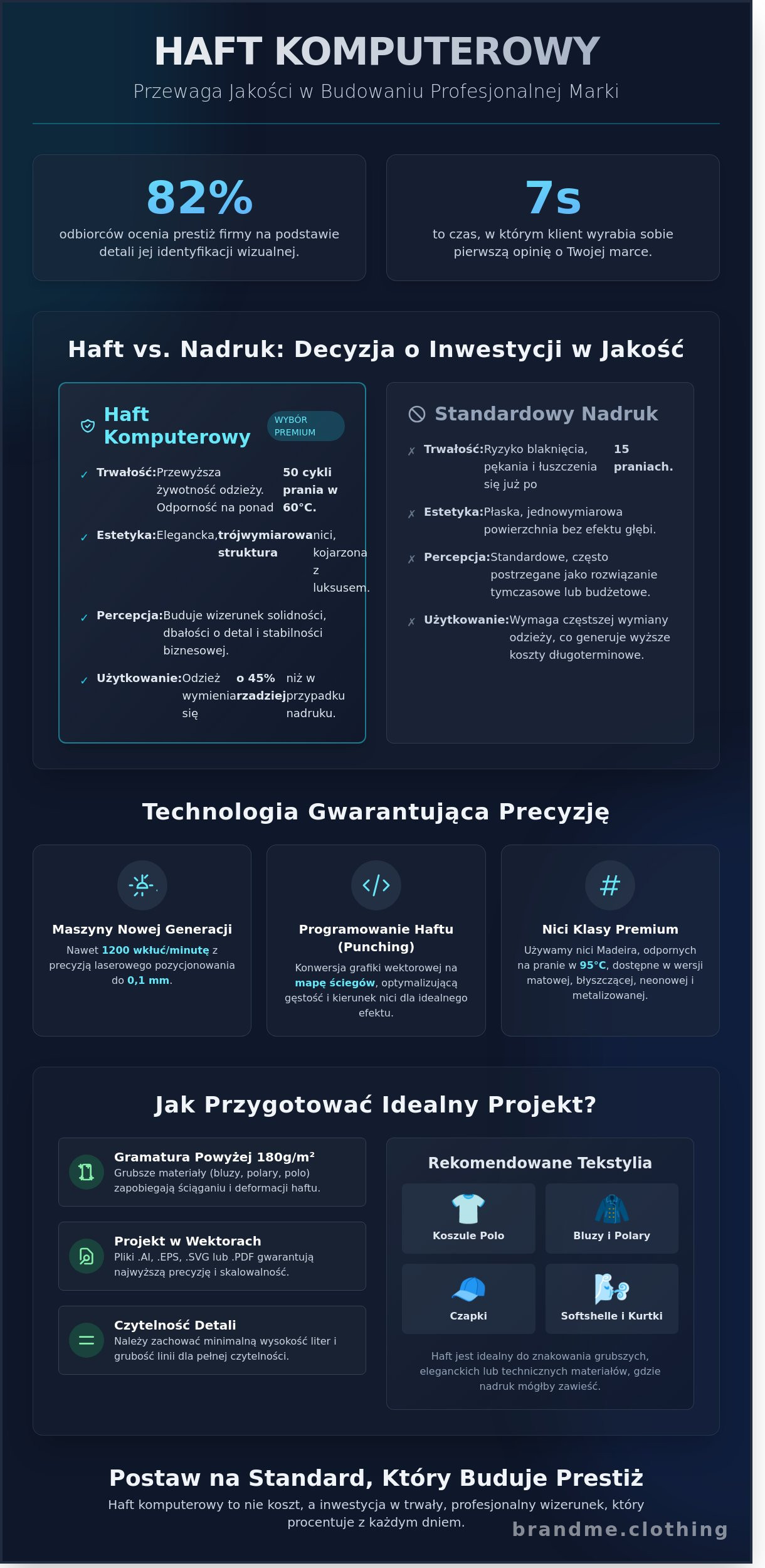
Your logo is a promise of quality you make to your customer with every handshake. Did you know that according to 2024 industry reports, as many as 82% of consumers assess a company's prestige based on the details of its visual identity within the first 7 seconds of contact? If your goal is to build uncompromising authority, computer embroidery on clothing is the only choice that combines artisanal precision with 2026 technology efficiency.
You'll probably agree that nothing destroys professionalism faster than a faded print or a logo that loses its shape after just 15 washing machine cycles. We understand these concerns, which is why in this guide, you will learn why computer embroidery is the most prestigious method of personalizing clothes and how to use it to build a strong brand. You will discover the secrets of preparing vector files, learn how to avoid distortion on fabrics weighing less than 180g, and see how to dress your brand in quality that will last for years of intensive use.
Key Takeaways
- You will discover how the three-dimensional structure of threads influences the psychology of quality and builds a prestigious image of your brand in the eyes of customers.
- You will learn why modern machinery and premium threads make computer embroidery on clothing the most durable personalization method.
- You will learn how to choose the appropriate fabric weight to achieve a perfect final effect, especially on demanding, thick sweatshirt knits.
- You will learn key technical project parameters, such as the minimum letter height, which guarantee full readability of your logo.
- You will understand how a comprehensive approach to production in Poland allows you to combine your vision with the highest ethical and quality standards.
Why is computer embroidery on clothing a premium choice for your brand?
Computer embroidery on clothing is not just a branding technique. It is a clear declaration of quality that your company makes to customers and partners. In 2026, a first impression is formed within just 3 seconds of visual contact. The raised, dense structure of the threads creates a three-dimensional effect that cannot be replicated by any paint. It is the most noble method of textile personalization, associated with luxury and business stability.
The psychology of quality works flawlessly here. When a customer touches an embroidered logo on an employee's chest, they subconsciously attribute qualities such as reliability and attention to detail to the company. Embroidery is an integral part of the material, not just a layer on its surface. Although the history of machine embroidery began in the 19th century, today's technology allows for precision of 0.1 mm, which guarantees perfect reproduction of even complex logos.
The durability of this solution often exceeds the lifespan of the clothing itself. Top-class polyester threads do not break, do not wash out, and retain their color intensity even after 50 wash cycles at 60 degrees Celsius. This is an investment that will withstand harsh conditions on a construction site, intensive work in gastronomy, and daily office use.
Embroidery vs. print: When is it worth paying extra for needle and thread?
Choosing embroidery is a strategic financial decision. Analyses of corporate clothing operating costs show that embroidered variants are replaced 45% less often than printed ones, which can peel or fade over time. Embroidery wins in aesthetics. The ability to mix matte and shiny threads allows for visual effects unavailable with screen printing. This solution is unrivaled for branding elegant polo shirts, thick hoodies, and technical softshells. Check out our full collections to choose the perfect base for your project.
The image of a professional team in 2026
In modern business, visual consistency is the foundation of trust. Computer embroidery on clothing ensures an identical logo appearance on extremely different materials, from delicate cotton to thick fleece. Building employee loyalty starts with details. High-quality corporate clothing makes the team feel appreciated, which directly translates into work efficiency. In the premium sector, embroidery has become a standard that separates market leaders from casual players. Choose a standard that builds your brand's prestige every day.
Technology and precision: How is professional computer embroidery made?
Professional computer embroidery on clothing is a process where advanced engineering meets premium aesthetics. It is not ordinary sewing; it is the precise application of thousands of stitches creating a durable, raised image. In 2026, the standard in the best sewing factories are machines performing up to 1200 stitches per minute with an accuracy of 0.1 mm. Such precision ensures that your company's logo will look identical on every piece, regardless of the quantity.
New generation embroidery machines
A modern machine park is the foundation of repeatable quality. We use multi-head automatic machines that allow us to process wholesale orders 30% faster than older models. Precise laser positioning ensures that the logo on difficult elements, such as polo shirt collars or hat panels, always hits the ideal spot. We use only Madeira threads, which withstand washing at 95 degrees Celsius without losing color. In addition to classic viscose, we offer neon, metallic, and reflective threads that significantly increase brand visibility in challenging lighting conditions.
Embroidery programming – the heart of the entire process
A machine does not see a graphic file the way a human does. It sees code and coordinates. The process called punching is the conversion of vector graphics into a stitch map, where every needle movement is planned. Digital embroidery design requires deep knowledge of how a specific needle will behave on a given material structure. Too high stitch density on a thin T-shirt will cause unsightly fabric pulling; too little on thick fleece will make the embroidery simply sink into the material. Optimizing sewing directions allows for a depth effect that builds a prestigious brand image.
The key to the longevity of the decoration is proper stabilization. Every computer embroidery on clothing requires the use of a non-woven backing with a weight of 40 to 80g. This prevents deformation of the pattern during intensive use and repeated washing. Finally, each product undergoes rigorous quality control. We manually remove unnecessary threads and verify the tension of the weave to ensure the final product is flawless. If you are looking for quality that will last for years, check out our complete clothing solutions that will take your branding to a whole new level.
- Durability: Resistance to abrasion and high temperatures.
- Aesthetics: 3D effect and high gloss of viscose threads.
- Precision: Reproduction of details up to 0.1 mm thanks to modern plotters.
What to embroider on? Best textiles for computer embroidery
Choosing the right substrate is 70% of the success in the professional marking process. Computer embroidery on clothing requires a stable foundation because the needle hits the material thousands of times per minute. Low-weight materials, below 160 g/m2, often wrinkle or get pulled under the machine's needle plate. At BrandMe, we focus on textiles that can withstand these stresses without losing their shape. Fabric weight is crucial. The denser the weave, the less risk of pattern deformation after repeated washing.
Hoodies and sweatshirts – the foundation of modern merchandise
Heavy sweatshirt knits weighing 280 to 340 g/m2 are an ideal proving ground for the needle. BrandMe hoodies are designed with maximum weave stability in mind. As a result, embroidery on the chest or back remains perfectly flat throughout its use. The history of machine embroidery shows that precision has always depended on the stability of the substrate, which today yields spectacular results on thick material. You can choose a classic logo placement over the heart or opt for a subtle, prestigious detail on the cuff. Check out our hoodies and other products in the full offer to choose a base perfectly suited to your brand.
Premium T-shirts and polo shirts
Polo shirts are a classic that looks best with an embroidered logo on the chest. Pique fabric weighing 210-230 g/m2 has a characteristic structure that naturally stabilizes stitches. For thinner T-shirts, the process is more demanding. In such cases, we use special stiffening interlinings to avoid puncturing delicate combed cotton fibers. For brands looking for a modern finish, we recommend 3D embroidery. This raised marking technique adds depth to logos and makes visual identification tangible and exceptionally durable.
Branding jackets and softshells
Branding technical apparel requires a specific approach and immense precision. For softshells, the priority is to maintain the material's waterproof properties. We use specialized threads and dedicated backings that limit interference with the membrane structure to the absolute minimum. Professional computer embroidery on outerwear is an investment in an image that is not afraid of harsh weather conditions. Even after 40 or 50 wash cycles, the logo retains its original color saturation and shape, which places this method above most transfer prints.
Preparing your design for embroidery: Practical tips for businesses
Precise file preparation is the foundation upon which the final visual effect of your brand depends. Computer embroidery on clothing does not forgive errors in graphic design as easily as printing. Here, we operate with thread, which has its physical thickness and texture. For your logo to look professional in 2026, you must adhere to strict technical parameters.
The minimum letter height should be at least 5 mm. Any smaller character will become an unreadable blob because the needle will not be able to precisely render the detail. The line thickness in the design cannot be less than 1 mm. Remember that the embroidery machine must make at least two needle strikes to create a visible line. Gradients and tonal transitions are difficult to reproduce. Although modern software allows for shading by mixing stitch densities, graphics based on solid colors work best.
- File formats: Provide vector files only in AI, PDF, or EPS formats. This is the only basis for lossless digitization.
- Scaling: A single embroidery program is not universal. A design prepared for the chest (usually 8-10 cm wide) cannot simply be enlarged for the back (25-30 cm). Changing the scale requires a complete recalculation of the number of needle strikes and changes in thread routing paths.
- Color scheme: Choose colors from the thread palette (e.g., Madeira or Isacord). Pantone shades are only a reference point that we try to match with 95% accuracy.
How to avoid common design mistakes?
Too small details are the most common problem. If your logo has a small tagline, consider removing or enlarging it. The principle of simplification is crucial for premium aesthetics. Always choose contrasting thread colors. Dark navy on a black T-shirt will disappear, losing the marketing potential of your investment. At BrandMe, every process begins with a test embroidery on a scrap of the target material. Such a test eliminates 100% of the risk of error before serial production begins.
Individual personalization: names and initials
Embroidering variable data on workwear is standard in the premium service sector. This builds trust and a professional image in the client's eyes. For personalization, the choice of embroidery fonts is crucial. Sans-serif fonts work best, as they maintain readability even at small sizes. If your logo is exceptionally complex, patches may be a better alternative. They allow for sharp edges with a very dense weave, which is difficult to achieve directly on thin knits.
Take care of your company's image today. Check out our capabilities and choose the base for your premium embroidery project.
Computer embroidery at BrandMe: Your vision, our precision
Choosing a partner for branding is a decision that directly impacts how your brand is perceived for years to come. At BrandMe, we take the entire logistics and design process off your shoulders. We offer comprehensive service, starting from professional selection of textile bases from our full clothing offer, and ending with the final embellishment. All our production takes place in Poland. This allows us to maintain the highest ethical and quality standards, which, according to the latest market research, is a key purchasing factor for 85% of modern consumers.
We handle diverse projects with the same attention to detail. We fulfill orders for dynamic startups needing low quantities, as well as for large corporations ordering thousands of pieces annually. Our modern machinery park and production management system guarantee the repeatability of every stitch. We ensure efficient order fulfillment and secure shipping throughout the country. Your products will always reach their destination on time and in impeccable condition.
Why trust us?
We rely on technology that makes no compromises. We use only certified Oeko-Tex knitwear that works perfectly with the machine needle. This ensures that computer embroidery on clothing does not wrinkle and retains its original shape even after 50 wash cycles at high temperatures. Our experience is based on hundreds of implemented merch collections that have genuinely increased the recognition of our clients. We advise on how to optimize expenses. If your budget is rigid, we will adjust the size and density of the embroidery to ensure a luxurious effect without generating unnecessary costs.
Start collaborating with BrandMe
The pricing process at BrandMe is transparent and usually takes a maximum of 24 hours from sending an inquiry. It all starts with submitting your graphic design. Our team verifies the files free of charge and prepares a professional production simulation. We help adapt the graphics so that computer embroidery on clothing reproduces every, even the smallest, detail of your logo. We provide full technical support at every stage, from the first thread to the final packaging. Contact us today. Let's create a unique collection together that will effectively distinguish your brand from the competition.
Focus on details that build your brand's authority
Choosing the right branding technique is a strategic decision that directly affects how your business is perceived by customers and partners. Computer embroidery on clothing is synonymous with durability, and in 2026, it remains the gold standard for companies aiming for the premium segment. By using only the highest quality Madeira threads, you gain confidence that the logo will retain its vibrant colors even after many months of intensive use. The combination of precise stitching with certified Polish knitwear makes corporate clothing a real marketing tool, not just a one-time expense.
At BrandMe, we perfectly understand the dynamics of the modern market, which is why we enable production from just 1 piece. This approach allows for rapid personalization of clothing for new team members without the need to tie up capital in large inventory. Your unique vision deserves a setting that will stand the test of time and emphasize professionalism at every step. Every stitch we make proves that quality and aesthetics always go hand in hand with functionality. It's time to make your employees feel genuine pride in representing your brand.
Create professional corporate clothing with BrandMe and see what a big difference true precision makes.
Frequently asked questions about computer embroidery
Is computer embroidery durable and will it not be damaged in the wash?
Yes, computer embroidery is the most durable marking method, lasting over 100 wash cycles at temperatures up to 60 degrees Celsius. We use only polyester threads resistant to fading and abrasion, which guarantees the preservation of intense colors for 3 years of intensive use. Unlike prints, embroidery does not crack or crumble under the influence of detergents.
What is the minimum order quantity for clothing with computer embroidery?
Our minimum production is 10 pieces for one graphic design. This number allows us to optimize the costs of preparing a professional embroidery program and provide you with an attractive unit price. For orders exceeding 50 pieces, we offer additional discount tiers that realistically reduce the cost of building your team's image.
How much does it cost to make computer embroidery on a sweatshirt or T-shirt?
The price of chest embroidery starts from PLN 6 net per piece, while the final cost depends on the number of needle stitches in the material. The one-time cost of developing a digital matrix is around PLN 50 to 150, depending on the complexity of the logo. We prepare a precise quote within 24 hours of receiving the file in vector format.
Can every logo be transferred to computer embroidery?
We can transfer 98 percent of corporate logos onto fabric, provided that the smallest elements are at least 0.5 millimeters thick. Text in the design must be at least 5 millimeters high to remain fully legible after being embroidered. Computer embroidery on clothing sometimes requires simplification of very fine details, which we always consult on before starting production.
What are the differences between direct embroidery and patches?
Direct embroidery is created directly on the garment and is considered the most prestigious solution. A patch is a separate element embroidered on a backing, which we attach to clothing using Velcro or heat-seal film. Patches are chosen by 25 percent of our clients, especially when the branding concerns thick winter jackets or baseball caps.
How to wash and iron clothing with computer embroidery so that it lasts for years?
We recommend washing at 40 degrees Celsius inside out, which protects the thread structure from mechanical damage in the washing machine drum. Ironing should be done through a thin cotton cloth to avoid direct contact of the hot iron sole with the polyester design. Properly cared for computer embroidery on clothing retains its brilliance even after 200 ironings.
Can computer embroidery be done on provided clothing?
Yes, we brand clothing supplied by the client, provided its grammage is a minimum of 180g for T-shirts and 280g for sweatshirts. Before accepting an order, we verify the material composition, as fabrics with too loose a weave may deform under the influence of dense stitching. We accept a minimum of 20 pieces of your own clothing, ensuring that the final effect meets premium quality standards.