
A logo embroidered on a work jacket looks the same after twenty washes as it did on day one. A printed logo? Often, after just a few months, it starts to crack and fade. This isn't about luck, but about technology and the base on which computer embroidery can function correctly.
You understand this difference, that's why you're here. You know that corporate apparel or your own brand is an investment, not a one-time cost. You've probably also experienced a puckering design, too thin fabric, or a digitization cost that didn't make sense for a small order.
This guide answers one key question: when does computer embroidery truly pay off, and how do you choose clothing that can support it? You'll learn which knits guarantee pattern stability, what the process from design to finished piece looks like, and why more and more streetwear brands and premium companies are choosing this marking method as the foundation of their visual identity.
Key Takeaways
- Computer embroidery on clothing is not just about aesthetics – it's about durability that withstands dozens of washes without losing quality, making it the foundation of long-term brand visual identity.
- The choice of clothing base is as important as the design itself: you'll learn which knit parameters determine embroidery stability and why not every hoodie is suitable for this technique.
- The process of digitizing a graphic design is a crucial step that determines the final effect – you'll learn design principles for embroidery that will save time and budget.
- A comparison of embroidery with printing (screen printing, DTF) will show you when the higher unit cost of embroidery truly pays off and for what applications it is the only reasonable choice.
- Production in Poland from 1 piece, without warehousing risk – discover how this solution changes the game for streetwear brands and companies ordering corporate apparel.
What is computer embroidery on clothing and why is it considered a premium standard?
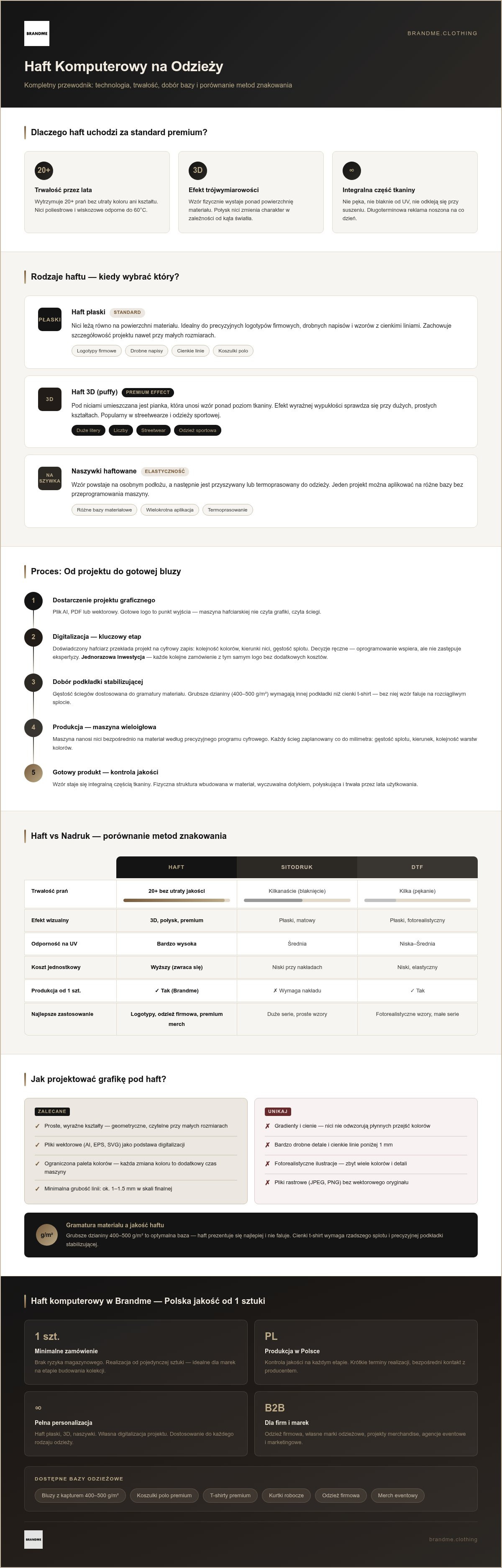
Computer embroidery on clothing is a process where a multi-needle machine applies threads directly to the material according to a precise digital program. Every stitch is planned down to the millimeter: stitch density, thread direction, color layer sequence. This is not printing. It's a physical structure embedded in the fabric, becoming an integral part of it.
The effect is immediately palpable. The design slightly protrudes from the material's surface, casting a microscopic shadow, and shimmering differently than the surrounding knit. It is this three-dimensional effect that makes a logo on a jacket or hoodie look more expensive, even before anyone checks the label.
The durability of embroidery stems directly from its structure. Polyester or viscose threads used in industrial embroidery can withstand washing at temperatures up to 60°C without losing color or shape. They don't crack from friction, don't fade from UV, and don't peel off during drying. DTF print or screen print loses elasticity over time and begins to crack with every stretch of the material. Embroidery simply doesn't have this problem.
Applications are wide: from an elegant polo shirt with a discreet company logo, to premium t-shirts, and even heavy hoodies weighing 400-500 g/m². This last application is particularly important, because it is on thicker knits that embroidery looks best, while also requiring a properly selected stabilizing backing so that the design does not ripple on the stretchy weave.
Advantages of embroidery in building brand image
The sheen of the threads is an element that no print can replicate. Depending on the angle of light, the embroidered design changes its character: sometimes it's subtle, other times it clearly dominates the material's surface. For streetwear brands and companies in the premium sector, this is not a detail, but a deliberate communication strategy. Graphics that don't lose color after years of use act as a long-term, wearable advertisement.
Types of embroidery: flat embroidery vs. 3D embroidery (puffy)
The choice between these two techniques depends on the effect you want to achieve:
- Flat embroidery – threads lie flat on the material's surface. Ideal for precise corporate logos, small texts, and designs with thin lines. Maintains design detail even at small sizes.
- 3D embroidery (puffy) – foam is placed under the threads, raising the design above the fabric surface. The effect of distinct convexity works well for large, simple shapes: letters, numbers, geometric logos. Popular in streetwear and sportswear.
- Embroidered patches – the design is created on a separate base and then sewn or heat-pressed onto the garment. They offer flexibility: one design can be applied to various bases without the need to reprogram the machine each time.
Each of these methods has its optimal applications. A good choice starts with understanding what material will be the base and what visual effect is a priority for the brand.
How is computer embroidery created? The process from design to finished hoodie
Before the needle touches the fabric, something happens that most clients are unaware of. A finished logo in PDF or AI format is completely useless to an embroidery machine. The machine doesn't read graphics. It reads stitches.
Embroidery program – the heart of the whole process
Digitization is the stage where an experienced embroiderer or programming specialist translates the graphic design into a precise digital record: color order, thread directions, stitch density in each area of the design. These are decisions made manually, not automatically. Software supports, but does not replace, knowledge of how a particular knit will behave under thread tension.
The cost of preparing an embroidery program is a one-time investment. Once the matrix is created, every subsequent order with the same logo does not generate additional digitization costs. For a brand planning regular production of corporate apparel or its own collection, this is a significant difference in the long-term calculation.
Stitch density must be adapted to the fabric weight. A thin t-shirt requires a looser weave than a heavy hoodie of 400 g/m². Too dense embroidery on a light material causes puckering and deformation of the fabric. Too loose on a thick knit gives a "show-through" effect. Precise optimization at this stage is the difference between professional embroidery and one that looks poor from the first use.
Technology in service of precision: machines, threads and stabilization
Threads used in industrial production are essentially divided into two types. Polyester threads are more mechanically durable and resistant to discoloration at high temperatures, making them standard in workwear and sportswear. Viscose threads have a more intense sheen and a softer feel, so they are more often used in projects where the visual effect is a priority.
A stage that competitors often omit in process descriptions is material stabilization. Before embroidery, a backing is placed under the knit, most often non-woven fabric or water-soluble film. Non-woven fabric stabilizes the stretchy weave and prevents deformation of the design during machine operation. Water-soluble film is used for long-pile materials, where a standard backing might leave visible marks after removal. Without proper stabilization, even the best-programmed design will ripple and lose symmetry.
Multi-head embroidery machines allow for simultaneous production of many pieces with identical quality. Each head executes the same program, eliminating differences between individual items in the batch. Quality control is ongoing: after embroidery is completed, each piece undergoes inspection for thread continuity, evenness of design edges, and color completeness.
Computer embroidery on clothing is a process where every stage is verifiable and repeatable. If you want to see how this works in practice for your project, check how to order a production sample before launching the full batch.
Embroidery or print? Comparison of marking methods for companies and brands
Each marking method has its optimal applications. The problem arises when the decision is based on unit price, not the total cost of use. DTF printing costs less for a one-time order. Embroidery costs more initially, but doesn't require reordering after a year because the design hasn't been damaged.
Durability is the first and most important axis of comparison. Screen printing and DTF lose elasticity after repeated washing and stretching of the material. Cracks first appear at the edges of the graphic, then in the middle. Computer embroidery on clothing structurally does not have this problem because it is not a layer applied to the material, but rather a part of it.
The second axis is color limitations. In industrial embroidery, working with several to a dozen thread colors in one project is standard. This is sufficient for the vast majority of corporate logos and streetwear designs. However, gradients, shading, and tonal transitions cannot be reproduced by embroidery, because threads do not mix like printing ink. Here, DTG or DTF have a technical advantage that should not be ignored.
When is computer embroidery unrivaled?
There are applications where no other method yields a comparable effect:
- Outerwear and fleeces – thick knit dampens print, while embroidery appears clear and maintains its shape throughout its use.
- Elegant corporate apparel – a discreet logo on a polo shirt embroidered with thread is a standard in the premium and financial sector. Print in the same place reads as a budget solution.
- Products in extreme conditions – workwear, outdoor, sports apparel. Polyester threads withstand industrial washing, contact with technical detergents, and intense friction. No print offers comparable mechanical resistance.
- Limited drops and streetwear collections – embroidery builds the perceived value of the product. The buyer feels the difference in touch before seeing the price.
When is it better to choose print?
To be honest, there are situations where digital printing is simply the more appropriate technical choice.
- Designs with gradients and tonal transitions – photorealistic graphics, illustrations with shading, multi-colored artistic projects. DTG or DTF will reproduce them accurately, embroidery will not.
- Very large graphics on the back – embroidery with an area above 20x20 cm becomes heavy and stiff. On a light t-shirt, such embroidery distorts the cut and reduces wearing comfort.
- Thin materials – knits below 150 g/m² poorly withstand embroidery tension. The backing stabilizes, but does not eliminate the risk of puckering with a dense design.
The decision doesn't have to be binary. Many brands combine both methods: embroidery on the chest or cuff as a brand identification element, print on the back as a field for more complex graphics. This approach yields the best visual effect while maintaining cost-effectiveness.
How to design graphics for embroidery? Tips for designers
A design that looks perfect on screen can disappoint after embroidery. Not because something went wrong during production, but because the graphic wasn't originally designed with needles and threads in mind. A few specific rules eliminate this risk before anything goes to the machine.
Minimum letter height is the first limitation worth remembering. With flat embroidery, letters below 4-5 mm lose readability: threads overlap, thin details blend into a uniform mass. Similarly, line thickness below 1-1.5 mm is technically risky. Subtle serifs, thin underlines, delicate ornaments all require simplification or enlargement before digitization. A good designer knows that embroidery is governed by the logic of sculpture, not painting.
Gradients and raster tonal transitions are an area where computer embroidery on clothing has its hard limits. Threads do not mix like pigments. Instead of a gradient, a color transition technique can be used by changing stitch density or alternating two colors, but the effect will never be photographic. If the project involves shading, it is worth considering a combination of embroidery with print or completely redesigning the graphic for the capabilities of this technique.
Technical requirements for graphic files
A vector file in AI or EPS format is the best starting point for a digitizer. Vectors maintain edge precision regardless of scaling and allow for a clean reading of the contours of each design element. Raster files (JPEG, PNG) can be processed, but require an additional reconstruction stage, which extends time and can introduce interpretive errors. Photos and photorealistic illustrations are not directly suitable for embroidery, as they contain thousands of shades that threads cannot reproduce. Simplifying the logo to clean color planes, clear contours, and a limited palette is not a compromise, but an adaptation to the capabilities of the medium.
Color palette from threads, not Pantone chart
Thread colors do not have equivalents in CMYK or Pantone systems. Thread manufacturers, such as Madeira or Isacord, offer their own catalog numbers with several hundred available shades. Before commissioning digitization, it is worth checking whether the brand's corporate color has a close equivalent in the thread palette, and not assume that every color from the visual identity book can be reproduced one-to-one. A slight correction at the thread selection stage is a much smaller problem than dissatisfaction with the finished product.
Personalization and placement of embroidery
Classic placements, such as the left chest, nape, or sleeve, work for specific reasons: the material there is flat, stable, and stretches well in the hoop. Embroidery on cuffs or the bottom edge of a hoodie requires greater caution, as the stretchy knit of the ribbing deforms the design when worn. A hood is a surface that works well for simple, large forms, but not for small lettering.
Metallic threads in gold or silver are a technically demanding category: they are stiffer than standard polyester threads and require a lower machine speed and a special needle. The visual effect is undeniable, especially on dark bases, but the design must be appropriately simplified so that the metallic threads can run without breaking.
If you have a finished logo and want to see how it will look embroidered on a specific base, order a production sample before launching the full batch. This is one step that eliminates the risk of misguided design decisions.
Computer embroidery at Brandme: Polish quality from 1 piece
Most companies offering computer embroidery on clothing separate two worlds: the textile base supplier and the embroidery workshop. The result? The client has to make sure that the material they bought elsewhere is suitable for the chosen marking technique. At Brandme, both elements are one process, designed so that the embroidery and the base work together from the very first stitch.
Synergy of embroidery with Brandme premium apparel
The key problem with cheaper apparel bases is simple: thin or loosely woven knit fabric puckers under thread tension, especially with denser designs. Hoodies and oversized t-shirts available at Brandme are sewn from OEKO-TEX certified knits with grammages selected for specific applications. The dense weave structure does not deform under the needle, and the design maintains symmetry both on a flat surface and when worn on the body.
Oversize and boxy cuts are not just an aesthetic choice. The flat, expansive surface of the front and sleeves gives embroiderers more working space and eliminates the problem of pattern distortion on tailored, fitted seams. Hoodies in oversized versions are particularly popular among streetwear brands precisely because 3D embroidery on a wide chest looks different there than on any other base. Dimensional stability after washing is another variable that isn't visible in product photos but is felt after several months of use. Seams don't twist, the cut maintains its proportions, and the embroidery stays exactly where it was on the day of production.
Services for Clothing Brands and Agencies
Unicat sewing factory, with 14 years of experience in clothing production, handles both individual prototype orders and regular deliveries for growing brands. The absence of a minimum order quantity (MOQ) changes the game for creators planning limited drops: you don't have to tie up your budget in inventory to see if a design finds an audience.
The White Label model means full production takeover under your brand name. Original labels are removed and replaced with your brand's jacquard labels. For clothing brands building their own identity, this solution eliminates the need to invest in your own machinery while maintaining full control over the product's image.
Before launching a full collection, it's worth taking advantage of the option to order a sample with your own embroidery. A single piece allows you to verify the thread color selection, pattern placement, and how the embroidery behaves on a specific base, before anything goes into wider distribution. This is a step that saves time, budget, and stress at the start of any new collection.
Start building a brand that will stand the test of time
Computer embroidery on clothing is a decision that pays dividends long after the first order leaves the factory. A design that doesn't fade, crack, or lose its shape after dozens of washes is the foundation of brand recognition, not a one-time visual effect. Choosing the right textile base, precise digitization of the design, and well-planned thread colors are three elements that together determine whether a product looks premium for a year or for a decade.
At Brandme, this entire process takes place in Poland, in the Unicat sewing factory with 14 years of experience, using certified OEKO-TEX fabrics. Production from 1 piece eliminates inventory risk and allows you to test designs before scaling the collection. You don't have to order hundreds of pieces to see if your logo looks as it should.
If you already know what you want, or are just looking for the right direction for your brand, create your collection with premium embroidery at Brandme and see what it means to have clothing that speaks for itself.
Frequently Asked Questions about Computer Embroidery on Clothing
What is the minimum order quantity for computer embroidery at Brandme?
At Brandme, there is no minimum order quantity, meaning you can order computer embroidery on clothing from just one piece. This solution works well for testing a new collection design, as well as for ordering a few pieces of company clothing for new employees. You don't have to tie up your budget in inventory to see if your idea works in practice.
Is every logo suitable for embroidery?
The vast majority of logos can be translated into embroidery, but this technique has its strict limitations. Gradients and smooth tonal transitions are not possible to reproduce with threads, and letters should be at least 4-5 mm high to maintain readability. Lines thinner than 1 mm usually require simplification before digitization. For complex graphics, it is advisable to consult the design with an expert who will advise whether to simplify the pattern or consider a different marking technique.
How much does it cost to prepare an embroidery program?
Preparing an embroidery program is a one-time cost that depends on the complexity of the design and the total number of stitches. Once saved, the matrix remains in the database, so for each subsequent order of the same design, you no longer incur this cost, regardless of the number of items ordered. For brands planning regular deliveries, this is a significant difference in the long-term calculation.
Can computer embroidery damage the material or cause it to wrinkle?
With professional stabilization and an appropriate garment base, embroidery does not damage the material. The problem of wrinkling primarily occurs with thin, loosely woven knits that cannot withstand thread tension. The certified OEKO-TEX fabrics used at Brandme have a dense weave structure chosen specifically for embroidery, ensuring that the design maintains symmetry and does not pull the material around it.
How to care for clothing with computer embroidery?
Embroidered clothing can be washed at standard temperatures in accordance with the recommendations on the garment's care label, and polyester threads are resistant to detergents. One practical detail: iron the embroidery from the inside out or through a thin cotton cloth. Direct contact of a hot iron with the threads can dull their shine, although it will not affect the durability of the design itself.
Can I order embroidery on my own clothing that I provide?
Brandme focuses on providing a complete premium product, so embroidery is primarily performed on the brand's own garment bases. This approach ensures full control over the quality of the final result: it is known in advance how a specific fabric will behave under the needle and how the design will look after years of use. If you are looking for a base that works optimally with embroidery, the range of hoodies and t-shirts available at Brandme is a worthwhile starting point.

Article by
Konrad Nosek
Entrepreneur and expert in clothing production and building clothing brands. For over 14 years, he has been developing the Unicat sewing factory, carrying out comprehensive production for Polish and foreign brands, including Dzik, OSHEE, and Relab. He specializes in designing production processes, material selection, garment branding, and implementing collections from concept to finished product.
He is also the founder of the BrandMe brand, which enables brands, companies, and creators to order high-quality personalized clothing - even from a single piece. In his articles, he shares practical knowledge on clothing production, building one's own brand, branding technologies, and trends in the fashion and merch industry.