

Have you ever wondered why prestigious brands almost always choose embroidery over printing? This is no coincidence, but a conscious decision to build a premium image that will last for years. Most entrepreneurs and creators seek a reliable answer to the question of how much it costs to embroider a logo, while simultaneously fearing high mold preparation costs or rigid minimum thresholds from competitors. These concerns are justified, especially when the market often operates with unclear pricing that does not account for the real durability of the product after many washes.
In this article, we will break down the cost structure into its basic components, proving that modern computer embroidery is the most cost-effective personalization method for conscious brands. You will learn how the number of needle stitches affects the valuation and why the one-time cost of preparing an embroidery program becomes your advantage with subsequent orders. We will also show you how Brandme fulfills orders for premium apparel produced in Poland, starting from just one piece, allowing you full freedom in building your own merchandise without unnecessary inventory risk.
Key Takeaways
- You will understand that the final price depends primarily on the number of needle stitches and machine operating time, not just the physical size of the design.
- You will learn how much it costs to embroider a logo in the context of a one-time fee for the embroidery design, which becomes your property for subsequent orders.
- You will discover specific ways to optimize your budget by intelligently simplifying design details without losing its prestigious character.
- You will discover why computer embroidery is the most cost-effective investment in garment durability, withstanding hundreds of wash cycles without losing quality.
- You will see how a production model starting from 1 piece in a Polish sewing factory allows for safe testing of new collections and premium personalization without inventory risk.
What determines the price of computer embroidery? Key factors
Understanding the pricing mechanisms of personalization allows you to consciously build your brand image without overpaying for unnecessary elements. Many people, when looking for information on how much it costs to embroider a logo, focus solely on its physical dimensions. This is a mistake. In professional premium production, the price is a derivative of machine operating time and the complexity of the design, not just the square centimeters occupied on the material.
Number of stitches – why is this the most important parameter?
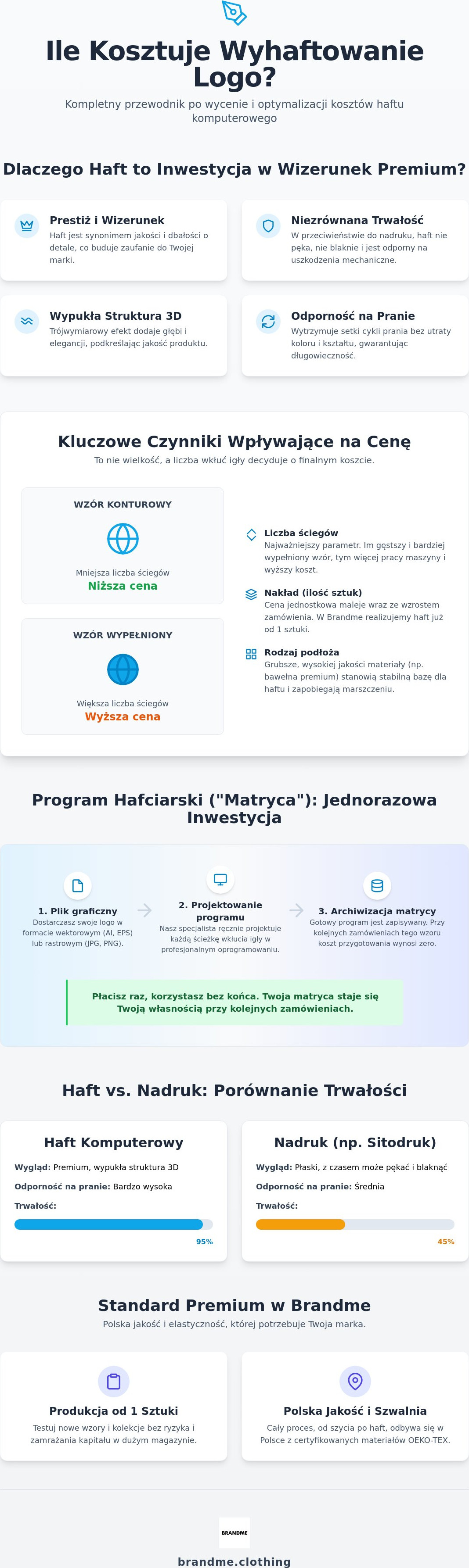
The number of needle stitches is the foundation of every cost estimate. Modern machine embroidery operates on thousands of needle strikes that create the final pattern. The more filled your logo is, the more thread and time it requires. Dense, high-grammage embroidery looks incredibly prestigious and is raised to the touch, which directly translates into the perceived quality of the product.
It is worth remembering a few dependencies:
- Outlines vs. fill: Logos consisting only of outlines are usually cheaper than those with a solid background.
- Details: Very small elements require greater precision and slower machine operation, which can affect the final price.
- Number of colors: Unlike screen printing, in computer embroidery, the use of many thread colors (usually up to 16) generally does not increase unit costs.
Impact of quantity on unit price
The economies of scale in computer embroidery are clear. Preparing production, setting up machines, and threading the appropriate threads are processes that take the same amount of time regardless of whether we embroider one piece or a hundred. Therefore, for larger orders, the unit price drops dramatically. However, at Brandme, we understand the needs of modern brands and merchandise creators. We fulfill orders from just 1 piece, which allows for testing designs without tying up capital in goods that are yet to hit the market.
Type of substrate and quality of execution
A frequently overlooked factor is the quality of the apparel itself. This is where the biggest difference between mass production and premium standards emerges. Embroidery on thin, low-quality t-shirts can cause the fabric to wrinkle, which looks unsightly. Thicker knits, which we offer as part of our production from scratch, provide a stable base. The use of certified OEKO-TEX materials ensures that the embroidery "works" with the fabric, does not deform after washing, and retains its original shape for years. Precise matching of machine parameters to the material's grammage is the key to achieving an effect that builds trust in your brand.
Cost of preparing an embroidery program (embroidery design)
Many clients wonder why simply sending a graphic in JPG or PNG format is not enough to start production. The answer lies in technology. Modern machine embroidery does not "see" pixels, but precise needle stitch coordinates, thread direction, and stitch density. That is why it is necessary to prepare a special control program, commonly called an embroidery design. When analyzing how much it costs to embroider a logo, you must treat this cost as a one-time investment in the quality of your brand.
The global embroidery machine market analysis indicates increasing precision of devices, but it is still the human factor in designing stitch paths that determines the final effect. The embroidery design is a digital record of the designer's work, who must manually "draw" each thread in dedicated software. Once prepared, the program remains in our archive forever. This means that for every subsequent order of the same design, the cost of preparing the embroidery design is zero. This makes embroidery extremely cost-effective when building permanent collections or regularly reordering corporate apparel.
What files are used to create the embroidery design?
Vector files (AI, EPS, or PDF) are ideal, as they allow for unlimited scaling without loss of quality. The embroidery designer analyzes each curve, deciding where the machine should start and end a given element. Automatic conversion of an image to embroidery usually results in failure: threads get tangled, and the material wrinkles unesthetically. Manual development of the program guarantees that the embroidery will be flat, legible, and durable, which is crucial for products such as premium oversized hoodies.
Average market costs of design preparation
The fee for preparing the program depends on the complexity of the graphic. A simple inscription requires less work than a multi-colored crest with a lot of details. However, it is worth knowing that for larger orders, usually exceeding several dozen pieces, this cost is often completely waived. At Brandme, we support you at every stage: we evaluate the submitted graphic and suggest optimizations that will allow you to achieve the best visual effect while maintaining a reasonable budget. Before starting full production, we always prepare a visualization for approval, which eliminates the risk of error.
If you are planning the first drop of your brand or want to see how your logo will look on the material, a good step is to order a sample before production. This will allow you to touch the finished product and personally see the precision of workmanship before deciding on a larger quantity.
Computer embroidery vs. other techniques – cost-effectiveness analysis
The choice of marking technique is a decision that affects the perception of the entire brand. When analyzing how much it costs to embroider a logo, we must compare this cost with alternatives such as screen printing or digital printing. Embroidery is not always the cheapest option to start, but it almost always turns out to be the cheapest when calculated as the cost per wear. This is due to its legendary durability. Threads are woven into the material structure, which makes the personalization an integral part of the product, not just a superficial layer.
In the case of personalized names, for example, for employees, computer embroidery is unrivaled. In screen printing, every change in text would require preparing a new screen, which generates huge costs for small quantities. An embroidery machine smoothly transitions from one name to another. This makes the process fast and relatively inexpensive while maintaining the highest aesthetic standard that builds trust in the team.
When to choose embroidery, and when DTF/DTG printing?
The choice of technique depends on the placement and size of the graphic. A classic chest logo, a small logo on the left chest, is an ideal place for embroidery. It adds elegance, especially when the base is polo shirts or high-quality hoodies. 3D embroidery, made with special foam, is an excellent way to stand out in the streetwear segment. However, it is worth remembering that for very large, complex graphics on the back, DTF printing is often a better choice. An embroidery of 30x30 cm would be too heavy, could unnecessarily stiffen the material, and drive up the unit price of the project.
Image value vs. return on investment
Investing in embroidery directly builds a premium image. Customers subconsciously associate embroidered clothing with higher-end brands, which allows for setting a higher final price for the product in the case of clothing brands. If your goal is to build a loyal community around merchandise, the aesthetics of the marking are crucial. Embroidery withstands hundreds of wash cycles, does not crack, and does not lose color. This is key for corporate apparel exposed to intensive use. The higher initial price quickly pays off in the form of not having to replace damaged clothing with new ones after just a few months, making it the most economical choice in the long run.
How to optimize your budget for logo embroidery?
Cost optimization in the premium segment is not about finding the cheapest substitutes, but about making decisions that eliminate unnecessary processes. When planning your budget and checking how much it costs to embroider a logo, it's worth looking at the project through the eyes of a technologist. Often, a minor change in the graphic or the choice of appropriate clothing base can save significant amounts without losing the prestigious appearance of the final product. Intelligent planning is the key to success for every clothing brand and company that cares about its image.
Simplifying details is the easiest way to reduce the unit price. An embroidery machine needs time to execute each complex element. Removing very small details, which would be barely visible after embroidery anyway, reduces the number of stitches. The same applies to size selection. A one-centimeter difference in logo width may seem insignificant visually, but in production scale, it can realistically affect how much it costs to embroider a logo, shortening machine operating time by several percent.
Preparing graphics step by step
Computer embroidery operates on physical threads, which excludes the use of smooth tonal transitions. Gradients in the logo are best replaced with solid colors or simplified color blocks. The legibility of inscriptions is also crucial. For text to be clear and aesthetic, the height of letters should not be less than 5 mm. Smaller characters may blend into an illegible thread blob. Consulting our team during the design phase helps avoid costly corrections after the machines have already started. Together, we select the stitch density so that the design is durable but does not overly stiffen the material.
Choosing the right base in Brandme
The quality of embroidery is inextricably linked to the density of the material. A stable, substantial knit provides solid support for thousands of needle penetrations, preventing the fabric from wrinkling around the design. An excellent example is products like oversized hoodies, whose high grammage ensures that the embroidery remains perfectly flat even after many washes. Using ready-made premium bases from our collection is also a great way to shorten lead times and reduce costs compared to sewing from scratch.
- Combining projects: Plan orders to combine several designs into one production session.
- Garment blanks: Choose proven styles that work well with the embroidery needle.
- Samples: Always order a prototype to verify the effect before full production.
If you want to accurately estimate your budget and avoid surprises, check out how to order a sample and production with printing to receive a personalized offer tailored to your needs.
Premium embroidery from one piece at Brandme – Polish quality
Most embroidery companies on the market impose strict limits, requiring orders of at least 10 or 20 pieces. At Brandme, we are changing these rules by offering project execution from just one piece. We understand that modern clothing brands and individual customers need flexibility to test new designs or create unique, personalized gifts without having to invest in large inventories. Our approach allows for precise verification of how much it costs to embroider a logo in practice, without the financial risk associated with mass production.
The foundation of our business is local production in Poland, based on the 14-year experience of the Unicat sewing factory. We are not just an intermediary, but a real apparel manufacturer. This gives us full control over every stage of product creation: from fashion design, through the selection of certified OEKO-TEX knits, to the final touch of the embroidery needle. This comprehensive approach means that personalization is not an "attached" element, but an integral part of premium apparel that retains its style and aesthetics for years of use.
Why choose Polish production?
Choosing a local supplier is primarily a guarantee of quality and speed of action. Imports from distant Asian markets often involve uncertainty about material composition and communication difficulties. At Brandme, you have direct contact with experts who will advise you on how to optimize the design from a technical point of view. Shorter supply chains also mean a smaller carbon footprint and supporting local craftsmanship. We use only top-quality threads that do not fade or discolor in washing, which is crucial for maintaining the prestigious appearance of your logo.
Brandme ordering process
Starting cooperation is simple and transparent. The entire process involves a few specific steps that eliminate stress and ambiguity:
- Base selection: You choose one of our proven premium styles or order custom sewing from scratch.
- Graphic submission: You send us your logo, and we provide a free quote and technical analysis.
- Rebranding: Upon request, we remove our labels and sew in your own jacquard labels, creating a product fully ready for sale.
- Sample approval: We prepare a physical prototype so you can personally assess the quality before launching production.
If you want to learn more about the technical aspects of cooperation, please refer to our guide on how to order production. Transparent rules and no hidden costs are standard with us, thanks to which we build long-term relationships with our business partners.
Choose quality that builds your brand
Computer embroidery is more than just a marking technique; it is a declaration of quality and attention to every detail of your image. Understanding how much it costs to embroider a logo allows for conscious budget management and the selection of solutions that will stand the test of time. Remember that the final price is an investment in durability that pays off with every wash and wear of the garment. The key to success is optimizing the design and choosing a stable base that will meet the expectations of your audience.
At Brandme, we combine years of craftsmanship with a modern approach to market needs. Our production is 100% in Poland, and the fabrics used are OEKO-TEX certified, ensuring the highest standard of safety and comfort. We fulfill orders starting from a single piece, giving you complete freedom to test new ideas or create exclusive series of personalized products without inventory risk.
Don't let unclear costs or high minimum order quantities from competitors hinder your growth. Choose a partner who prioritizes transparency and precision at every stage of the process. Your project deserves a premium setting that will effectively set you apart from the competition and highlight the professionalism of your actions.
Create your collection with premium embroidery – request a quote
Frequently Asked Questions
How much does it cost to prepare a program for computer embroidery?
The cost of preparing an embroidery program is a one-time fee for transforming graphics into instructions understandable by the machine. This amount depends on the complexity of the design and the number of details that the designer must manually develop. Once prepared, the matrix remains in our archive forever, which means that for subsequent orders of the same design, you do not incur this cost again. This allows for real savings when regularly reordering corporate clothing or merchandise.
Does the price of embroidery depend on the number of thread colors?
Unlike screen printing, the number of thread colors used usually does not affect how much it costs to embroider a logo. Most modern machines support up to 16 colors simultaneously without incurring additional charges for matrix preparation. This allows you to create multi-colored, complex emblems and logos, maintaining a constant unit cost of personalization, which is crucial for maintaining the visual consistency of your brand while keeping a reasonable budget.
What is the minimum order quantity for embroidery at Brandme?
At Brandme, we fulfill orders starting from a single piece. We do not impose high minimum production thresholds, allowing for full flexibility in managing collections and merchandise. This approach is ideal for clothing brand creators who want to test a new design, or for companies needing a unique gift for a client. You can order a single sample to personally verify the quality of the embroidery before deciding on a larger production run.
Can embroidery be done on every type of material?
Computer embroidery can be done on most woven and knitted fabrics, but the best results are achieved on heavier weight materials. Dense weaves in hoodies or polo shirts provide a stable base that does not wrinkle under the thousands of needle stitches. For very thin materials, we use special stabilizing interlinings, but we always advise choosing a premium base to guarantee an aesthetic and durable logo appearance that will not deform after washing.
What files are needed for embroidery quotation and execution?
For an initial quote, a graphic file in JPG or PNG format is sufficient, but for professional matrix creation, vector files such as AI, EPS, or PDF are essential. Vector formats allow our designer to scale the design without loss of quality and precisely plan the thread paths. If you are unsure whether your graphic is suitable for this technique, our experts will analyze it and advise you on how much it costs to embroider a logo in your specific case.
Is computer embroidery more durable than printing?
Yes, computer embroidery is widely recognized as the most durable method of clothing personalization available on the market. Threads are physically woven into the structure of the material, making the design resistant to high washing temperatures and intensive use. Unlike some types of prints, embroidery does not crack, crumble, or lose color intensity even after many years, making it an investment with the highest return in the product's life cycle.
How long does it take to fulfill an order for embroidered clothing?
The standard order fulfillment time is usually 7 to 10 business days from the moment of visualization acceptance and payment confirmation. This period may change depending on the size of the order and the current workload of the Polish sewing factory. For single pieces or samples, this process is usually shorter, allowing for efficient implementation of a new collection. We always inform about the planned shipping date, ensuring transparency and adherence to agreed cooperation terms.
Can I order embroidery on my own clothing?
We focus on working with our proprietary premium clothing bases to guarantee the highest quality of the final product. Our t-shirts and hoodies are factory-tested for compatibility with embroidery machines, which eliminates the risk of material damage. Choosing clothing from Brandme's offer ensures that the fabric is OEKO-TEX certified and produced in Poland, which, combined with our sewing factory's 14 years of experience, guarantees a result that will satisfy even the most demanding customers.

Article by
Konrad Nosek
An entrepreneur and expert in clothing production and building clothing brands. For over 14 years, he has been developing the Unicat sewing factory, carrying out comprehensive production for Polish and foreign brands, including Dzik, OSHEE, and Relab. He specializes in designing production processes, material selection, clothing branding, and implementing collections from concept to finished product. He is also the creator of the BrandMe brand, which enables brands, companies, and creators to order high-quality clothing with full personalization – even from a single piece. In his articles, he shares practical knowledge on clothing production, building one's own brand, branding technologies, and trends in the fashion and merch industry.