

Have you ever wondered why the same logo looks perfect on a monitor screen, but loses its magic after being embroidered on a sweatshirt? The key to success is not just a modern machine, but primarily how to prepare a file for computer embroidery so that it becomes a precise instruction for the needle and thread. In the world of premium apparel, every millimeter matters. Errors made at the design stage often result in unreadable details or unnecessarily high costs for preparing the embroidery matrix.
Many entrepreneurs and designers worry that their artistic vision will not survive the encounter with the physicality of the stitch, especially when the logotype contains small elements. We understand this uncertainty, which is why we have prepared a complete guide for 2026. From it, you will learn how to professionally prepare a design so that your apparel embroidery is precise, durable, and aesthetic. We will explain the differences between vector and raster, guide you through the process of converting graphics into an embroidery program, and suggest which techniques will best emphasize your brand's prestige. You will learn specific technical parameters that will allow you to achieve the highest quality effect, even for single-piece orders realized in our Polish sewing factory.
Key Takeaways
- You will understand the difference between ordinary graphics and a machine control program, which will help you avoid costly corrections at the production stage.
- You will learn how to prepare a file for computer embroidery in vector formats so that every detail of your logotype remains sharp and readable.
- You will discover the safe limits for line thickness and letter height, ensuring your designs look professional on every type of knitwear.
- You will find out how to choose the appropriate grammage of premium apparel so that the embroidery does not wrinkle the fabric and retains its shape for years of use.
- You will see how, thanks to production in Poland and the possibility of ordering from 1 piece, you can build your own clothing brand without the risk of large initial investments.
What is computer embroidery and why does it require a special file?
Computer embroidery is one of the most noble methods of apparel branding. Unlike traditional prints, which apply a layer of paint or film to the fabric surface, embroidery involves physically weaving threads into the material's structure. What is computer embroidery in practice? It is a process where an advanced machine, controlled by precise software, performs thousands of needle stitches, creating a durable and raised pattern with a unique texture. The final effect is not just a logotype. It is a declaration of quality, associated with the premium segment and professionalism.
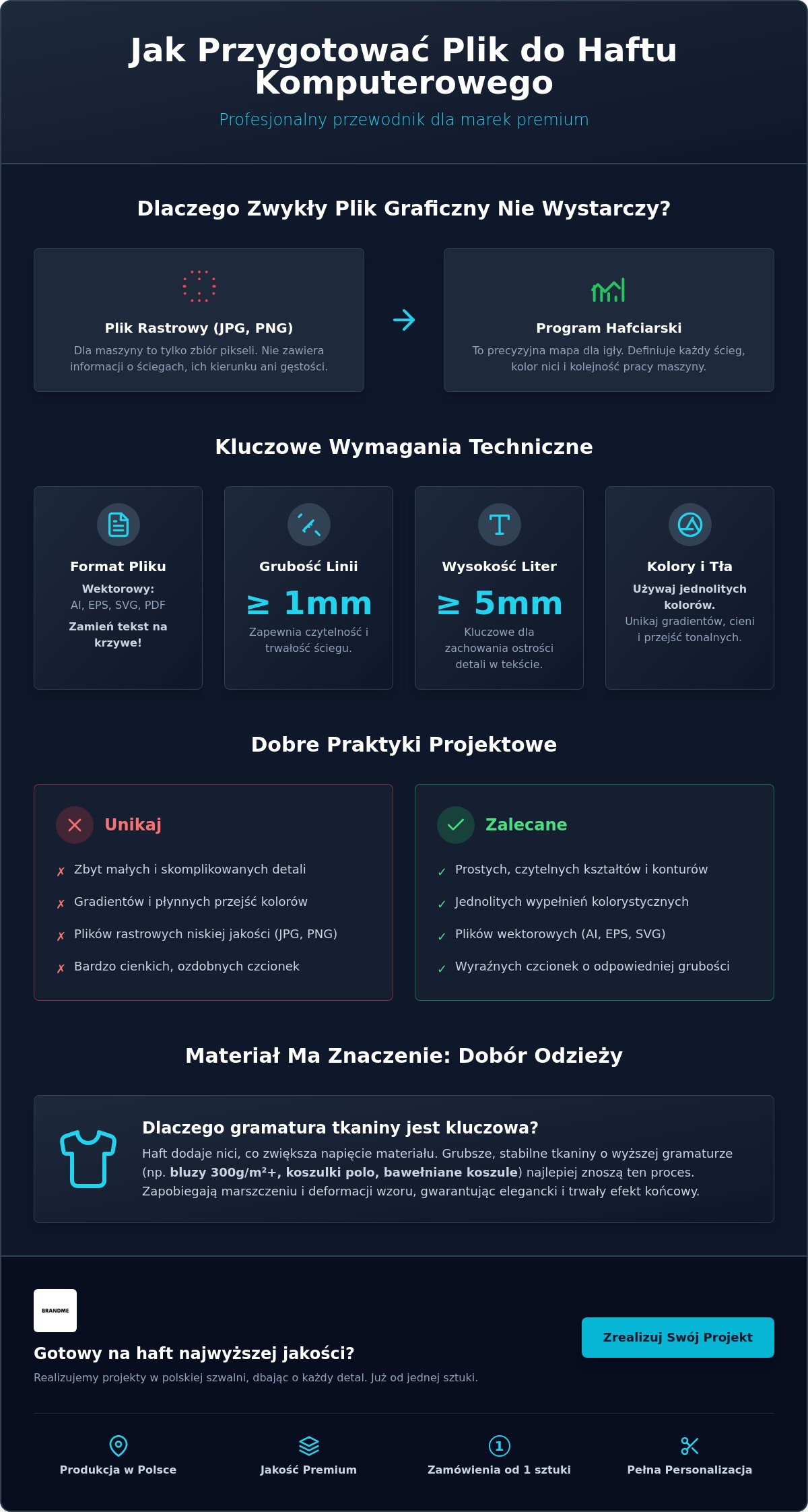
Many clients send us photos in JPG or PNG format, expecting immediate machine start-up. Unfortunately, an embroidery machine does not "see" pixels like a monitor. For the machine, a regular photo is just a collection of colored dots, not an instruction for needle movement. For the process to begin, digitization is essential, which means converting graphics into commands understandable to the machine's processor. It is at this stage that understanding how to prepare a file for computer embroidery becomes crucial. The production file must contain information about stitch density, direction, and the sequence of thread color changes. Without professional embroidery software, the machine simply would not know where to start and how to guide the thread to make the pattern legible.
Embroidery versus other marking methods – when is it worth choosing?
The choice between embroidery and methods like DTF or screen printing depends on the effect you want to achieve. Embroidery is synonymous with prestige. It is practically indestructible; it does not crack, does not wash out, and withstands hundreds of cycles in the washing machine. It is an ideal solution for clothing brands building a premium image and for companies looking for durable branding on workwear. Due to its weight and specificity, embroidery looks best on thick, stable materials. Every hoodie or classic polo shirt gains a three-dimensional character that cannot be replicated by any paint.
What is an embroidery program and why is it paid?
Preparing an embroidery program, often called a "digital matrix," is a manual process requiring the experience of a digitizer. It is the digitizer who decides how the thread will lay on the material to avoid fabric puckering. The quality of this file determines the final appearance of the logotype. The fee for preparing the program is a one-time charge. Once created, the matrix remains in the Brandme archive, meaning that for subsequent orders, you only pay for the embroidery execution itself. This is an investment in the repeatability and perfection of each piece, regardless of whether you order one item or an entire collection for your company.
Technical requirements: How to prepare a file for embroidery step by step?
The foundation of perfect embroidery is the quality of the source file. An embroidery machine works based on coordinates, which is why vector files are the best material to work with. Formats such as AI, EPS, SVG, and PDF (provided vector data is preserved) are the gold standard in the industry. They allow for arbitrary scaling of the logotype without loss of edge sharpness, which is crucial during pattern digitization. When considering how to prepare a file for computer embroidery, you must start by ensuring that your graphic is not a "blurred" collection of pixels, but a precise technical drawing.
Another critical step is converting all texts to curves (outlines). This is a simple operation in graphic programs that prevents errors in font interpretation. If you send a file with active text and our workstation does not have the identical font, the software will substitute a default font, which will completely change the appearance of your design. Curves guarantee that the letters remain exactly as you designed them. In the case of raster files, such as JPG or PNG, their use is possible, but requires much more effort in manual tracing of the pattern. We only accept them if they have high resolution (minimum 300 DPI) and are legible.
Vector vs. raster graphics in embroidery
The main difference is how the image is described. Vectors are based on points and lines, which makes it easier for embroidery programs to determine needle paths. Raster files often have so-called noise around the edges, which makes precise reproduction of details difficult. Technical aspects of how machines interpret different embroidery file formats show that the cleaner the input file, the lower the risk of error. If you are unsure about the quality of your file, it is worth consulting us before starting production.
Thread colors and brand color reproduction
In the world of embroidery, we do not operate with CMYK or RGB palettes. Each color is a physical spool of thread. Although we have hundreds of shades, their number is finite. To achieve maximum consistency with your company's visual identity, please provide Pantone numbers. At Brandme, we select threads from leading manufacturers to most faithfully reproduce brand colors. We also offer premium solutions that go beyond the standard palette. We can use metallic threads (gold, silver), neon for merchandise designs, or fluorescent threads that glow in the dark. Such details give your corporate apparel a unique, luxurious character.
Limitations and common mistakes in designing for embroidery
Computer embroidery, though exceptionally prestigious, has its technical limits due to the physical nature of thread and needle. The most common mistake when trying to understand how to prepare a file for computer embroidery is treating the material like paper, and thread like ink. In reality, each stitch has its volume. If your design includes letters smaller than 5 mm in height, you risk the eyes of letters like "e" or "a" simply disappearing, merging into an illegible blob. A similar rule applies to line thickness. 1 mm is considered a safe limit. Anything thinner may be "pushed" by the machine into the knitwear, becoming almost invisible.
Another challenge are gradients and tonal transitions. An embroidery machine operates with solid colors. It is not possible to achieve the smooth color blend known from digital printing without drastically increasing the number of stitches, which usually negatively affects aesthetics. Too high a pattern density leads to the so-called sheet metal effect. The material becomes stiff, unpleasant to the touch, and starts to move unnaturally on the silhouette. Professional embroidery design therefore requires the ability to synthesize and simplify form while maintaining the character of the graphic.
How to simplify a logo for embroidery without losing brand identity?
Simplifying a logotype does not mean giving up its recognizability. Often, it is enough to remove small taglines located under the graphic symbol or to forgo very thin outlines. A good solution is to use a negative. Instead of embroidering a large, full background, which stiffens the apparel, it is better to use the material color as a compositional element. At Brandme, we help clients adapt complex emblems or logotypes so that they look clean and professional when transferred to thread. This is a crucial stage that determines whether your premium apparel will be worn with pride.
Embroidery size and placement on apparel
The location of the embellishment directly affects the comfort of wearing the product. Classic placements include the left chest (heart), nape, or sleeve. For larger designs on the back, we must remember the maximum embroidery area, which for most machines is about 35x45 cm. It is important to avoid designing patterns that cross seams or pockets, as the needle can damage the joint structure of the materials. For example, our oversize medium light brushed black hoodie has a specific cut that best complements a central, medium-sized embroidery or minimalist branding on the chest. Knowing how to prepare a file for computer embroidery considering a specific garment model helps avoid pattern deformation during daily wear.
Apparel selection for embroidery – why material matters?
Even perfect knowledge of how to prepare a file for computer embroidery will not guarantee success if we forget about the physical properties of the substrate. Embroidery is an invasive process. Thousands of needle stitches and hundreds of meters of thread create tensions that the material must cope with. The key parameter here is grammage. The heavier and denser the knitwear, the greater the stability of the pattern. On thin, low-grammage T-shirts, dense embroidery can cause unsightly puckering of the material around the logotype, which cannot be eliminated even with the best non-woven stabilizer. In the premium segment, we aim for bases that will "carry" the design, maintaining the garment's shape for years.
At Brandme, we focus on enzymed cotton and dimensional stabilization processes. Enzyming removes protruding fibers, making the material surface smooth, which facilitates precise thread guidance. In turn, stabilization ensures that the knitwear does not shrink in the wash, and the embroidery stays in place, without deforming over time. It is this synergy between file preparation and the quality of Polish knitwear that determines the final effect, which delights with details and durability. Remember that embroidery on pique polo shirts requires a different stitch density than embroidery on a smooth sweatshirt, which is why we always adjust the digitization parameters to the specific product.
Best apparel bases for computer embroidery
Choosing the right base is a strategic decision for any brand. Our hoodies with high grammage are an ideal "canvas" for threads. Their fleshy structure perfectly withstands even very large and complex patterns on the back or chest. For business clients looking for classic elegance, regular polo products will be the best choice. The specific pique weave in our polo shirts is stiff enough to hold precise, small company logotypes on the chest without the risk of them sinking into the material structure.
Polish sewing factory and quality control
Brandme's advantage stems from the fact that we are a Polish sewing factory that combines apparel production with branding in one place. This allows for full control over the process. We know exactly how our knitwear will behave under the needle, because we test it at every stage. All materials we use are OEKO-TEX certified, which guarantees safety for the skin and the absence of harmful chemicals. This approach allows us to fulfill orders from as little as one piece, offering substantive support on how to prepare a file for computer embroidery to perfectly match the chosen garment model. If you plan to create your own collection, check out our capabilities in apparel production from scratch and bet on quality that builds trust in your brand.
Embroidery at Brandme – from design to finished premium apparel
Choosing a contractor is the last, but most important step towards creating a unique collection. At Brandme, we don't just operate machines. We act as a strategic partner who ensures your vision is realized without compromise. Even if you know perfectly well how to prepare a file for computer embroidery, our team verifies every submitted design for technical aspects. We check stitch density and thread selection to ensure the final premium apparel product is identical to your vision. What distinguishes us? Flexibility. We fulfill orders from just one piece, which is a rarity among professional sewing factories. This is an ideal solution for fashion startups, merch creators, and companies needing personalized gifts for key contractors.
For those building their own clothing brands, we have prepared a comprehensive White Label service. This involves complete rebranding of apparel. We remove manufacturer labels and sew in your own jacquard labels or perform branding inside the neck. This way, you receive a finished product that builds your brand's prestige from the first touch. Our service is fully integrated. From apparel construction, through precise branding, to final packaging and shipping to your warehouse or directly to the client.
How to order a sample and check embroidery quality?
Most companies avoid producing single test pieces due to the high costs of machine setup. We believe that a test run is key to satisfaction. Investing in a prototype allows you to check how the thread works with specific knitwear and whether the logo scale is appropriate. If you want to learn more about the procedure, check out our guide: how to order a sample and print production. This approach minimizes the risk of errors with large quantities and gives you confidence that every item in the order will be perfect. We work closely with marketing and event agencies, providing them with samples that help close key projects.
Why choose Polish production?
Production in Poland is not just about economic patriotism; it's primarily about real business benefits. By choosing Brandme, you leverage 14 years of experience from the Unicat sewing factory. We guarantee fast order fulfillment and eliminate the risks associated with importing from Asia, such as transport delays or product discrepancies. You have full insight into the process and the assurance that we only use certified fabrics. If standard cuts are not enough, we offer custom clothing production. We will create a unique design for you, select the fabric weight, and advise you on how to prepare a file for computer embroidery so that your original project becomes a market success. Choose quality that speaks for itself.
Transform your vision into a lasting symbol of quality
Knowing how to prepare a file for computer embroidery is fundamental to building a modern brand's image. Remember, the key to success is combining precise vector graphics with a well-chosen, high-grammage base fabric. Embroidery is a three-dimensional interpretation of your visual identity. On premium clothing, it looks exceptionally noble and professional. Every stitch is proof that you care about the smallest details and do not accept half-measures.
At Brandme, we combine 14 years of experience in the international market with the dynamism of a Polish sewing factory. We use only the highest quality fabrics that work perfectly with needle and thread. We bring your ideas to life starting from just one piece. This gives you space to test new drops or create unique series of corporate clothing. You don't have to worry about technical complexities. Our team will ensure that the final result exceeds your expectations and emphasizes the prestige of your project.
Design your premium merch and request an embroidery quote. It's time to give your brand a physical form that inspires trust and pride in everyone who wears it.
Frequently Asked Questions (FAQ)
Do I need a vector file to order computer embroidery?
A vector file is not strictly required, but it is the best basis for digitizing a design. We also accept high-resolution raster files, a minimum of 300 DPI, such as JPG or PNG. Remember that how to prepare a file for computer embroidery directly affects the precision of detail reproduction. Working with vectors allows us to most accurately define the needle paths and avoid unwanted distortions on the finished garment.
What is the minimum letter size in embroidery for legibility?
The safe limit for the legibility of small letters is 5 mm in height. Smaller characters may blend due to the physical thickness of the thread and the fabric structure. For very thin fonts, we recommend slightly thickening or simplifying them during the design stage. This ensures the logo remains clear even after many washes, and the needle does not damage the material structure around small elements of the design.
How much does it cost to prepare an embroidery program?
The cost of preparing an embroidery program is a one-time fee and depends on the complexity of your project. The price reflects the working time of an experienced digitizer who manually programs each needle penetration and stitch direction to prevent material puckering. Once created, the digital matrix remains in our archive. This means that for each subsequent order of the same design, you no longer incur preparation costs.
Can computer embroidery be done on any type of material?
Embroidery looks best on stable, thick knit fabrics, such as sweatshirts, polo shirts, or premium high-grammage cotton. On very thin T-shirts, dense embroidery can cause material puckering that cannot be completely eliminated. In such situations, we advise optimizing the design or choosing another marking technique to maintain the highest wearing comfort for your corporate apparel.
Can I order just one embroidered sweatshirt?
Yes, at Brandme, we fulfill orders starting from just one piece, which sets us apart from traditional sewing factories. This is an ideal solution for individuals building personal brands or apparel startups who want to test a product before starting larger production. We treat every order, regardless of quantity, with the same precision and attention to premium quality, drawing on our 14 years of experience.
What are the most popular file formats for embroidery?
We prefer to work with vector files in AI, EPS, SVG, or PDF formats. Embroidery machines require specialized machine files, such as DST or PES, but our team handles their preparation during the digitization process. Knowing how to prepare a file for computer embroidery in vector format allows us to start work immediately without the need for manual tracing of graphics.
Is computer embroidery more durable than screen printing?
Computer embroidery is considered the most durable method of clothing branding available on the market. The threads are physically woven into the fabric structure, making the design practically indestructible. Unlike screen printing or other prints, embroidery does not crack, peel, or lose color intensity even after hundreds of wash cycles at high temperatures, making it ideal for premium apparel.
Can I use my own thread colors outside the standard palette?
We select thread colors to most accurately reflect the Pantone palette of your visual identity. We have access to hundreds of shades from leading global manufacturers, allowing for very precise color matching to your logo. Upon special request, we also use metallic, neon, or fluorescent threads, which give projects a unique character and help distinguish your brand in the market.