

What if your team's company T-shirts could generate more inquiries than your last social media campaign? This isn't a provocation, but a strategic question that changes the game. Too often, workwear is a compromise between price and quality that ends the same way: a faded logo after a few washes and clothes employees wear out of obligation, not pride. This is not only a missed opportunity to build an image, but a real cost that yields no return.
In this guide for 2026, we will prove that the answer to the question of how to choose workwear for employees is key to transforming an ordinary uniform into a powerful marketing tool. We will show you how to select materials that will last for years, choose cuts that make your team feel confident and professional, and how to make your logo a symbol of quality. From unraveling the mysteries of branding techniques to creating a cohesive image – get ready for a complete transformation of your approach to company merchandise.
Key Takeaways
- You will learn how to choose workwear for employees so that it becomes a mobile business card for your brand and builds a professional image.
- You will learn how to analyze team needs to perfectly match styles to the nature of the work – from office elegance to freedom of movement in the field.
- You will understand what key parameters, such as fabric weight, mean to consciously invest in quality and wearing comfort.
- You will learn the most effective branding methods and how to choose the technique (e.g., embroidery or screen printing) for the type of fabric and your logo.
Why is choosing employee clothing a key image decision?
Your team's attire is more than just an item of clothing. It's a mobile billboard, the first line of communication with the client, and a silent ambassador for your brand. Every employee in company attire becomes a living business card for the enterprise, working daily to build its reputation. Therefore, the question of how to choose workwear for employees is actually a question of how you want your company to be perceived in the market.
Imagine two situations. In the first, a client sees a team dressed in faded, ill-fitting T-shirts with cracked prints. In the second, employees wear aesthetic, perfectly tailored polo shirts with a precise embroidered logo. Which company inspires more trust? The answer is obvious. The quality of clothing directly translates into the perception of professionalism and attention to detail, which are the hallmarks of the entire organization. It's a message sent to the environment: we are solid, consistent, and do not compromise on quality.
A uniform also has immense psychological power within the company. It builds a sense of belonging and community, blurring visual differences and strengthening team spirit. Employees, feeling part of a cohesive whole, are more engaged and proud of their workplace. This is a subtle yet extremely effective way to build a strong organizational culture.
This is particularly important in industries where aesthetics and direct client contact are fundamental to the business. In the beauty sector, for example, in nail salons, professional and consistent staff attire visually confirms precision and attention to detail. Clients, seeing a well-coordinated team, subconsciously transfer this positive impression to the quality of services. Many brands in this industry understand this perfectly, and inspiring examples of building such a professional image can be found on sites like fingerspa.pl.
Company clothing and Employer Branding
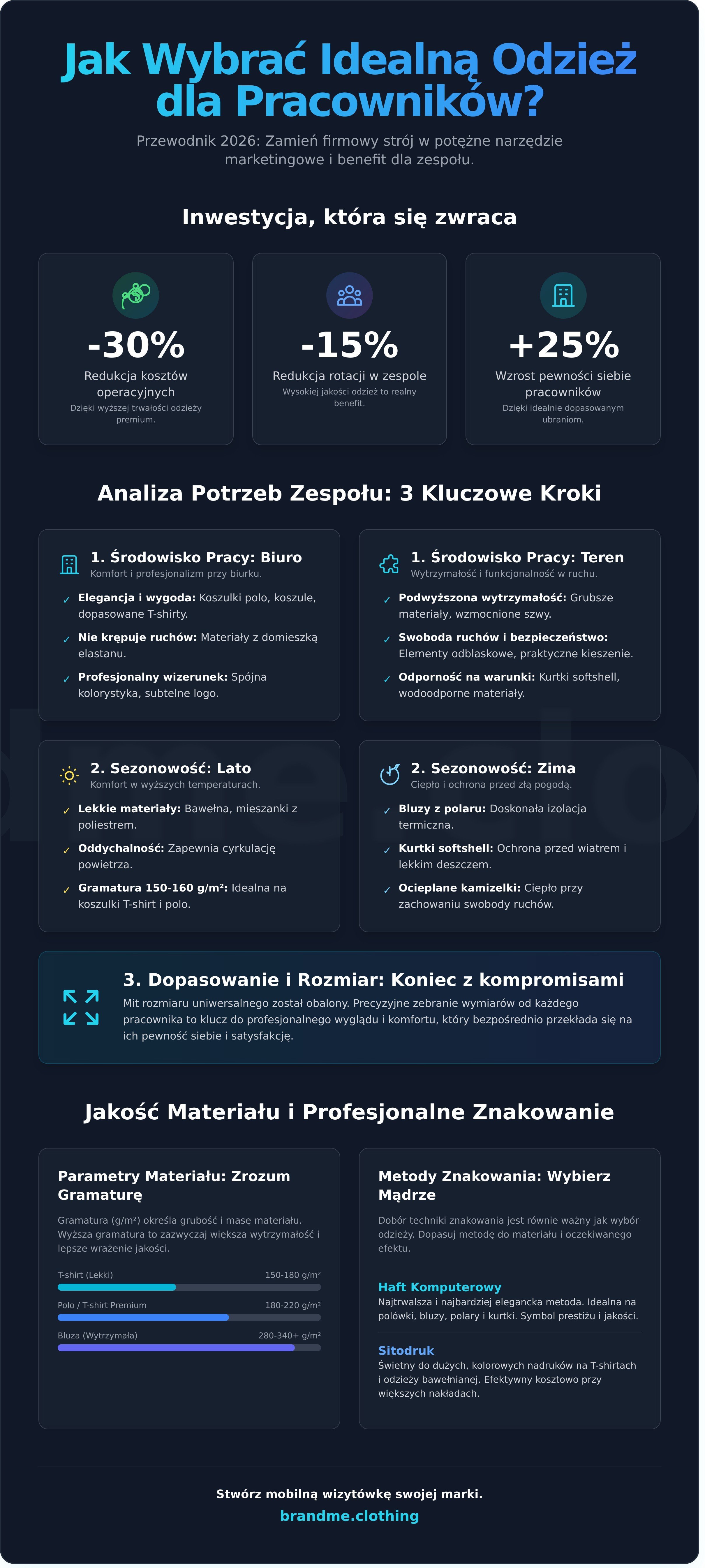
High-quality, comfortable, and aesthetic clothing is no longer just a marketing tool, but a real employee benefit. Employees appreciate when a company invests in their comfort and image. Attractive sweatshirts, jackets, or premium T-shirts, often included in welcome packs, become a desirable wardrobe item, worn with pride even after work hours. This directly contributes to increased satisfaction and loyalty, reducing team turnover by as much as 15% according to industry studies from 2023.
Investment vs. Cost: Why quality pays off?
The initial cost of purchasing premium clothing is higher than for cheap, promotional T-shirts. However, in the long term, quality generates real savings. Cheap T-shirts lose their shape and color after a few washes, and prints crack, requiring replacement even 3-4 times a year. Professional workwear from BrandMe, made from certified materials and adorned with durable computer embroidery, retains its properties for years. A thorough product lifecycle analysis shows that the durability of branded clothing reduces operational costs associated with apparel by at least 30% annually. This is not a cost; it's an investment that pays off on many levels.
Team needs analysis: How to match clothing to the nature of the job?
Before you start browsing catalogs, pause. The crucial question of how to choose workwear for employees isn't about the latest trend, but about a fundamental understanding of their daily challenges. Appropriately chosen attire is not just a company's business card, but primarily a work tool that affects efficiency, comfort, and safety. The first step is a thorough analysis of the environment and job specifics so that clothing becomes an aid, not an obstacle.
Where does your team spend most of its time? In an air-conditioned office, in dynamic field work, or perhaps in a hybrid model that has gained popularity in over 40% of Polish companies since 2020? Each of these environments places different demands. An office worker needs elegant yet comfortable attire that doesn't restrict movement during an 8-hour day at a desk. In contrast, an installer or service technician – like those employed by construction companies such as Pauresta – requires clothing with enhanced durability, ensuring freedom of movement and safety. For jobs with increased physical risk, it is crucial to familiarize yourself with official regulations, such as the American personal protective equipment guidelines, which serve as an international model for assessing workplace hazards.
Polish weather can be fickle, so considering seasonality is not a luxury but a necessity. In summer, opt for light, breathable materials, like cotton with a weight of 150-160 g/m², which will provide comfort even on hot days. In winter, with temperatures dropping below 5°C, warmer solutions will be essential:
- Fleece sweatshirts: excellent insulation and lightness.
- Softshell jackets: protection against wind and light rain.
- Insulated vests: arm mobility while retaining warmth.
The myth of "one size fits all" has long been debunked. Ill-fitting clothing looks unprofessional and is simply uncomfortable, directly affecting employee well-being. Studies conducted by the University of Hertfordshire in 2018 showed that a well-fitting uniform can increase an employee's confidence by up to 25%. Therefore, always collect exact sizes from each team member. Investing in precise sizing is an investment in image and morale.
Clothing for office workers and sales representatives
Elegant polo shirts with a discreetly embroidered logo are the golden mean between a formal shirt and a regular T-shirt. They are ideal for client meetings and everyday work. Plain crewneck sweatshirts are becoming an increasingly popular, modern alternative to blazers, especially in creative and IT industries. Remember the details – subtle branding on the chest or sleeve speaks volumes about class and attention to image.
Attire for field and event staff
In the field and at events, comfort and functionality reign supreme. Hoodies protect against wind and light rain, and their pockets are extremely practical. For intensive use, choose premium T-shirts with a weight above 190 g/m², which will withstand many washes without losing their shape. Color scheme is also crucial here – a distinct company color will make your team visible from afar, which is invaluable at trade fairs or in a crowd.
As you can see, the answer to the question of how to choose workwear for employees is complex and multi-faceted. Precisely matching styles and materials to the company's specifics is a task where an experienced apparel branding partner becomes invaluable support, helping to dress your brand for success.
Quality you can feel: What material parameters should you pay attention to?
Employee clothing is an investment in image that pays off every day. However, its true value lies not in a trendy cut, but in the quality you feel from the first wear. A durable material guarantees that your company's logo will look impeccable for months, not weeks. Understanding a few key technical parameters is fundamental when considering how to choose workwear for employees that will stand the test of time and intensive use.
The basis is the material composition and its weight. At BrandMe, we rely on proven solutions, which is why 9 out of 10 of our sweatshirts are sewn from Polish tracksuit fabric made of 80-90% cotton with a polyester blend. Why? Pure cotton, although pleasant to the touch, is prone to deformation and shrinkage. A small, 10-20% addition of polyester stabilizes the fibers, provides elasticity, and drastically increases resistance to pilling. This is a compromise that does not reduce comfort but maximizes durability.
Every batch of material we use is certified with OEKO-TEX Standard 100. This is an international safety mark that confirms the fabric is free from over 100 harmful substances, including pesticides and allergens. This is not only about environmental care but primarily about the comfort and safety of your team.
Weight Guide for Managers
Weight is the weight of one square meter of material expressed in grams (g/m²). It determines the thickness, warmth, and "feel" of the clothing. Light t-shirts (160-180 g/m²) are ideal for summer or work in heated rooms. Thick sweatshirts (320-360 g/m²) provide thermal comfort outdoors and build an image of solidity. Weight also directly affects the durability of branding. A denser weave of higher weight material provides a more stable base for computer embroidery, preventing the fabric from wrinkling around the logo. It is also worth paying attention to the type of cotton. Combed cotton, unlike classic cotton, undergoes an additional process of combing out short fibers. The result? It is smoother, stronger, and much more resistant to pilling, which translates into longer lifespan and aesthetics of the clothing.
Polish production vs. import: Why does a local sewing factory win?
Choosing a local producer is a strategic business decision. At BrandMe, we control 100% of the production process – from thread selection, through cutting, to the last stitch. This allows us to guarantee color and quality consistency even for orders of 500 pieces, which is impossible with imported catalog clothing. Supporting the Polish economy and ethical production are values that resonate with modern brands. Investing in clothing sewn in Poland is not just about clothing, but a key element in building a brand image, where each employee becomes its ambassador. What's more, cooperation with us opens the door to private label sewing, giving complete freedom in creating unique labels, cuts, and details that will 100% reflect the character of your company.
Branding methods: How to professionally apply a logo to clothing?
The chosen clothing is just the canvas. The true brand identity appears on it with the logo. When you wonder how to choose workwear for employees, the decision about the branding method is as crucial as the choice of the fabric itself. It determines the durability, aesthetics, and the final impression your team will make. An incorrectly chosen technique can ruin the effect of even the most expensive sweatshirt, while professional branding will elevate even a standard T-shirt. Let's analyze the most popular technologies so you can make an informed decision.
Computer embroidery - prestige and indestructibility
Embroidery is synonymous with elegance and durability. Its three-dimensional structure adds depth and a prestigious character to the logo, perfectly suited for thicker materials. It is an absolute favorite for premium clothing: polo shirts, fleeces, sweatshirts, jackets, and caps. Properly executed embroidery is virtually indestructible - it will withstand not 100, but hundreds of washes, often outliving the garment itself. Its pricing does not depend on the size of the design, but on the number of stitches required to make it. This means that a small but very detailed logo can be more expensive than a large, simple inscription. However, it is important to remember the limitations: embroidery does not cope well with smooth tonal transitions (gradients) and very fine details, which can become illegible. For logos with complex graphics, modern prints will be a better solution.
Modern prints: Screen printing and DTF
When precision of details and perfect color reproduction are important, digital printing and screen printing techniques come into play. Each has its unique application.
- Screen printing: This is the king of large print runs. If you plan to order more than 50 T-shirts with the same, relatively simple design (up to a few colors), screen printing is the most cost-effective choice. The ink is pressed directly into the fabric structure, which guarantees high durability (easily withstands 50-80 washes) and color saturation. It is ideal for cotton T-shirts, bags, and sweatshirts.
- DTF (Direct to Film): This is a revolution in apparel branding. DTF technology allows for applying full-color, photorealistic graphics with perfect tonal transitions to almost any type of material – from cotton, through polyester, to blends. The print is flexible, smooth to the touch, and extremely durable. This is the best choice when your logo is complex, colorful, or when you need to brand technical clothing.
For a perfect result, file preparation is key. Regardless of the technique, the design should be provided in vector format (e.g., .ai, .eps, .pdf). This guarantees ideal sharpness of edges, even when scaled. The correct choice of branding technique is the final but decisive step in the process of how to choose workwear for employees that will genuinely build a professional company image.
Not sure which technique best expresses your brand's character? Consult your project with BrandMe experts and be confident that your logo will look impeccable.
How to order employee clothing in 2026? Implementation strategy
Choosing the ideal clothing is half the battle. The other half is efficient order fulfillment. A process that seems simple at first glance hides several pitfalls that can undermine all the effort put into building an image. Below, we present a proven strategy that will guide you step-by-step through the ordering process - from the brief to receiving smiles on employees' faces.
The key is to treat this task not as a purchase, but as a project. Precise planning at every stage guarantees that the final product will be exactly what you expect. Here are five key steps to success:
- Brief preparation. Before contacting a supplier, create a document outlining the project's fundamentals. It should include: the exact number of pieces (e.g., 80 T-shirts, 30 hoodies), an initial budget (e.g., PLN 70-110 net per piece), and an unmissable deadline, especially if the clothing is needed for a specific event, such as a trade fair on June 12, 2026.
- Sample ordering. A picture in a catalog will not convey the fabric weight or seam quality. Always order samples. Only when you touch the material, assess its thickness (e.g., 280 g/m² for a sweatshirt) and elasticity, will you be 100% sure you are investing in quality, not a one-time gadget.
- Size collection. This is one of the most critical stages. Instead of relying on general declarations ("I wear M"), provide the team with the exact size chart from the manufacturer of the chosen model. An L size from one brand can differ by as much as 4-5 cm in chest measurement from an L size of another. The best solution, if possible, is to order a set of sample sizes (a "sizing kit") and organize fittings in the office.
- Project finalization and visualization approval. A professional supplier will provide you with a digital visualization of the product with the logo applied. Check it extremely carefully. Pay attention to the placement, size, and colors of the branding (preferably using PANTONE codes). Approving the visualization is like signing a contract - it's the last moment for cost-free corrections.
- Distribution and feedback. After receiving your order, plan its distribution. You can prepare personalized packages for each employee. Approximately two weeks after distributing the clothing, gather feedback using a short online survey. Questions about comfort, fit, and overall impressions will help you refine future orders and show the team that their opinion matters. This is the last, but very important, element of the strategy for how to choose clothing for employees for years to come.
Common mistakes when ordering corporate clothing
Saving a few pennies per item often leads to a reputational disaster. Choosing the cheapest offer without verifying quality results in the "rag after the first wash" effect – clothing shrinks, loses color, and the print cracks. Remember that an employee in damaged corporate clothing becomes negative advertising for your brand. Equally problematic is ignoring team feedback and forcing overly complicated logos that become an unreadable blur on an 8 cm wide embroidery.
Cooperation with BrandMe: Your partner in clothing production
We understand the challenges faced by modern companies. That's why at BrandMe, we have simplified the process to a minimum, focusing on transparency and flexibility. We fulfill orders starting from 1 piece, which is an ideal solution for startups, small teams, or testing new designs. We guarantee a quick quote within 24 hours and provide full graphic support at no extra cost, so your logo looks perfect on every product. Don't waste time on mistakes. Design clothing for your employees with BrandMe and invest in an image that works for your success.
Dress your brand for success in 2026
Choosing clothing for your team is much more than a logistical challenge. It's a powerful tool for building identity and organizational culture. As our guide has shown, the key to success is understanding employee needs and prioritizing uncompromising quality of materials and branding. These elements determine comfort, durability, and a professional appearance that works to your advantage every day.
Now that you know how to choose clothing for employees, it's time to move from theory to action. Instead of seeking compromises, choose a partner who understands your goals. At BrandMe, we carry out all production in our sewing facility in Krzemienica, using certified premium fabrics. This ensures that your investment will last for years, and production flexibility (orders from 1 piece) allows you to tailor your order perfectly to your needs.
Start building an image that inspires trust and pride. Configure your corporate clothing collection with BrandMe and see how professional attire strengthens your brand.
How to choose clothing for employees? Frequently asked questions (FAQ)
How much does a complete set of clothing for one employee cost?
The cost of a complete set of clothing for an employee is variable and depends on the selected products and branding technique. A basic set, for example, a T-shirt and a sweatshirt with a logo, can cost from about PLN 150 net. More extensive sets, including a softshell jacket and trousers, amount to PLN 400-600 net per person. We always prepare an individual quote to perfectly match the offer to your budget and the brand's image needs.
What is the minimum order quantity at BrandMe?
The minimum order quantity at BrandMe is 20 pieces of one type of product with the same branding. This threshold allows us to optimize production preparation costs, for example, screens for screen printing or embroidery programs, which translates into an attractive unit price. Thanks to this, we guarantee the highest, repeatable quality of execution within a reasonable budget. For regular customers, we offer flexible terms for reorders.
How long does it take to fulfill an order with a logo?
The standard lead time for an order with a logo is 10 to 14 business days. This period is counted from the moment of acceptance of the final visualization and receipt of payment. The lead time may change depending on the complexity of the project, the size of the order, and the current production workload. We always inform about the estimated delivery date at the order placement stage, focusing on full transparency.
Can I order clothing with my own labels?
Yes, we offer full rebranding of clothing, including sewing in labels with your brand's logo. This is an excellent way to enhance the prestige and visual consistency of your company. We can remove original manufacturer labels and replace them with yours, made according to an individual design. The rebranding service is available for orders over 50 pieces. Contact us to discuss the details and create a product that is 100% tailored to your brand.
How to care for corporate clothing so that the print/embroidery lasts for years?
To ensure maximum durability of the branding, wash clothing inside out at a temperature not exceeding 40°C and avoid strong detergents and bleaches. Iron clothes also inside out, avoiding the direct area of the print. Computer embroidery is inherently more resistant to mechanical damage, but proper care will always extend the aesthetic appearance of the clothing and protect your investment in the brand's image.
Do you help with preparing the graphic design of the logo?
Yes, our graphic design team offers support in preparing your logo for branding. If you have a logo in a raster format (e.g., JPG, PNG), we will help convert it to a vector format, which is essential for achieving the highest quality print or embroidery. We also advise on the optimal placement and size of the logo. However, we do not create logos from scratch; we work with materials and visual identity provided by the client.
What certificates do the materials used by BrandMe have?
Most of our textiles are OEKO-TEX® STANDARD 100 certified, which guarantees that they are free from harmful substances and safe for skin contact. Our offer also includes products made from organic cotton with GOTS certification or recycled materials (GRS). We focus on quality and safety, which is why we cooperate only with verified European clothing suppliers.
Is it possible to reorder single items for new employees?
Yes, for our regular customers, we offer the possibility of reordering single items of clothing for new team members. We understand how important visual consistency is, which is why we store designs and specifications of previous orders. Although the unit cost for such an order is higher, it ensures continuity and a professional appearance for the entire team. This is a key element when considering how to choose clothing for employees in the long run.