

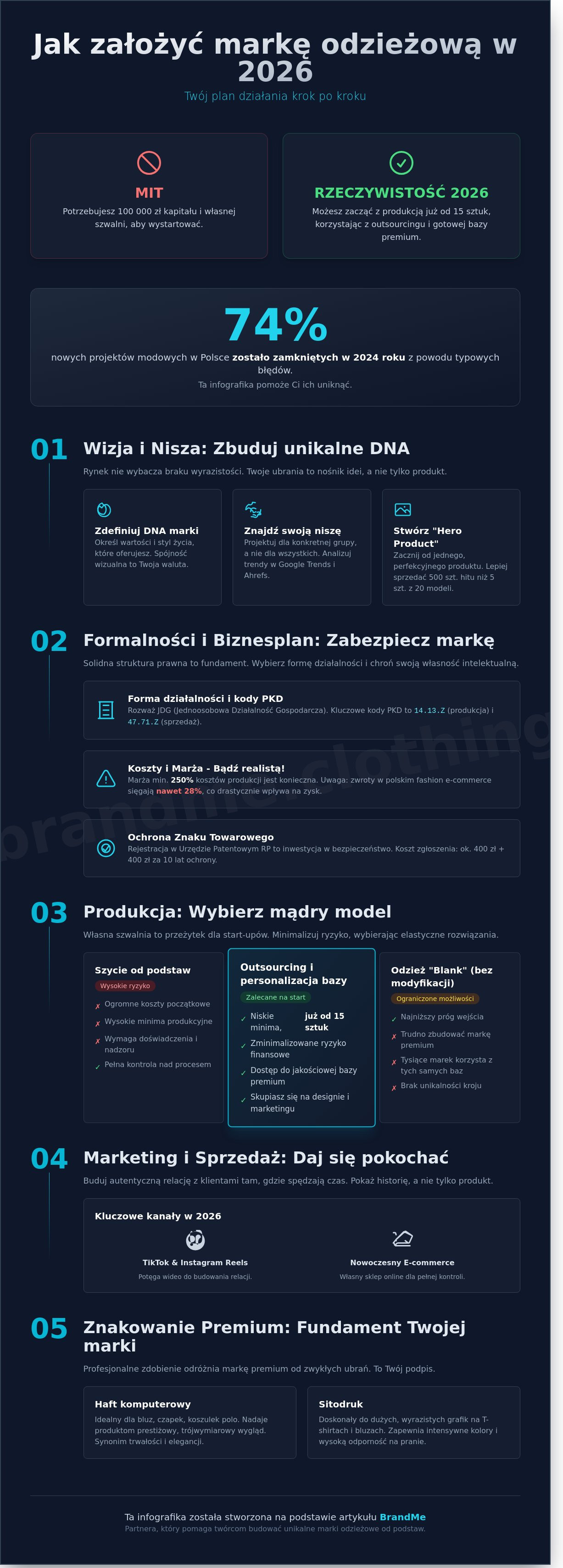
Did you know that in 2026, owning your own sewing facility is the last thing you'll need to conquer the fashion market? Many people daily search for "how to start a clothing brand" on search engines, fearing that without capital of PLN 100,000, they stand no chance of starting. This is a myth that effectively blocks the creativity of many ambitious creators.
You probably feel that the barrier to entry is too high. High production minimums and a lack of reliable suppliers of quality base garments keep everyone who wants to create more than just clothes awake at night. We understand this. At BrandMe, we help designers build their unique identity from scratch every day. This article is your ready-made action plan. You will learn how to transform your vision into a profitable business and avoid the mistakes that, according to 2024 data, led to the closure of 74% of new fashion projects in Poland.
We will go through the entire process. You will learn the secrets of selecting the highest quality materials and modern branding methods, such as precise computer embroidery. We will show you how to find a partner ready for small-batch production starting from just 15 pieces. It's time to dress your brand for real success.
Key Takeaways
- You will learn how to create a unique brand DNA and precisely define your target group to effectively stand out in the 2026 fashion market.
- You will understand the legal aspects and PKD (Polish Classification of Activities) codes that will explain step-by-step how to start a clothing brand in Poland, choosing the most favorable tax form.
- You will compare the model of in-house production with outsourcing and "blank" apparel, which will allow you to minimize financial risk at the start of your business.
- You will discover how to leverage the power of video on TikTok and Instagram and modern e-commerce platforms to build stable sales and an authentic customer relationship.
- You will learn how to select professional embellishment techniques, such as computer embroidery or screen printing, to give your products the desired premium brand status.
Where to start a clothing brand? Vision and Niche
The fashion market in 2026 does not forgive a lack of distinctiveness. If you are planning how to start a clothing brand, you must understand that clothes are just a vehicle for your idea. Without a unique DNA that differentiates you from the 150,000 other entities registered in the European fashion industry, your project will disappear in the digital noise. Today, success is built on values and a specific identity, not just the product itself.
Forget about designing for everyone. That's the shortest path to financial failure. Focus on a specific problem or aesthetic of a chosen group. When considering what a clothing brand is nowadays, it's worth remembering that it's primarily a promise and a lifestyle. Your visual identity must be consistent at every customer touchpoint. A logo is just the beginning; typography, packaging style, and a distinctive detail that makes the product recognizable without looking at the tag all matter.
Market trend analysis for 2026 indicates fatigue with fast fashion. Customers are looking for authenticity. Instead of copying runways, focus on timeless style seasoned with a modern twist. This will allow you to build a brand that won't expire after one season.
Choosing a market niche and competitor analysis
Finding a gap requires hard data, not just intuition. Use tools like Google Trends, AnswerThePublic, or Ahrefs to check what Poles are actually looking for. Perhaps there's a lack of technical clothing for urban cyclists that looks like a suit? Or clothes made from certified Polish linen for minimalists? A SWOT analysis will help you assess whether your flexibility and personalization can beat the mass production of giants. Focus on what they can't do: building a close relationship with the customer.
Creating a mood board and concept for the first collection
A mood board is your roadmap, protecting against design chaos. Gather images, material textures, and color palettes that convey the brand's emotions. In 2026, the most effective strategy is to start with a "hero product" instead of a broad assortment. Focusing on one perfectly refined item, like an ideal oversized hoodie or a technical coat, builds authority and simplifies budget management. When planning how to start a clothing brand, remember: it's better to sell 500 pieces of one hit than 5 pieces of 20 different models.
- Define your DNA: What makes you different?
- Choose your group: Design for someone who has a name and specific needs.
- Build visually: Consistency is your strongest currency.
Business Plan and Formalities: How to Legally Start a Clothing Company
The foundation of success is a solid legal structure. When considering how to start a clothing brand, you must choose a tax form that suits the scale of your plans. Unregistered activity is a great testing ground if your income does not exceed 75% of the minimum wage (approx. PLN 3,400 in 2026). However, most creators choose a Sole Proprietorship (JDG) due to the simplicity of accounting. When registering with CEIDG, the PKD codes are crucial: 14.13.Z for clothing manufacturing and 47.71.Z for retail sales.
When analyzing how to start a clothing brand, you cannot overlook intellectual property protection. Registering a trademark with the Polish Patent Office guarantees the security of your brand. The cost of registration in one class is approximately PLN 400, and protection for 10 years costs an additional PLN 400. This is an investment that protects you from name theft and builds company value. How to start a clothing business step-by-step shows that legal planning is not just bureaucracy, but a defense strategy for your capital.
Costs of running a clothing brand in 2026
The startup budget for 2026 must be precise. Preparing one professional pattern and prototype costs between PLN 600 and PLN 2000. Marketing will initially consume at least PLN 3500 per month. Remember about the margin. It should be at least 250% of the production costs to cover logistics and returns. In Polish e-commerce, the return rate in the fashion industry often reaches 28%, which drastically affects financial liquidity. Hidden costs, such as ecological packaging or payment system commissions (approx. 1.5-2%), can reduce profit by another few percent.
Legal aspects and textile certification
The label is your proof of honesty. It must contain the raw material composition, country of origin, and care instructions in Polish. In 2026, OEKO-TEX Standard 100 certification is becoming a market requirement. Customers are looking for safety and ecology, and this mark confirms the absence of harmful substances in your products. If you plan original prints, ensure you have agreements for the transfer of copyrights with graphic designers. Only then do you have full control over what you sell. Looking for a base for your designs? Check out our products ready for personalization, which meet the highest quality standards.
Clothing Production: Sewing from Scratch or Premium Base Personalization?
For many aspiring entrepreneurs, owning a sewing facility is a symbol of prestige. In reality, however, it is a huge logistical and financial challenge. The cost of equipping a small workshop with professional machines and hiring staff in 2026 can exceed PLN 250,000 to start. Outsourcing production to external sewing facilities reduces these costs, but still requires ordering large quantities, often from 100 to 300 pieces of a single color and size. For those just exploring how to start a clothing brand, the "blank apparel" model proves to be the safest solution.
This model involves using ready-made premium apparel as a base for your own prints or embroidery. This eliminates the risk of structural errors and allows you to focus on marketing. However, before ordering the first batch of goods, make sure you meet all the official requirements for company registration in Poland. Operating without proper entries in the CEIDG or KRS can result in severe financial penalties at the very beginning of your business.
You can tell the quality of the fabric by three parameters. Grammage is fundamental; a premium T-shirt should have a minimum of 180-200 g/m2, and a hoodie over 300 g/m2. The weave must be dense and even, which is best seen against the light. Silicone finishing or enzyming makes the material soft and prevents pilling after the first wash. Always order samples. Test them aggressively: wash at 40 degrees, spin at high RPMs, and check if the side seams don't twist.
Advantages of personalizing high-quality ready-made apparel
Speed is your biggest advantage. By choosing ready-made bases, you will shorten the time-to-market from six months to just two weeks. You don't have to tie up capital in hundreds of pieces of each size. You can order goods in batches, responding to real customer interest. You benefit from cuts that have been tested on thousands of figures, which minimizes the number of returns in your online store.
How to choose a clothing supplier for your brand?
Look for a partner who guarantees consistency. Nothing destroys brand trust like a different shade of "the same" black hoodie in the next delivery. Check stock availability and certificates such as OEKO-TEX, which confirm textile safety. A professional supplier is the foundation on which you build your credibility. Check out our all products that can become the base of your brand and provide the quality that modern consumers expect. Remember that in 2026, customers buy not only design, but above all, product durability.
Marketing and Sales: How to Make Customers Love Your Clothes
The e-commerce market in 2026 doesn't forgive mediocrity. If you're analyzing how to start a clothing brand that will succeed, you must bet on your own store on the Shopify or Shoper platform. These give you full control over the customer's purchase path, while marketplaces like Allegro or Zalando charge commissions often reaching 15 to 25 percent of the product price. Your main outreach tool will be social media, but forget about static photos. TikTok and Instagram Reels have dominated sales. Short, authentic videos showing seam details or how the material drapes build trust faster than any graphic advertisement.
Collaborations with influencers in 2026 are based on niches. Instead of targeting celebrities, choose creators with 5,000 to 15,000 engaged followers. Such micro-influencers generate up to 60 percent higher conversion compared to large accounts because their recommendation is treated like advice from a friend. From day one, also build your own mailing list. A welcome offer of PLN 20 for first purchases will allow you to collect data that is resistant to changes in social media algorithms.
Product photos and storytelling
Packshots on a white background are an absolute minimum, but sales are generated by lifestyle. An image session must show the world your customer lives in. Tell a story through details: close-ups of precise embroidery, the texture of organic cotton, or unique buttons. Product descriptions cannot be just a list of features. Instead of writing "hoodie," write about the comfort during cool evenings and the durability that will allow you to enjoy the product for many seasons. This builds a brand identity that customers want to be a part of.
Logistics and customer service in the fashion industry
Fast 24-hour shipping has become a market standard. To prevent returns from destroying your margin, invest in accurate size charts and video presentations of figures. Ecology is a requirement in 2026: 70 percent of Polish consumers declare that they choose brands using recycled, plastic-free packaging. Every package is an opportunity to create a smile. Adding a personalized thank you or garment care instructions makes customers more likely to return to you.
Branding Techniques as the Foundation of a Premium Brand with BrandMe
Choosing an embellishment technique is the moment your design gains real market value. It is the details that determine whether a customer perceives a product as luxurious or as a cheap promotional gadget. Computer embroidery remains the most prestigious method. We use it wherever texture and the convexity of the logo matter. The dense weave of the threads makes the branding virtually indestructible. For large runs exceeding 50 pieces of a single design, screen printing becomes unrivaled. It guarantees the lowest unit cost while maintaining saturated colors. If your project contains complex tonal transitions or multi-color graphics in small quantities, DTF (Direct to Film) technology will be a bullseye. It allows for precise reproduction of 100% of the graphic design details.
Remember, the devil is in the details. Custom jacquard labels or elegant patches can increase the perceived value of a garment by 25 to 40 percent. BrandMe supports young creators in the personalization process, offering comprehensive advice on selecting threads and dyes. When planning how to start a clothing brand, you must treat branding as an integral part of the design, not just an add-on at the very end of production.
Choosing an embellishment method for the type of assortment
Branding hoodies offers enormous scope for creativity. A logo placed on the back of the neck, sleeve, or centrally on the chest is standard, but it's also worth considering embroidery on the edge of the hood. This is a detail that will distinguish you from the competition. For polo shirts, it's best to stick to classics. Discreet embroidery 8 centimeters wide on the left chest builds a premium image. Printed T-shirts, however, require the most attention to durability. The screen printing inks we use withstand over 60 wash cycles without cracking or color loss, which is crucial for building trust in your brand.
Collaboration with a professional contractor
Effective production starts with correctly prepared files. Your graphics must be saved in a vector format, such as PDF, AI, or SVG. This allows the pattern to be scaled without losing edge sharpness. If you are just starting out and want to test the market, BrandMe enables production from a single piece. This is an ideal way to create an MVP (Minimum Viable Product) of your collection without freezing capital in unsold inventory. Use the experience of Unicat and BrandMe to avoid errors during the prototyping phase. You can immediately check our range of clothing bases and choose products that best reflect the character of your vision. Professional technical support at the start saves time and ensures that your brand will look professional from the first order sent. Knowing how to start a clothing brand combines practical craftsmanship with modern technology here.
Turn your vision into a profitable business today
The fashion market in 2026 does not forgive mediocrity, so focus on authenticity and uncompromising quality. The key to success is a precisely defined niche and a business model that combines creativity with thorough cost analysis. Knowing how to start a clothing brand is the foundation on which you will build a loyal community around your products.
Success in the fashion industry depends on details and trusted partners. With BrandMe, you gain access to certified premium fabrics and expert support from the Polish company Unicat. The biggest barrier to entry is often capital, which is why we offer order fulfillment from just 1 piece. This allows you to test the market without freezing cash in unsold inventory. Your brand deserves a setting that will highlight its unique character from the very first stitch.
Start building your brand with professional BrandMe apparel and create a collection that will set new quality standards in your industry. It's time to dress your ideas for real success.
Frequently Asked Questions about Starting a Clothing Brand
How much money do you need to start a clothing brand?
To start a clothing brand, you need between PLN 5,000 and even PLN 50,000, depending on the chosen business model. PLN 5,000 is enough for a print-on-demand model or small-scale dropshipping. If you plan your own collection consisting of 3-5 original designs, prepare a budget of around PLN 20,000. Remember that 35% of these funds should be allocated to marketing and professional photo shoots, because without online visibility, the product will not reach customers.
Do I need to know how to design clothes to start my own brand?
You don't need a fashion design background to successfully know how to start a clothing brand and achieve market success. Statistics show that 70% of new brand owners use external clothing designers or ready-made templates. Your key task is to create a cohesive vision and select appropriate materials. Entrust the technical preparation of patterns and size grading to professionals, which will ensure consistency and high-quality finishing of every collection item.
How to find a reliable sewing factory or clothing supplier?
You can find a reliable sewing factory most quickly on industry portals such as Fashion-Biznes or by visiting textile fairs in Łódź. Before signing a permanent contract, order the production of 3 prototypes to check the precision of the stitching and the subcontractor's punctuality. Be sure to check if the sewing factory has an Oeko-Tex Standard 100 certificate. In 2026, this is an absolute requirement for 85% of conscious consumers who are looking for products that are safe for the skin and the environment.
What is "blank" clothing and is it worth building a brand on it?
Blank clothing refers to ready-made, high-quality garments without manufacturer's tags, which are factory-prepared for personalization and branding. Choosing this route shortens the time to market by nearly 60% and eliminates the risk of costly design errors during the prototyping phase. It's an ideal solution for a start-up. It allows you to focus on unique print design and building brand identity without having to invest in expensive tailoring forms and your own production from scratch.
What are the most important fashion trends for 2026?
In 2026, the market will be dominated by circular fashion and the use of intelligent recycled materials. Data indicates a 45% increase in interest in clothing with GRS (Global Recycled Standard) certification compared to previous years. Customers are looking for multi-functional clothing that combines street style with the technical properties of materials. Another very strong trend is ultra-personalization, which means offering short, limited series of products that emphasize the individuality of the recipient.
Is selling clothes online still profitable?
Selling clothes online is still very profitable, and the Polish e-commerce market in the fashion industry is growing steadily by 8% annually. Currently, over 65% of Poles regularly buy clothes online, most often using mobile devices. The key to high profits is finding a specific niche and authentic communication on social media. This allows for a margin of 40-60% with appropriate optimization of production and logistics costs.
Which printing techniques are the most durable?
The highest durability and resistance to mechanical damage are guaranteed by computer embroidery and traditional screen printing. Embroidery withstands over 50 wash cycles without any damage, which builds a prestigious image of a premium brand and increases the perceived value of the product. In the case of complex, multi-colored graphics, screen printing provides deep color saturation and resistance to cracking. This is crucial for maintaining product quality for many years of intensive use by the customer.
Can I order just one piece of clothing with my own logo for a trial?
Yes, modern technologies such as DTF digital printing allow you to order even a single prototype with your own logo. The cost of such a sample is usually 150-300% higher than the unit price in wholesale, but it is a necessary investment before approving a larger production batch. This allows you to check in practice how your graphic looks on the selected material and whether the colors exactly match your design assumptions.