

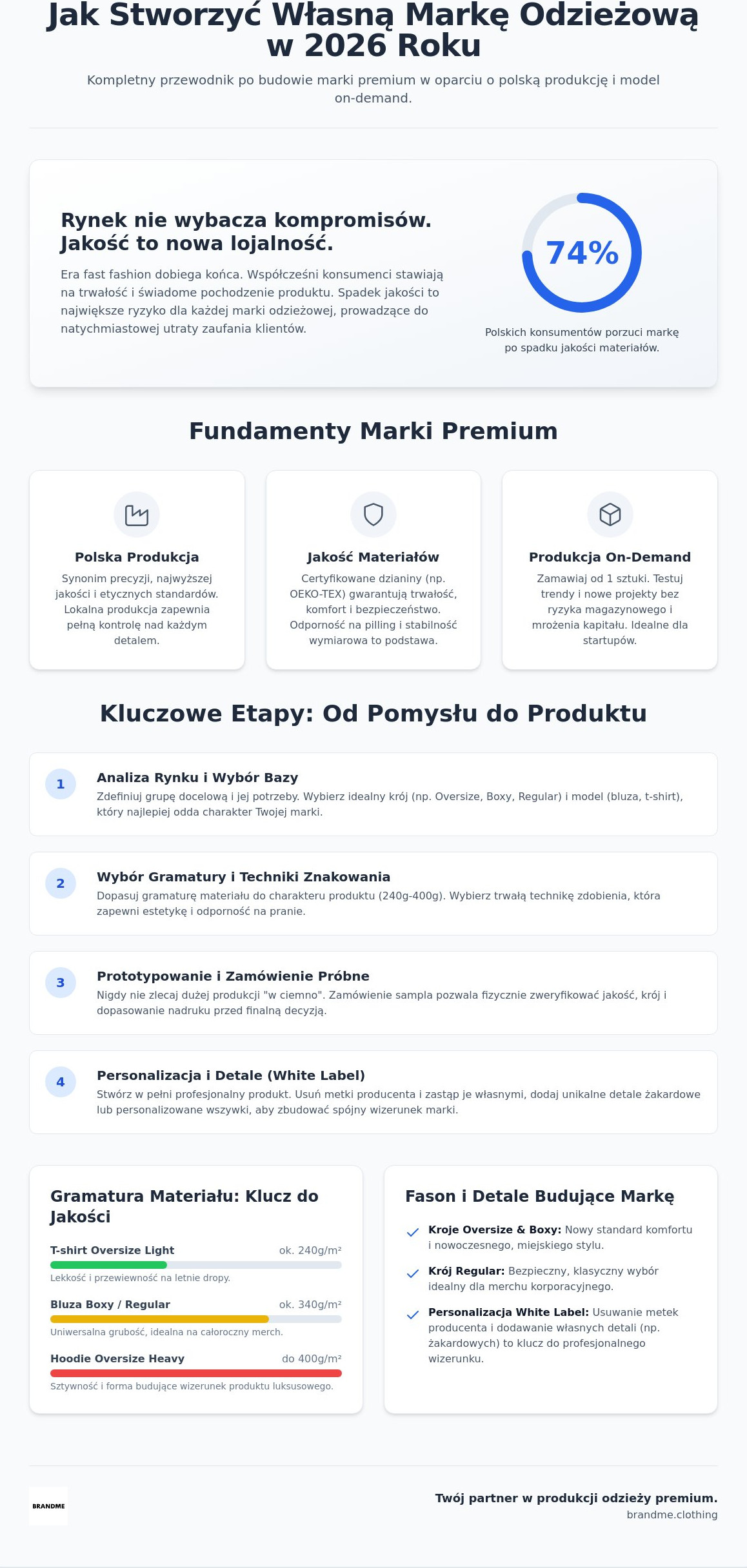
As many as 74% of Polish consumers declare that they will unhesitatingly abandon their favourite brand if the quality of its materials drops in favour of mass production. In 2026, the market no longer tolerates any compromises, and success depends on the speed of testing trends on premium bases without unnecessary inventory risk. This complete guide to creating your own clothing brand will show you how to turn your vision into a professional business that builds customer loyalty from the very first touch of the fabric.
You are probably worried that traditional sewing factories will impose prohibitive production minimums on you, and a lack of technical knowledge will result in a batch of clothes that lose their shape after the first wash. These are real challenges that often block ambitious projects at the outset. However, I promise that from this text you will learn how to build a profitable premium brand step by step, focusing on Polish production and a safe on-demand model. We will analyse every stage of the process, from selecting durable embellishment techniques to optimising logistics, to ensure your start is professional and free from costly mistakes.
Key Takeaways
- You will understand why local production in Poland has become the new standard for premium quality and how to leverage the conscious consumption trend to build a sustainable market advantage.
- This complete guide to creating your own clothing brand will show you how to safely test new designs by ordering clothing from as little as one piece without freezing capital.
- You will learn how to precisely select technical parameters, such as material weight (from 240g to 400g) and marking techniques, to ensure premium aesthetics and durability for your products.
- You will discover the practical aspects of customisation in the White Label model, including techniques for removing manufacturer tags and designing your own jacquard details that build a professional brand image.
Creating a clothing brand in 2026: Why quality trumps quantity?
In 2026, the fashion industry is undergoing a fundamental change. The era of mindless consumerism and fast fashion is giving way to conscious choices, where product durability becomes the highest value. Today's definition of a fashion brand is much more than just a catchy logo printed on a cheap, imported T-shirt. It is a promise of quality that the customer verifies at the first contact with the material. Polish production has become, in this context, a synonym for luxury and precision, setting standards for premium brands throughout Europe. This complete guide to creating your own clothing brand will show you that the key to success is now a strategy of short runs and so-called drops. This is the safest business model for startups, allowing them to build desire without the risk of unsold goods accumulating in the warehouse.
Market analysis and niche selection
Success begins with precisely defining who you are designing for. Today's customer is looking for authenticity and safety, which is why certified OEKO-TEX fabrics are no longer an extra, but a necessity. You need to find a target group that appreciates attention to detail and the origin of raw materials. Regardless of whether your goal is niche streetwear, professional event merch, or premium corporate clothing, you must first verify your idea. Instead of investing in thousands of pieces, it is worth starting with a clothing production model from 1 piece. This allows for a real assessment of market interest and refinement of details before a larger launch, which minimises financial risk at the start.
Building brand value through product
Quality is not just a word in the product description. It refers to physical characteristics of clothing, such as dimensional stability and resistance to pilling. According to data from the Brandme report from March 2026, as many as 74% of Polish consumers declare that they will abandon their favourite brand if they notice a drop in the quality of the fabrics used in favour of mass production. That is why transparency of the production process and focusing on high-quality bases is currently the best marketing strategy. Building loyalty begins where the disposability of clothes ends. A good hooded sweatshirt or Premium T-shirt must maintain its shape and colour depth even after many washing cycles. This directly translates into the image of your business as a trustworthy partner who does not compromise on performance standards.
Key stages of building a collection: From concept to finished product
Turning a vision into a physical product requires a precise plan. This process is not a linear path, but a series of conscious technical decisions that determine market success. This complete guide to creating your own clothing brand emphasises eliminating errors already at the design stage. Instead of guessing what customers need, it is worth focusing on proven construction solutions and modern marking technologies. The entire process is completed in five key steps: from base selection, through graphic design, to the final launch and rebranding. Each of these stages must be consistent with the premium values that your brand declares.
Choosing the ideal cut and model
In 2026, oversized and boxy cuts ceased to be a trend and became the new standard. Customers are looking for clothes that combine aesthetics with maximum comfort. The Hoodie Oversize Heavy is an absolute bestseller, which thanks to its stiffness and high grammage perfectly retains its shape, building the image of a luxurious product. When planning summer drops, it is worth using the T-shirt Oversize Light base. It is lighter, breathable, and at the same time retains a modern, loose fit. The choice between Boxy Premium and Regular fit depends on the nature of your target group. The former emphasises a modern, urban character, while Regular remains a safe choice for classic corporate merch.
The role of prototyping and sample orders
Never commission mass production without prior verification of a physical sample. Ordering a sample is the only way to realistically check how the selected grammage fits the figure and how the print reacts to washing. If you are looking for additional business tips, check out this complete guide to starting a clothing company, which will help you systematise your knowledge of brand management. When testing a hoodie before a larger order, pay attention to the colour reproduction in DTF and DTG techniques. A trial piece will allow you to assess the colour saturation and elasticity of the print. This will help you avoid complaints and ensure that the final product meets your quality expectations.
After the sample is approved, we move on to customisation. This is the moment when a no-name product becomes part of your brand. Removing manufacturer tags and replacing them with your own jacquard labels is an absolute must in the premium segment. In addition, custom hangtags and ecological packaging create the so-called unboxing experience. Remember that the customer builds their first impression even before putting on the clothes. If you want to be sure that every detail is perfected, it is worth consulting your project with experts who will help you choose the best finishing techniques for your first collection.
Choosing the base and marking technique – the foundations of your brand's durability
The foundation of a premium brand is a product that stands on its own after being taken out of the packaging and after the tenth wash. In the clothing industry, quality is measurable. This complete guide to creating your own clothing brand focuses on the technical aspects that determine whether a customer will return for another drop. The key parameter is grammage. While standard market T-shirts hover around 150-180g, a Premium T-shirt should start from 240g. Such weave density ensures appropriate stiffness and a luxurious feel. In the case of sweatshirts, the high-end segment standard is 400g. Such material not only better insulates heat, but above all builds the desired, heavy silhouette of the garment.
Premium materials: Polish knitwear vs. import
Choosing Polish knitwear is not only economic patriotism, it is pure quality calculation. Polish materials undergo enzyme and stabilization processes. Enzyming removes protruding fibres, preventing pilling, and stabilization ensures that your hoodie will not shrink by two sizes after its first contact with water. The difference between combed and standard cotton is also important. The former is much smoother and more durable, which directly affects the sharpness of prints. Having the OEKO-TEX Standard 100 certificate is today the strongest sales argument. It confirms that the product is free from harmful substances, which for 2026 is an absolute requirement of the conscious consumer.
Matching the marking technique to the design
The marking technique must be chosen according to the quantity and complexity of the graphics. Screen printing remains unrivalled for large series, for example, when creating concert merch in hundreds of pieces. This method is extremely durable and cost-effective for high volumes. However, if your collection is based on complex tonal transitions or photos, digital DTG or flexible DTF printing will be a better choice. These methods allow for the production of single pieces, which perfectly fits the market testing strategy.
For designs that are meant to exude luxury, computer embroidery on clothing is the best solution. This technique is practically indestructible, allowing for a 3D effect and building the highest product margin. Remember that every technical choice should be part of a broader business plan. If you are just putting together your strategy, it is worth checking out these 10 steps to starting a business, which will help you systematise the formal aspects of running a business. Appropriately matching the embellishment method to a high-grammage base is the easiest way to create clothing that will last for years, building the authentic value of your brand.
Detail customisation and White Label model: How to create professional merch?
Your own brand is not just a graphic on the chest. It is the sum of small details that together build a professional image and customer trust. This complete guide to creating your own clothing brand would not be complete without discussing the White Label model. It allows you to create an original product based on ready-made, high-quality cuts. The key here is rebranding, a process in which we remove manufacturer tags and replace them with your own markings. Thanks to this, the product looks as if it was designed and sewn exclusively for you from start to finish. In 2026, premium customers are looking for consistency, and the White Label model is the shortest way to achieve it without investing millions in machinery.
White Label service in practice
Rebranding at Brandme is a comprehensive service. We don't just limit ourselves to printing. Our team takes care of precisely unpicking technical labels and sewing in personalised jacquard labels. We cooperate with the best suppliers of tailoring accessories, such as TAWO, to ensure that your labels are durable, aesthetic and do not irritate the skin. Remember that personalised clothing labels are not only a legal requirement regarding material composition. Above all, they are a carrier of your logo, which the customer sees every time they put on the garment. In the White Label model, you can also add your own cardboard tags, i.e. hangtags. They are an ideal place to tell a short brand story or place a QR code leading to your social media.
Logistics and preparation for sale
Professional merch requires appropriate logistical support. Each product should be carefully ironed and folded before shipping. At Brandme, we take care of packaging, which means that clothes reach the customer in aesthetic, protective packaging. If you plan to scale your business, it is worth considering the B2B Dropshipping model. It allows orders to be shipped directly from our production to your end customer. This optimisation shortens delivery time and completely eliminates the need for your own warehouse. Precise product preparation and attention to detail during packaging drastically minimise the number of returns, building customer loyalty from the first unboxing. If you want to create a product from scratch, using our full technical facilities, check out the capabilities of our sewing factory and start building your brand on solid foundations.
Brandme as your business partner: Clothing production without inventory risk
Choosing a production partner is the last, but most important, step in building your brand. In 2026, success in the fashion industry no longer requires huge upfront investments or renting large warehouse spaces. Brandme redefines the rules of the game by offering an on-demand production model. This complete guide to creating your own clothing brand emphasizes the flexibility provided by the ability to order clothing from as little as one piece. This allows for quick testing of new designs and drops without tying up capital in unsold goods. If a particular design is met with enthusiasm from your community, you can seamlessly transition to larger runs while maintaining full financial liquidity.
Why choose Brandme for production in Poland?
Our background includes 14 years of experience from the Unicat sewing factory, which translates into unique know-how in the premium segment. The entire production process takes place in Krzemienica, giving us full control over every stage of clothing creation. By choosing local production, you completely eliminate the risks associated with long sea transport or complex customs procedures from Asia. It's simple. Your brand gains agility because it usually takes only a few days from visualisation approval to the shipment of finished products. For customers seeking uniqueness, we offer the possibility of production from scratch in a Polish sewing factory, where we collaboratively refine every design detail.
Business model for creators and agencies
Cooperation with us is an ideal solution for marketing and event agencies that need limited merch of the highest standard. Brandme becomes an external production department for your company. You don't need to be an expert in the technical aspects of fabrics or embroidery machine settings. Our experts will guide you through the entire process, advising on the choice of grammage and marking techniques so that the final product is consistent with your visual identity. We serve both clothing brands building permanent collections and online creators focusing on quick, thematic drops.
Building your own clothing brand is a process that, with the right partner, becomes safe and predictable. Focus on vision creation and marketing, and leave the technical and logistical matters to us. We are ready to be the foundation of your success. Contact us for a free quote for your first project. Together, we will create clothing that not only looks good but, most importantly, builds real business value. This complete guide to creating your own clothing brand is just the beginning of your journey. It's time to turn theory into a finished premium product.
Time for your premium debut
Building your own brand in 2026 is a process that requires combining artistic vision with technical precision. The most important conclusion from market analysis is that premium quality, based on OEKO-TEX certified fabrics and Polish tailoring, has become an absolute requirement for conscious consumers. Thanks to the flexible one-piece production model, you can safely test your most daring designs without freezing capital, which completely changes the game for startups and merch creators. This is an opportunity to build a business in a sustainable and agile way, avoiding the risk of overproduction.
This complete guide to creating your own clothing brand has shown you how to successfully move from the idea phase to a finished, professional product with full White Label rebranding. Leveraging our 14 years of industry experience, you gain a partner who handles all the logistics and precise production, allowing you to focus solely on building your brand's identity. Don't wait for the perfect moment, because it is created through action and consistently striving for quality that will stand on its own with every customer interaction.
Start building your brand with Brandme – Check out our offer for clothing brands. Your vision deserves top-class treatment and the support of experts who do not compromise on manufacturing standards.
Frequently Asked Questions (FAQ)
Can I launch a clothing brand by ordering just one piece to start?
Yes, at Brandme you can order clothing starting from just one piece, which allows for a safe start without freezing capital. This is an ideal solution for creators who want to test a specific graphic design or cut before commissioning a larger batch. This way, you check real market interest without inventory risk and costly excess stock.
How much does it cost to produce the first collection of clothes under my own brand?
The cost of starting depends on the chosen base and embellishment technique, but the on-demand model allows for maximum optimization of initial expenses. Instead of investing in hundreds of pieces, you only pay for the products you actually sell or order as prototypes. This makes the market entry barrier much lower than in the traditional sewing model, which requires high production minimums.
Which printing techniques are the most durable and do not wash out after a few washes?
Computer embroidery and screen printing offer the highest durability, being virtually indestructible with standard use. For smaller runs and complex graphics, the DTF technique works great. It is flexible and highly resistant to washing out and cracking, provided you maintain appropriate garment care parameters, such as washing at low temperatures.
Do I need my own patterns, or can I use ready-made premium bases?
You don't need to have your own patterns, as you can use our ready-made premium bases with boxy and oversized cuts. They are developed according to current trends and made from high-quality Polish knit fabrics with grammages up to 400g. However, if your vision requires a unique construction, we also offer custom sewing from scratch according to your technical specifications in our sewing workshop.
What formalities do I need to complete to legally sell clothes with my own logo?
The basic requirement is business registration, which in Poland can be done free of charge via the CEIDG portal. New entrepreneurs can take advantage of the "Start-up Relief" for the first six months, paying only the health insurance contribution. Remember also about tax obligations and preparing terms and conditions for your online store, which must comply with current EU directives on consumer rights and returns.
What is the difference between White Label production and standard promotional clothing?
White Label production focuses on complete product rebranding, including removing manufacturer tags and sewing in your own jacquard labels. Promotional clothing usually consists of ready-made products with a printed logo, while White Label allows you to create a premium brand image. We use heavier fabrics, enzyme finishing processes, and precise finishes that you won't find in standard promotional catalogs.
How long does production and delivery of an on-demand order take?
Order fulfillment in the on-demand model usually takes several working days from the moment the visualization is approved. Because all production takes place in Poland, you avoid waiting weeks for deliveries from abroad and supply chain problems. The speed of action allows you to efficiently react to trends and the needs of your customers without the need for inventory.
Is Polish clothing production profitable for small batches?
Yes, Polish production is profitable even for small series, as it guarantees high quality and minimizes the number of costly returns. This complete guide to creating your own clothing brand shows that savings on transport and the lack of customs duties offset higher unit costs. Premium customers are more likely to pay more for a local product that retains durability and style for years.

Artykuł autorstwa
Konrad Nosek
Przedsiębiorca i ekspert w zakresie produkcji odzieży oraz budowania marek odzieżowych. Od ponad 14 lat rozwija szwalnię Unicat, realizując kompleksową produkcję dla polskich i zagranicznych marek, w tym m.in. Dzik, OSHEE i Relab. Specjalizuje się w projektowaniu procesów produkcyjnych, doborze materiałów, znakowaniu odzieży oraz wdrażaniu kolekcji od pomysłu do gotowego produktu. Jest również twórcą marki BrandMe, która umożliwia markom, firmom i twórcom zamawianie wysokiej jakości odzieży z pełną personalizacją - nawet od jednej sztuki. W swoich artykułach dzieli się praktyczną wiedzą z zakresu produkcji odzieży, budowania własnej marki, technologii znakowania oraz trendów w branży fashion i merch.