

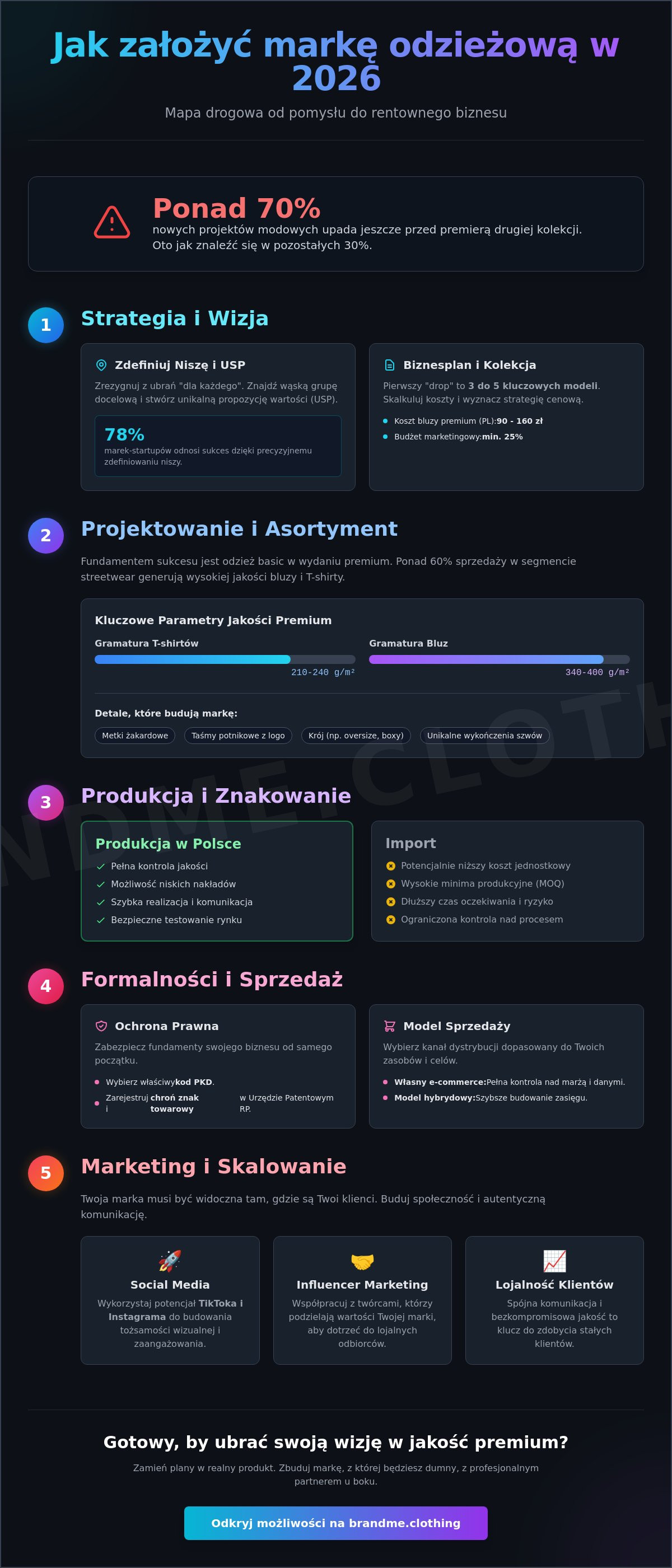
Did you know that over 70% of new fashion projects in Poland cease operations even before the launch of their second collection because they got stuck in the dead zone between vision and production? You might have a great idea and a unique style, but a lack of knowledge about printing techniques or difficulties in finding a sewing factory that accepts low-volume orders can effectively extinguish your enthusiasm. It's natural to fear risk when every zloty invested in goods must yield a tangible return. An appropriate visual identity is not just about aesthetics; it's the foundation of your market credibility.
In this article, you will learn exactly how to start your own clothing brand in 2026, turning your creativity into a professional business based on uncompromising quality. We will show you how to imbue your brand with values that will stand the test of time and earn customer loyalty. You will receive a concrete roadmap from us, enabling you to understand the differences between marking methods and find a production partner who understands the needs of a modern entrepreneur. It's time to stop planning and start building a brand you can truly be proud of.
Key Takeaways
- Discover why, in 2026, the key to success is finding a narrow niche and defining your Unique Selling Proposition (USP), rather than creating clothes "for everyone."
- You will understand how to start your own clothing brand based on premium products, by choosing the appropriate fabric weight and composition for your flagship hoodies and T-shirts.
- Learn the differences between production in Poland and import, and discover how low-volume collections allow you to safely test the market without the risk of excess inventory.
- Uncover the necessary formal steps, from selecting the correct PKD code to effectively protecting your trademark at the Polish Patent Office.
- Learn how to leverage the potential of TikTok and Instagram, and collaborations with influencers, to build a strong brand identity and reach loyal customers.
From Vision to Strategy: How to Define Your Clothing Brand's Character?
Dreaming of your own brand? In 2026, the market does not forgive a lack of precision. Designing "for everyone" is the shortest path to business failure. Currently, the global clothing industry has evolved towards micro-communities and hyper-targeting. Your brand must solve a specific problem or manifest unique values to survive its first year of operation. Before you start checking how to start your own clothing brand, define your Unique Selling Proposition (USP). This is your foundation. It could be an innovative, breathable material, a system of interchangeable elements in hoodies, or certified organic cotton from Polish farms. In 2026, customers are looking for authenticity. An analysis of 1200 new startup brands shows that 78% of them succeed by precisely defining a niche, rather than competing with fast fashion giants. Your target audience is not just a demographic statistic. They are real people with specific needs. Consider whether your clothes should make life easier for digital nomads or emphasize the status of professionals in the creative industry. A consistent visual identity, from the logo to the aesthetics of your social media feed, must be an extension of this philosophy. A logo is not just a picture. It is a promise of quality that you make to the customer with every purchase.Creating a Mood Board and Collection Concept
Avoid mindlessly copying trends from Pinterest. In 2026, authentic storytelling matters. A mood board should combine textures, architecture, and color palettes that evoke specific emotions in your audience. For the first drop, prepare 3 to 5 key models. This is an optimal number that allows you to present collection coherence without excessive financial risk. Choose a base from our collections and give it a unique character through professional embellishments.
Clothing Brand Business Plan
Cost calculation is your roadmap. The production of one premium hoodie in Poland in 2026 costs between 90 and 160 PLN, depending on the fabric weight and embroidery complexity. Add to this marketing, which should consume at least 25% of your operating budget, and logistics costs. Choose a sales model tailored to your resources. Your own online store gives you full control over the margin and customer data, while a hybrid model (your own store + selected boutiques) allows you to build reach faster. If you are targeting the premium segment, your pricing strategy must be justified by the quality of workmanship and the uniqueness of the design.
Design and Assortment Selection: Where to Begin Building Your Offering?
Designing the first collection is the moment when your artistic vision clashes with market demands. When considering how to start your own clothing brand, you must first define the core of your offering. In 2026, the foundation of most fashion industry successes remains premium basic clothing. Why? Because customers are looking for products that combine universal style with exceptional durability. Market statistics from 2025 show that over 60% of sales in the streetwear segment are generated by high-quality hoodies and T-shirts.
The key to success is understanding technical parameters. Fabric weight directly affects how a garment drapes on the body. For T-shirts, the current premium standard is 210-240g, while heavyweight hoodies should range between 340-400g. Material composition also matters; 100% combed cotton provides softness, but a polyester blend in hoodies can increase their resistance to deformation. Choosing the right cut is another strategic decision. Although regular fit is safe, oversized and boxy styles dominate urban trends, offering users desired comfort and a modern silhouette.
Details build brand identity. Personalization goes beyond the print itself. Custom woven labels, neck tapes with logos, or unique seam finishes are elements that distinguish a professional product from an ordinary gadget. However, before you immerse yourself in the creative process, remember to build solid business foundations. It is worth checking the formalities of starting a business to build your brand on legal and safe principles from the outset.
Most Popular Products for a Start
A hooded sweatshirt is an absolute icon of modern merch and streetwear. It's a year-round product that generates the highest profit margin. A Premium T-shirt, on the other hand, determines customer returnability; if the quality of the cotton withstands a dozen washing cycles without losing color, you will gain a loyal fan. To complement the collection, it's worth considering Polo shirts or classic crewneck sweatshirts, which will attract customers looking for a slightly more subdued, yet modern style.
Preparing Files for Production
Errors in technical specifications are the most common cause of financial losses at the start. Sewing factories and print shops require vector files (.ai, .eps, or .pdf formats), which allow for arbitrary scaling of logos without loss of quality. For raster graphics, a resolution of at least 300 DPI is necessary. When preparing the specification, define the exact distances of prints from seams and the neckline. You can use our full product offer as a base for applying your designs, which greatly simplifies the prototyping process and guarantees consistent quality.
A well-prepared design is half the battle. Check out our ready-to-use apparel bases and see how high-quality materials can elevate the value of your future brand.
Clothing Production and Marking: How to Achieve Premium Quality?
In 2026, the fashion market does not forgive mediocrity. Choosing a production model is a crucial moment that will define the profitability of your business. Importing from Asia, while tempting with low unit prices, involves freezing capital in thousands of units of goods and the risk of 90-day delays in sea transport. For new players, an agile model is the optimal solution. Before investing all your savings, check out Forbes' step-by-step guide, which sheds light on strategic budget planning in this industry.
Low-volume production, covering batches of 20 to 50 units per model, allows for rapid market testing. If a particular style doesn't find buyers within 14 days, you can immediately correct the design without inventory losses. This flexibility is what determines how to start your own clothing brand that will survive its first year of operation. Premium quality, however, is built not only by short runs but primarily by rigorous control. This process begins with checking the weight of the raw fabric and ends with precise pressing and eco-friendly packaging of each item.
The conscious consumer in 2026 is looking for confirmation of your promises. The OEKO-TEX Standard 100 certificate is no longer an add-on; it has become a market requirement. It guarantees that the material is free from over 100 harmful chemical substances. Building trust through transparency is the shortest path to customer loyalty, who will be more willing to pay 250 PLN for a safe and durable product than 60 PLN for disposable clothing from a chain store.
Overview of Garment Marking Methods
Computer embroidery is the best choice when your goal is elegance and indestructibility. This method withstands hundreds of washing cycles, retaining color saturation and thread structure. If your design includes complex tonal transitions or fine details, opt for DTF (Direct to Film) technology. It provides photographic print quality while maintaining material flexibility. For brands seeking uniqueness, 3D patches and material applications are ideal solutions. They give clothes a depth that cannot be achieved with classic printing. Choose a base for your designs by browsing the offer at https://www.brandme.clothing/collections/all.
Why is it Worth Sewing in Poland?
Local production is primarily about time. Cooperation with a Polish sewing factory allows for closing the cycle from design to finished product in 21 days, which is unattainable with imports. Direct communication with the technologist eliminates errors at the clothing construction stage. By choosing Polish factories, you promote ethical production and fair wages. This is a strong selling point that resonates with the values of modern consumers. A short supply chain reduces your brand's carbon footprint by almost 70% compared to intercontinental transport. This is concrete knowledge on how to start your own clothing brand with respect for the environment and the local economy.
Formalities and Sales: Launching Your Brand on the Market
Before your first designs reach customers, you need to sort out the legal foundations. Registering your business is the moment when passion turns into business. Choose PKD code 14.13.Z if you plan to produce outerwear, and obligatorily 47.91.Z for online sales. These are crucial steps for anyone analyzing how to start their own clothing brand professionally and in accordance with Polish regulations.
Intellectual property protection is another pillar of your success. Registering a trademark at the Polish Patent Office (UPRP) costs about 450 PLN for one product class, plus fees for the protection period. This is the only way to effectively protect your name and logo from unfair competition. Equally important are the rules for product labeling. Each piece of clothing must have a label with the raw material composition in Polish (e.g., 100% bawełna) and care instructions. Lack of this information exposes you to financial penalties during Trade Inspection controls.
Choosing an e-commerce platform will determine your daily work. In 2026, a mobile-first approach is standard, as over 80% of transactions in the fashion industry occur on smartphones. Opt for SaaS solutions, like Shopify or Polish Shoper, which offer ready integrations with payment systems and courier companies. Focus on website loading speed. Every second of delay reduces conversion by almost 7%.
Logistics and Warehousing
Logistics in the clothing industry is more than just shipping packages. Packaging with your own logo creates the so-called unboxing experience. Statistics show that 65% of customers are more likely to return to a brand that cares about the aesthetics of the shipment. Remember to have an efficient return system. In Polish e-commerce clothing, the average return rate is around 30%, so this process must be maximally simplified for the buyer. You can read about how to start a clothing brand in 2026 and optimize operational costs in our other guides.
Building Customer Relationships
Start by gathering feedback. Give the first 20-30 pieces of the collection to a selected group of testers. Their opinions on the fit and durability of the material after several washes are more valuable than any market report. Build a community through loyalty programs, offering access to pre-launch drops. A consistent image is key, so ensure your team looks impeccable during events or trade shows. Utilizing professional corporate apparel with a logo immediately boosts your brand's credibility in the eyes of investors and early customers.
Ready for the first step? Choose the highest quality base for your collection and start building your brand today.
Marketing and Scaling: How to Make Your Brand Known?
Producing the first collection is only half the battle. The real challenge is to break through the informational noise and reach customers' wallets. In 2026, fashion marketing is based on short video formats. Statistics show that 83% of Gen Z uses TikTok and Instagram as their main source of shopping inspiration. Your brand must be present there not as a seller, but as a creator of engaging content. Show the process of clothing creation, material durability tests, and behind-the-scenes of photo shoots. This builds authenticity that chain stores lack.
Collaboration with influencers remains the fastest way to build reach. The key, however, is matching the creator to the brand's DNA. Instead of targeting celebrities with millions of followers, focus on micro-influencers with 5,000 to 25,000 fans. Such creators generate, on average, 60% higher engagement per post. Their recommendation is treated like advice from a friend, which directly translates into conversion. Educate your audience about quality. Explain why 280g fabric weight is better than standard chain store cotton. Understanding these details is a crucial element of your strategy when analyzing how to start your own clothing brand that will achieve market success.
- Content marketing: Publish articles and posts on how to care for clothes so they last for years.
- Company merchandise: Create high-quality clothing for other companies. This is a stable source of income and free advertising of your production capabilities.
- User Generated Content: Encourage customers to tag your brand in exchange for discounts on future purchases.
"Dressing the Brand" Strategy
Your clothes must become a walking advertisement for your vision. Every seam and every print testifies to your professionalism. Using high-quality promotional clothing allows you to build a consistent brand image from the very first day of operation. Don't be afraid of the "drops" model. Releasing limited editions, available for example only for 72 hours, creates a psychological sense of urgency. Customers are more likely to buy a product they know will soon disappear from the offer forever.
Scaling the Clothing Business
Scaling begins when your customer lifetime value (LTV) exceeds your customer acquisition cost (CAC). Once basic products achieve stable sales of 200-300 units per month, it's time for new categories. Introduce softshell jackets or accessories that will complement your offer. Think globally from the outset. Polish quality of workmanship is valued in Western Europe, and markets such as Germany or the Czech Republic are within reach thanks to cross-border logistics.
Growth requires a stable foundation. A professional clothing manufacturer, like Brandme, then becomes your most important business partner. With expert support, you can focus on strategy and sales, confident that production quality will remain impeccable even with a sharp increase in orders. This is how you build the foundation for how to start your own clothing brand that will become a leader in its niche by 2026.
Time to turn vision into a finished product
The fashion market in 2026 emphasizes authenticity and uncompromising quality. The key to success is combining a unique strategy with precise execution of every detail. You already know how to start your own clothing brand, so it's time to move on to concrete implementation. Focus on building identity, and entrust technical matters to experts who fully understand your vision and the needs of the modern market.
At BrandMe, we eliminate entry barriers that often hinder the creativity of aspiring designers. We enable order fulfillment from as little as 1 piece, allowing you to safely test new designs without the risk of overproduction and unnecessary costs. We guarantee high quality confirmed by fabric certifications, which builds customer loyalty from the first purchase. We provide comprehensive support at every stage: from professional advice on selecting appropriate materials to final, precise labeling with your logo. Your project deserves a premium setting that will effectively distinguish it from the competition.
Create your collection with Brandme – professional clothing production
Your brand starts here. We are waiting for your first project.
Frequently asked questions about starting a clothing brand
How much does it cost to start your own clothing brand initially?
The cost of how to start your own clothing brand begins at approximately PLN 10,000 to PLN 15,000 for the first, limited collection. This budget covers construction preparation, purchase of certified materials, and basic marketing activities on social media. Larger projects with a wide assortment require outlays exceeding PLN 50,000. Precise financial planning helps avoid downtime and ensures production liquidity in key starting months.
Do I need to know how to design clothes to start a brand?
You don't need to know how to design or sew to learn in practice how to start your own clothing brand and succeed. Your main task is to create a strong vision and business strategy, while technical issues are delegated to professional constructors. Collaboration with an experienced sewing factory will transform your ideas into finished, high-quality products. Focus on building a unique brand identity, while experts handle the precise execution of clothing.
What is the minimum order quantity when ordering clothes with a custom logo?
The minimum order quantity in Polish sewing factories is usually from 20 to 50 pieces of one model or color. If you need a smaller batch, you can use ready-made premium clothing bases, where logo personalization is possible from as little as 10 pieces. This is a safe strategy that allows you to test customer interest without freezing a large capital in inventory. This enables you to rotate your assortment faster and react flexibly to changing market trends.
How long does the production process for the first clothing collection take?
The production process for the first clothing collection usually takes 3 to 6 months, from the initial sketch to the finished product. The sewing stage itself takes about 4 weeks, but the preparation of patterns, sewing of prototypes, and material shrinkage tests significantly extend this timeline. When planning a premiere for a specific season in 2026, start design work at least six months in advance. Remember that reputable sewing factories have schedules booked many months ahead.
What materials are best for sewing sweatshirts and t-shirts?
The best sweatshirts are made from knitted fabric with a weight of 280g to 400g, while t-shirts require combed cotton of 180-200g. Higher grammage guarantees product durability and gives it a luxurious character, which customers appreciate upon first contact. The addition of 10% polyester in sweatshirts can increase their resistance to pilling and deformation. Choosing premium materials is the foundation of your credibility, building brand prestige from the first item sold.
Does selling clothes online require owning a warehouse?
Selling clothes online does not require owning your own warehouse if you choose to cooperate with a fulfillment center. In 2026, about 40% of new clothing brands delegate logistics to external partners who handle storage and package shipping. This solution allows you to save on rental costs and focus on marketing. You only pay for genuinely processed orders, which significantly facilitates business scaling in the initial development phase.
What printing methods are the most durable in 2026?
The most durable methods of decorating clothing in 2026 remain traditional screen printing and computer embroidery, resistant to repeated washing. Modern DTF (Direct to Film) technology is also gaining importance, offering photographic print quality while maintaining high flexibility. The choice of a specific technique depends on the complexity of the graphic and the planned quantity of the collection. Investing in professional labeling methods is the simplest way to achieve a premium effect that will distinguish you from the competition.
How to check if a sewing factory is reliable?
The most effective way to check a sewing factory's reliability is to commission a prototype before signing a contract for the entire batch of goods. Ask for a portfolio of completed projects and contact information for at least two regular contractors to gather feedback. A visit to the facility will allow you to assess the condition of the machinery and verify the ethical standards of production, which is crucial for a modern brand. A professional partner is always happy to share technical knowledge and advise on optimizing production processes.