

Does your brand deserve to be associated with cracking prints and pilled fabric after just one month of use? The truth is brutal. Over 60% of corporate apparel loses its aesthetic appeal within a year because low-quality knitwear damages the image of a professional team. The key to success lies in one specific question: what material to choose for hoodies with prints so that the product becomes an authentic marketing tool, not just an unnecessary cost?
We understand your concerns about choosing fabrics that lose their shape after a few washes. It's frustrating when your company logo cracks on cheap cotton. In this comprehensive guide for 2026, we will show you how to precisely select the composition and grammage to ensure your team looks impeccable for years. We will explain the technical differences between 280g and 340g knitwear and create a clear plan for choosing a model that will genuinely increase your business's value. It's time to dress your brand in quality that builds trust from the first glance.
Key Takeaways
- Learn why combed cotton is the foundation of quality and in what situations a polyester blend genuinely enhances the durability of your corporate apparel.
- Discover the key differences between French Terry and brushed fleece to perfectly match the softness and thermal comfort of a hoodie to user needs.
- Understand what material to choose for hoodies with prints and what grammage (from 240g to 400g) best complements modern premium and oversized styles.
- Find out how the smoothness of the weave affects the precision of DTG printing and how to select material thickness to prevent creasing under computer embroidery.
- Check how Polish production and rigorous knitwear selection help build a professional brand image that will last for years of intensive use.
The Foundation of Quality: Types of Materials for Corporate Hoodies
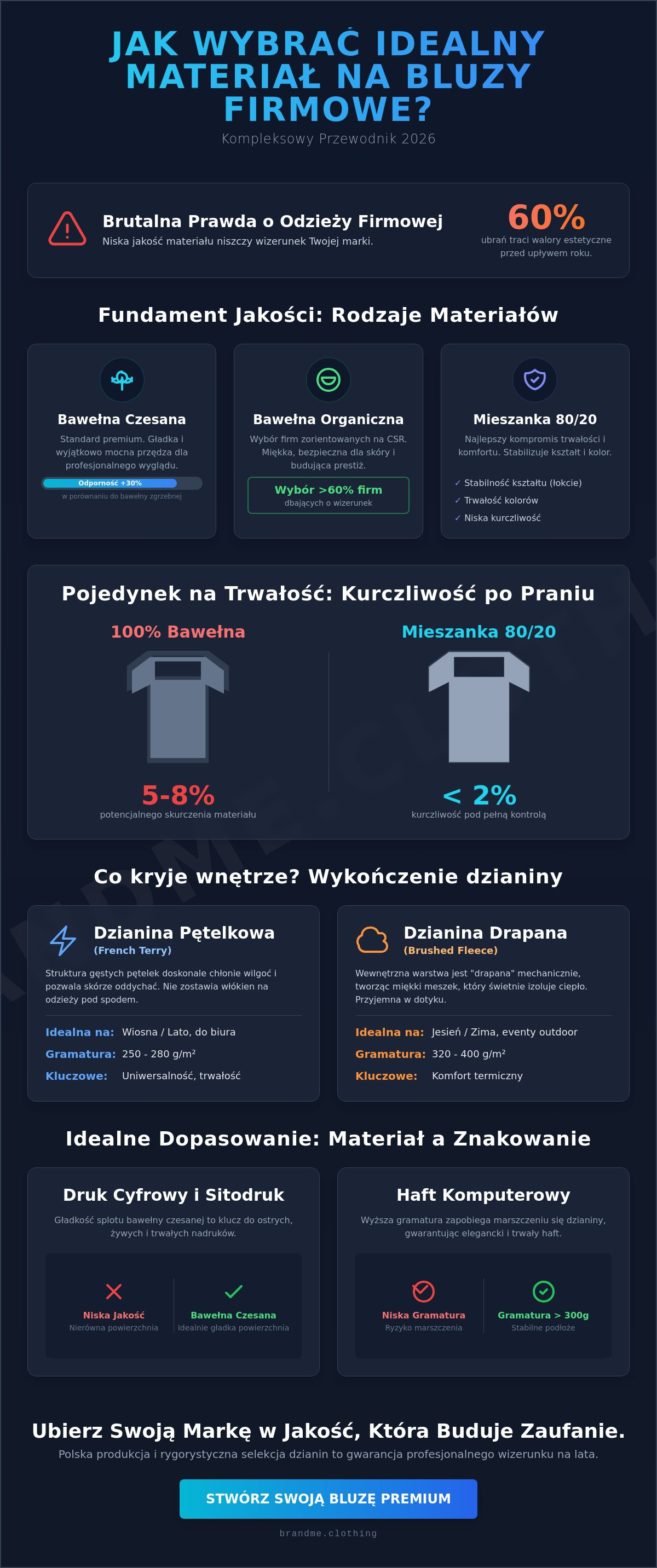
Choosing the right knitwear is a strategic decision that goes beyond aesthetic considerations. In 2026, combed cotton remains the undisputed leader in the premium segment. The combing process removes short fibers and impurities, resulting in a smooth, exceptionally strong yarn. This material is 30% more resistant to abrasion and pilling compared to standard carded cotton. This is crucial information when analyzing what material to choose for hoodies with prints that will ensure your brand maintains a professional appearance for many seasons. Organic cotton is no longer a niche trend. Currently, over 60% of image-conscious companies choose textiles with GOTS certification. This choice builds prestige and genuinely supports CSR strategies. The difference in touch is immediately noticeable. Organic cotton is free from chemical residues, making it safer for employees' skin and softer to the touch.100% Cotton or Polyester Blend?
Pure cotton is synonymous with naturalness and excellent air circulation. It is ideal for office work where thermal comfort is stable. However, in everyday corporate use, an 80/20 blend (80% cotton, 20% polyester) most often wins. Polyester acts as a stabilizer here. It prevents excessive stretching of the material at the elbows and dramatically improves color durability. Most importantly, the addition of synthetic fibers reduces garment shrinkage. A pure cotton hoodie can shrink by as much as 5 to 8 percent after the first wash. In the case of high-quality blends, this rate rarely exceeds 2 percent.Innovative Fibers in Corporate Apparel
Modern textile technology introduces solutions that just a few years ago were reserved for sportswear. The addition of 3-5% elastane (spandex) makes hoodies more elastic and better fitting, without losing their original shape. For companies seeking outdoor solutions, Polar fleece remains an important material, valued for its lightness and insulating properties. In 2026, silicone finishing of knitwear is becoming standard. This refining technique makes the material surface slippery and silky to the touch. It also facilitates the branding process. Digital prints and screen printing look much sharper on such a prepared surface. If you are looking for solutions that combine durability with modern design, check out our offer on all products and choose a base that best reflects the character of your business. Remember, what material to choose for hoodies with printsFrench Terry or Brushed Fleece? Choosing the Hoodie's Interior Finish
The decision of what material to choose for hoodies with prints that will be best for your team starts with the underside of the knitwear. It is the inner layer that determines whether an employee will feel comfortable in an air-conditioned office or get cold during a winter outdoor event. The interior finish also directly affects the grammage and how the garment drapes on the body. Choosing between French Terry and brushed fleece means choosing between lightness and insulation.
The technical quality of the material is crucial for the durability of branding. Professional sewing workshops rely on rigorous testing, assessing dimensional stability and pilling resistance. Detailed Parameters and testing standards for fabrics, such as ASTM D3776, allow precise determination of weave density, which translates into the final appearance of your logo after many washes.
French Terry – Versatility
You can recognize French Terry by its characteristic, dense loops on the reverse side of the fabric. This structure makes the knitwear exceptionally hygroscopic; it absorbs moisture well and allows the skin to breathe. It is an ideal solution for office wear and merchandise prepared for spring/summer seasons. French Terry hoodies typically have a lower grammage, about 250-280 g/m2, making them thinner and better fitting, without adding optical bulk.
- No "shedding" of material: French Terry does not leave small fibers on shirts underneath, which is crucial in business dress codes.
- Durability: The loop structure is less prone to mechanical deformation during intensive use.
- Application: Long-sleeve shirts and light hooded sweatshirts for summer evenings.
Brushed Fleece – Thermal Comfort
Brushed fleece is created by mechanically brushing the loops. This results in a soft, fluffy "nap" that creates an additional insulating layer. This is a classic choice for winter. Such a material is usually thicker (above 300 g/m2) and stiffer, which gives the hoodie a solid, "beefy" look. This is particularly important for manual laborers or technical teams working outdoors in temperatures close to 0°C.
When considering what material to choose for hoodies with prints that will withstand the toughest conditions, opt for cotton-polyester blends in a brushed version. Polyester stabilizes the "fluff" structure inside, preventing it from excessive flattening. Remember to wash such garments inside out at 30-40 degrees; this will maintain the softness of the interior for at least 50 wash cycles. If you are looking for solutions that combine durability with aesthetics, check out our proposals, which we test for intensive business use.
Choosing the finish is not just a matter of aesthetics, but primarily functionality. Brushed fleece provides 20-30% better heat insulation than French Terry of the same weight. In turn, French Terry offers greater freedom of movement and better air circulation, which dynamic teams in modern co-working spaces will appreciate.
Grammage and Composition: How Technical Parameters Affect Durability
Grammage is the parameter that most often raises doubts when ordering personalized apparel. It is simply the weight of a square meter of knit fabric expressed in grams (g/m²). The common belief that higher grammage equals better quality is one of the most frequent misconceptions. What material to choose for hoodies with prints should depend on the garment's purpose, not just its thickness. High grammage means a warmer and heavier product, but it's the weave density and the quality of the cotton itself that determine whether the hoodie will stand the test of time.
Lightweight hoodies with a grammage of 240-270g are an ideal solution for transitional seasons or as a layering piece. They are flexible, take up little space in a bag, and are perfect for indoor events. In contrast, the premium segment and oversized styles rely on grammages of 300-400g. Such garments convey a sense of solidity and luxury, which directly translates into how the brand is perceived by the customer or employee. Thicker material holds its shape better, wrinkles less quickly, and provides high thermal comfort on colder days.
Technical parameters are also crucial for branding aesthetics. A dense, compact knit creates a smooth surface that is an ideal substrate for DTG digital printing or screen printing. On loose weaves, ink can settle unevenly, causing the edges of the logo to become frayed. For computer embroidery, high grammage prevents the material from puckering around the logo, which is a common problem with overly thin fabrics.
Grammage Ranking for Different Applications
- 280g: This is the absolute market standard. Approximately 70% of orders for promotional and workwear are based on this value. It is a compromise between durability and price, ensuring an appropriate logo presentation.
- 320-340g: A clear leap towards the premium segment. The material is substantial and soft to the touch. This is the best choice for gifts for key business partners, where quality is meant to build prestige.
- Above 360g: Heavyweight hoodies. Dominant in streetwear brand collections. They are heavy, very warm, and extremely resistant to deformation even after dozens of washes.
Weave Durability and Pilling
Nothing spoils a company's image like a pilled hoodie after two weeks of use. The phenomenon of pilling, or the formation of small balls on the surface, depends on the length of the cotton fibers and how they are twisted. Anti-pilling knits undergo special finishing processes that smooth the fiber structure. When choosing what material to choose for hoodies with prints that will be best, look for combed or ring-spun cotton. They have a significantly longer lifespan than cheaper open-end cotton.
High weave density means not only fewer pills but also less shrinkage in washing. Dimensional stability is crucial when investing in corporate apparel with a logo of high density. Such a product does not twist at the seams and maintains its original shape for years. Professional apparel should withstand at least 50 wash cycles without visible loss of shape, which is practically impossible with low weave density.
How to Match Material to Marking Method?
The choice of what material to choose for hoodies with prints that will ultimately go into production determines not only wearing comfort but, above all, the durability and aesthetics of your branding. Marking technology places specific physical demands on the knitwear. Ignoring these parameters leads to cracking prints, puckering of the material around embroidery, or color migration, which destroys the visual effect of the design. For DTG (Direct to Garment) digital printing, a smooth surface is crucial. 100% combed or ring-spun cotton works best here. Any protruding polyester fiber can disrupt the print structure, causing a "grainy" effect. Water-based inks used in DTG must penetrate deep into natural fibers to ensure photorealistic quality and a soft hand. If your strategy involves complex graphics with tonal transitions, opt for pure cotton with a dense weave.Best Materials for Computer Embroidery
Embroidery is the most prestigious form of marking, but also the most demanding on the material. The needle strikes the knitwear thousands of times, creating a dense thread weave. To avoid the effect of material pulling around the logo, you must choose a base with a grammage of at least 280g/m2, and preferably 320g/m2 or higher. Substrate stability is a priority here. Thin knitwear under the tension of embroidery threads will start to ripple unpleasantly, which even the best interlining cannot save. Zip-up hoodies are a particular challenge. Embroidery placed too close to the zipper can cause it to bend ("ripple"), so for such models, we recommend smaller, more compact graphic forms or choosing heavy fleece knitwear.Materials Ideal for Screen Printing and DTF
Screen printing is the industry standard for large runs. Although plastisol inks adhere well to cotton-polyester blends, your sewing factory needs to know what composition it's dealing with. For high polyester content (above 35 percent), it is necessary to use inks with a dye migration blocker. Without this, a white logo on a red hoodie could turn pink after a few weeks. DTF (Direct to Film) technology has become a hit in 2026 because it almost completely eliminates the problem of material selection. DTF transfers work excellently on cotton, polyester, and even challenging softshell. This is an ideal solution when you want to maintain visual consistency across different types of apparel within a single collection. Choose garment marking technology for companies tailored to your project to avoid technological mishaps. Your brand deserves quality that will withstand dozens of wash cycles without losing shape or color. Check out our best bases for your projectPremium Hoodie Production with BrandMe: Your Brand at Its Best
Choosing what material for printed hoodies will be best for your project is the foundation upon which we build the final product. At BrandMe, we make no compromises. Every fabric undergoes rigorous selection for weave density and surface smoothness. We use materials with grammage from 280 g/m2 up to 400 g/m2, which provides an ideal base for screen printing, computer embroidery, or DTF technology. This ensures that graphics retain color saturation and precise contours even after 50 wash cycles.
As an experienced apparel manufacturer with our own machinery in Poland, we guarantee full repeatability of production. We control every stage: from cutting fabric rolls, through precise sewing, to final embellishment. Having our own machines allows us to react quickly and eliminate errors that often occur when subcontracting work. Personalization at BrandMe goes beyond simple printing. We offer original finishes, such as:
- Selection of cord color and thickness (cotton, polyester, with metal aglets).
- Production and sewing of woven labels and printed labels (neck-print).
- Use of contrasting reinforcing tapes on the neckline.
- Custom cuts adapted to current streetwear trends (oversize, boxy fit).
Comprehensive Support in Assortment Selection
Our technical consultations help avoid costly mistakes. We advise on what material for printed hoodies will work best for a specific budget and purpose. If you are building a brand from scratch, you will appreciate the option to fulfill orders starting from 1 piece. This is an ideal solution for startups testing the market or creators of limited drops. The standard lead time for most orders is 10-14 business days, which allows for efficient inventory management in your store.
Your Brand Deserves Professional Presentation
High-quality BrandMe hoodies are an effective tool for building identity. In 2025, over 85% of our corporate clients stated that consistent merch significantly increased the sense of belonging in their teams. We have implemented projects for IT industry leaders, creative agencies, and renowned influencers, delivering products that people want to wear every day, not just "at home." Every hoodie leaving our sewing factory is a testament to your professionalism. Check out all BrandMe collections and see how we can jointly create apparel that will make you stand out in the market.
Turn Vision into a Product That Builds Loyalty
The choice of what material to choose for hoodies with prints that will ultimately be part of your collection is a strategic decision for the market longevity of your brand. Grammage above 280 g/m2 and a well-thought-out cotton composition with a minimal polyester blend ensure that the garment will retain its original shape even after 50 intensive wash cycles. Precisely matching the embellishment technique to the French Terry structure or the soft, brushed interior completely eliminates the risk of prints cracking or logo deformation. At BrandMe, we transform these technical parameters into your image success. We use modern machinery, offering precise computer embroidery, classic screen printing, and incredibly detailed DTF printing.
All our production takes place in Poland using only certified fabrics, confirming the highest quality and ethical standards. Thanks to our flexible approach, we fulfill orders starting from 1 piece, allowing you to test new designs without unnecessary financial risk. Your brand deserves a presentation that will last for years and delight every user from the first touch.
Create your perfect company hoodies with BrandMe
Invest in quality that becomes the best showcase of your professionalism.
Frequently Asked Questions About Choosing Fabric for Hoodies
What grammage is best for a winter hoodie?
The best grammage for a winter hoodie ranges from 320 to 400 g/m2. This thickness of fabric guarantees effective thermal insulation and protects the body from hypothermia even at temperatures below 0 degrees Celsius. Choosing heavier materials makes the garment a solid element of winter workwear or promotional clothing.
Thicker fabric with a dense weave retains heated air closer to the body more effectively. In 2026, 340 g/m2 hoodies, which combine wearing comfort with exceptional durability in harsh weather conditions, are becoming the standard for premium brands.
Are hoodies with polyester of lower quality than those made of 100% cotton?
Hoodies with a polyester blend are not of lower quality, and often surpass pure cotton in terms of mechanical durability and resistance to deformation. An optimal content of 15% to 30% polyester prevents elbows from stretching out and the material from shrinking after washing. Synthetic fibers stabilize the garment's construction, which is crucial for intensive use in logistics or construction companies.
Modern material blends provide better moisture-wicking than pure cotton. As a result, the hoodie dries faster and retains its original shape for many seasons, which speaks to its high utility value.
Which material should I choose so that the print does not crack after the first wash?
When choosing which material for custom printed hoodies will be the most durable, opt for combed cotton with a smooth surface texture. The dense weave of such a knit fabric ensures ideal adhesion for screen printing inks and heat transfer films, eliminating the risk of the graphic cracking under stretching. Materials with a grammage above 280 g/m2 best stabilize the print, protecting it from mechanical damage during washing.
Avoid loosely woven materials that stretch too much under the ink layer. A smooth, fiber-free surface of ring-spun cotton is the foundation that allows logo details to remain intact for over 50 wash cycles.
What is the difference between French Terry knit and regular fleece?
French Terry knit is distinguished by its characteristic looped weave on the inside, while classic brushed fleece has a soft nap. French Terry is lighter and more breathable, which is why 85% of clothing brands choose it for their spring and summer collections. This material is also less prone to pilling on the inside, which enhances the product's aesthetic.
Brushed fleece, on the other hand, provides 20% more warmth, which is why it dominates products intended for the autumn-winter season. The choice between these two types of knit depends solely on the intended use of the garment and the expected level of thermal insulation.
Can computer embroidery be done on every hoodie?
Computer embroidery can be done on most hoodies, but the knit fabric must have a grammage of at least 250 g/m2 to avoid puckering around the design. Thin materials can be damaged by the dense stitches of the embroidery needle, leading to holes. A solid textile base is fundamental for precise logo reproduction and aesthetic preservation for years.
For thick winter hoodies, embroidery is the most prestigious method of branding. Thick knit fabric with a grammage of 320 g/m2 perfectly withstands thread tension, resulting in a raised, three-dimensional effect that builds a professional brand image.
How to care for hoodies with custom prints so they last for years?
Hoodies with prints should always be washed inside out at a temperature not exceeding 30 or 40 degrees Celsius. Avoiding tumble dryers extends the life of the print by 50%, protecting it from crumbling due to high temperatures. Using mild detergents without bleach helps maintain the depth of the fabric colors and the integrity of the graphic for a long time.
It is also important to avoid direct ironing on the print surface. Always iron the hoodie inside out or through a cotton cloth, which will prevent vinyl elements from melting or the screen print ink structure from being damaged.
Which material is the most ecological for merch production?
The most ecological choice is GOTS-certified organic cotton combined with polyester made from recycled PET bottles. The production of such fabric uses 91% less water than conventional cotton cultivation. When deciding which material for custom printed hoodies to choose in 2026, it is worth opting for rPET raw materials, which reduce CO2 emissions by nearly 30%.
Eco-friendly materials are not inferior in quality to traditional knit fabrics, and often offer better softness and color fastness. The use of certified fabrics in merch production builds a conscious brand image and responds to growing customer expectations regarding environmental protection.
What grammage is suitable for oversized hoodies?
For oversized hoodies, a high grammage ranging from 340 to 450 g/m2 is suitable. The heavy material allows for the desired boxy fit and ensures the garment maintains its shape on the silhouette. Choosing a lower-density knit for an oversized cut results in an unflattering drape of the fabric, which ruins the modern styling effect.
High grammage with a loose fit also provides greater comfort and a premium quality feel. Hoodies weighing over 400 g/m2 are currently the most popular product in the streetwear segment, as their structure perfectly showcases large, artistic prints on the back.