

Why does your carefully designed print lose its luster after just three washes, while the T-shirt starts to resemble a shapeless piece of fabric? This is rarely the fault of the branding technique itself, but almost always the result of a weak foundation. Choosing the best material for printed T-shirts directly determines whether your brand will be remembered as a premium label or a supplier of disposable clothing. Many merch creators and business owners painfully realize that apparent savings on knit fabric quickly result in pilling, material shrinkage, and customer frustration.
We agree that nothing destroys brand trust like clothing that deforms shortly after purchase. This article is your practical guide to selecting a material that guarantees print durability, maximum comfort, and a professional brand image in 2026. We will analyze the technical aspects of knitwear, the significance of the latest OEKO-TEX standards, and the tangible advantages of production in Poland over mass imports from Asia. You will learn how to effectively test samples and adjust fabric weight so that your T-shirts build prestige with every wear, regardless of the order volume.
Key Takeaways
- Understand the technical differences between knit and woven fabrics, allowing you to choose a base that provides maximum freedom of movement and shape retention.
- Learn which material for printed T-shirts works best with modern branding techniques like DTF or custom embroidery.
- Discover the importance of ring-spun combed cotton and the new OEKO-TEX 2026 standards for the safety and prestige of your collection.
- Find out when it's worth opting for a high fabric weight of 240g and how trendy Boxy and Oversize cuts influence customer brand perception.
- See how, thanks to production in Poland and no minimum order quantity (MOQ 1), you can flexibly build your offer without the risk of excess inventory.
Knit or Woven? The key difference in choosing a base for printing
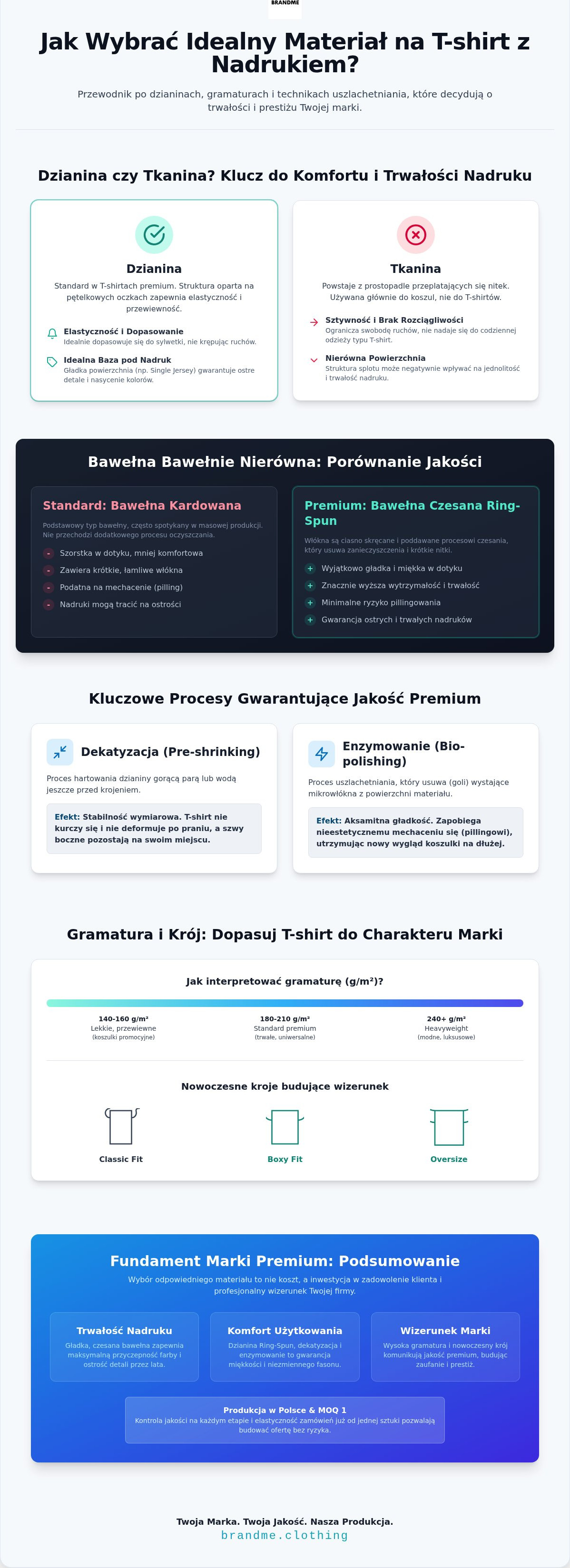
When choosing a base for their own clothing collection, many clients use the word "fabric" interchangeably with "material." This is a technical error that affects the final visual and functional result. T-shirts are almost exclusively made of knitwear. The difference lies in the construction itself. Woven fabric is created from interlacing warp and weft threads, creating a rigid, low-stretch structure. Knitwear, on the other hand, is based on a system of loops, similar to knitting. It is this looped construction that makes the T-shirt flexible, form-fitting, and breathable. When wondering which material for printed T-shirts to choose, you must look at the density of these loops. The smoother and more compact the surface, the more precisely the ink settles on the fibers. This translates directly into the sharpness of the details in your design.
Single Jersey – the standard in the T-shirt world
Single Jersey weave is the absolute foundation of the modern clothing industry. It is characterized by a clear distinction between the right side, showing fine "braids," and the left side, filled with transverse rows. It is this smooth, right side that provides the perfect canvas for DTG printers and modern DTF transfers. A classic cotton jersey of high quality has no protruding fibers that could poke through the layer of ink. At Brandme, we use knitwear that undergoes a combing process. This eliminates impurities and short, brittle fibers. As a result, the print not only looks better but is also more durably bonded to the substrate. Choosing the right weave is the first step toward creating a product that the customer will want to wear for years.
Why dimensional stability is the 'make or break' for your brand?
Nothing destroys brand prestige like side seams that "migrate" to the center of the stomach after the first wash. This is the effect of a lack of dimensional stability in the knit fabric. In our Polish sewing room, we eliminate this problem at the material preparation stage. Shrink-proofing (decating) is key. This is the process of tempering the knitwear with hot steam or water before cutting. Thanks to this, the finished Premium T-shirt retains its original size and shape. Additionally, we use enzymatic finishing. This treatment "shaves" microfibers from the surface of the material. This prevents pilling, i.e., the unsightly fuzzing of the T-shirt. A stable base ensures that the print will not crack under the influence of material deformation. These technical details determine whether your corporate clothing will stand the test of time, building a professional image with every wear.
Not all cotton is the same: Ring-spun, combed, and OEKO-TEX certificates
A label saying "100% cotton" is just the beginning of the road to creating a premium product. For the end customer, this inscription is synonymous with naturalness, but for a manufacturer, it is too general information. Deciding which material for printed T-shirts to choose, you must distinguish between cheap carded cotton and high-quality combed cotton. The former is rough, contains impurities and short fibers that wear out quickly. Combed cotton, on the other hand, is material that has undergone additional selection. It is smooth, shiny, and extremely durable. This is where prints look best because the ink does not have to fight against protruding yarn fibers.
Another technical differentiator is ring-spun yarn. Unlike mass-produced open-end yarn, ring-spun fibers are tightly twisted. The effect is a thinner but much stronger thread. Such a T-shirt is soft to the touch while being resistant to stretching. Sometimes it is also worth moving away from pure cotton. The addition of 5 percent elastane makes the Premium T-shirt perfectly adapt to the silhouette and not lose its shape even after many wash cycles. This is crucial for slim-fit cuts, where the material works along with the user's body.
Combed cotton – the foundation of the premium segment
The combing process is the mechanical removal of all imperfections from the yarn. As a result, we obtain knitwear with a very dense weave. Why is this important? A smooth surface means fewer problems with screen printing or DTG technology. The ink settles evenly, which allows for sharp graphic edges and deep color saturation. Combed cotton is also characterized by:
- Higher resistance to tearing and mechanical damage.
- Minimal risk of surface pilling.
- A pleasant, cool touch that is associated with luxury clothing.
Certificates that build customer trust
In 2026, environmental awareness is not a trend, but a market requirement. Modern brands must prove the safety of their products. OEKO-TEX Standard 100 certificates are crucial here. Since June 2026, these standards have been tightened even further. The limit value for bisphenols B, F, and S has been reduced from 1000 mg/kg to just 200 mg/kg. This is a guarantee that your corporate clothing is free from harmful chemicals and safe for the skin.
At Brandme, we only use certified knitwear, which ensures the repeatability of every production batch. Polish production allows us full control over the supply chain, which is impossible with mass imports. If you care about building prestige, it is worth considering our Organic Line. Organic cotton combined with the precision offered by our sewing room is the best way to stand out in the market. We encourage you to check the possibilities of our custom garment production, where we will tailor every detail of the material to your vision.
How to match the material to the printing technique? (Table and guidelines)
Choosing which material for printed T-shirts will be a bullseye depends primarily on the planned decoration area and its weight. There is a simple technical rule: the more complex, multi-colored, or "heavy" the graphic is, the more stable and dense the base must be. A thin, low-weight knit fabric can start to move under the influence of a large screen print, leading to unsightly puckering of the material around the design. At Brandme, we treat every production individually, advising clients on the optimal combination of weave and branding technology so that the final product builds brand prestige.
In 2026, DTF (Direct to Film) technology became the standard in personalization. It is valued for its versatility because it works great with both pure cotton and polyester blends. However, if you care about a "second skin" effect and maximum breathability, DTG printing remains unrivaled, provided you use 100% combed cotton. The smoothness of the fibers is crucial here, as every yarn unevenness affects the sharpness of the details. When choosing a base, it is also worth remembering the new OEKO-TEX 2026 guidelines, which drastically lowered bisphenol limits to 200 mg/kg. By choosing certified materials from our Polish sewing room, you gain certainty that the product is safe and ready for international markets.
Branding on heavy knit fabrics (Heavyweight)
Knit fabrics with a weight of over 200g provide the perfect foundation for streetwear projects. An Oversize T-shirt with a dense weave is the best base for a large screen print on the back or massive computer embroidery. Thicker material not only handles repeated needle strikes better but also prevents the knit from pulling around the thread. This is especially important for 3D embroidery, which requires meaty cotton to achieve the desired raised effect. The dimensional stability of our materials guarantees that even after many washes, the graphic will stay in place, and the seams will not twist.
Digital techniques on lighter materials
Lighter weights, in the 160-180g range, work perfectly with digital technologies. Our Premium T-shirt made of ring-spun cotton has an exceptionally smooth surface, which is essential for the durability of tonal transitions in DTG printing. The absence of protruding microfibers means the ink adheres perfectly to the surface, which translates into high wash resistance. For event and promotional brands looking for a balance between quality and price, we recommend the DTF technique on a lighter base. It allows for vibrant colors while maintaining the comfort of wearing the T-shirt on warmer days. Before making a final decision, you always have the option to order samples, which allows you to see live how the chosen material works with your design.
Fabric weight and cuts: From classics to modern Boxy and Oversize
The weight of the knit fabric is a parameter that most often raises doubts when planning a new collection. It is simply the mass of one square meter of material expressed in grams. Often, clients wonder which material for printed T-shirts to choose, incorrectly assuming that the higher the number, the better the quality. In reality, a 160g weight made of high-quality combed cotton can be much more durable and pleasant to the touch than a 200g weight made of cheap, rough yarn. In 2026, however, heavy knits in the 240g range are becoming the standard in the premium segment. They provide excellent structure, are not see-through, and build a prestigious, "meaty" feel to the product that customers associate with luxury brands.
The choice of weight must go hand in hand with the purpose of the clothing. Lightweight T-shirts (150-160g) are the perfect choice for event merch organized in the summer or as a base layer under a hoodie. In turn, medium weights (180-200g) are a classic of corporate clothing and streetwear brands. Polo shirts are a separate category. Here, the Piqué weave, characterized by a raised structure, requires a higher weight (usually 200-220g). This ensures that the collar and button placket retain proper rigidity and do not deform after washing. In our Polish sewing room, we ensure that every batch of material is pre-shrunk, which guarantees dimensional stability regardless of the chosen cut.
Streetwear revolution in merch: Oversize and Boxy
The Boxy and Oversize cut are currently the foundations of modern merch, which completely dominated the market in 2026. The Hoodie Boxy Premium model or T-shirt Oversize Heavy are characterized by a wide body, a strongly dropped shoulder line, and a specific square profile. This is the aesthetic that Gen Z and modern influencers consider the standard. Such a cut automatically increases the perceived value of the product. The customer feels that they are receiving an element of an authentic fashion collection, and not just a regular promotional gadget. The heavy cotton in these cuts makes the material stand aesthetically on the silhouette, which allows for the effective display of large prints on the back or raised 3D embroideries.
Classics for B2B: Regular cut and Premium Cotton
Despite the popularity of oversize trends, the B2B sector and corporate clothing still prefer the proven Regular cut. It is a safe solution for companies that order clothing for employees with diverse silhouettes. In this case, we recommend the Premium Cotton T-shirt with a weight of 180g. It is elegant enough to build a professional image while being light enough to ensure comfort during all-day work. For those looking for the highest elegance, the perfect choice will be a Polo with embroidery, which combines sporty comfort with a business touch. We encourage you to check the full range of possibilities in the Brandme T-shirt collection, where you will find cuts tailored to every brand strategy.
If you are not sure which cut and weight will best reflect the character of your project, the safest step is to take advantage of the option to order a set of samples. This will allow you to evaluate the quality of our knitwear live before launching full production.
In the clothing industry, full control over the production process is the foundation of success. Most companies offering branding are merely intermediaries using finished, often low-quality products from mass imports. Brandme is a Polish manufacturer with its own Unicat sewing room in Krzemienica. For 14 years, we have been building experience in the international market, which allows us to oversee every seam and every meter of knitwear. Choosing which material for printed T-shirts will best reflect the character of your vision, you gain certainty that you will receive a premium product, and not cheap no-name promotional clothing. Local production also means speed of operation. Standard lead times ranging from 24 hours to 7 working days are unattainable for companies relying on imports from distant markets. A key advantage of our offer is the lack of a minimum order quantity (MOQ 1). This allows for safe market testing without freezing capital in thousands of pieces of merchandise. You can create a single piece, evaluate its quality, fit, and print durability, and only then move to a larger scale. This is an ideal solution for clothing brands, merch creators, and companies that value precision and flexibility. Verifying the material in practice is the best way to avoid disappointment and build a lasting relationship with your own audience.Sewing from scratch vs. ready-made premium bases
We offer two paths of cooperation tailored to your business needs. The first is choosing ready-made models from our catalog, which are constantly available in stock. This is the fastest way to create a professional, high-standard collection. The second option is production from scratch in our sewing room. At Unicat, we create original patterns, from classic to avant-garde cuts, that will distinguish your brand from the competition. You have access to a base of timeless templates that we can modify at will. This allows for full personalization: from choosing a unique knit weave, through non-standard dyeing, to specific ribbing finishes.Your brand, our execution: Re-branding and logistics
The White Label service at Brandme is more than just printing. We build the complete visual identity of your products, making them look like they come from the best boutiques. We remove the manufacturer's tags and sew in your own, personalized jacquard labels, which are a symbol of the highest quality. We take care of every detail of the post-production process. This includes professional ironing, packaging in dedicated containers, and logistics. We can send goods directly to your clients, which significantly relieves your operational resources. However, before you launch mass sales, check out our Sample GuideBuild your brand's prestige on a solid foundation
Choosing which material for printed t-shirts will serve as the foundation of your collection directly defines how your business is perceived by your audience. Remember that smooth ring-spun combed cotton and dimensional stability are not just technical parameters, but a real guarantee that the print will retain its sharpness and color depth after many wash cycles. In 2026, the premium standard is OEKO-TEX certified knitwear, which combines the highest safety standards with modern Boxy or Oversize cuts.
At Brandme, we combine 14 years of international experience with the precision of a Polish sewing room, offering you full control over every stage of production in Krzemienica. Thanks to the lack of a minimum order quantity (MOQ 1), you can test the quality of our fabrics and the durability of our branding starting from just one piece, completely eliminating the risk of bad investments. Your brand deserves clothing that is authentic, durable, and made with attention to every detail. It is time to turn your creative vision into a physical product that your customers will wear with real pride for many seasons.
Create your premium collection – Order printed T-shirts from 1 piece!
Frequently Asked Questions (FAQ)
What fabric weight is best for printing?
The best fabric weight depends on the intended use, but the premium standard is 180-200g for regular cuts and 240g for oversize models. A higher weight provides better stability for large screen prints and computer embroidery. Thinner knits, around 160g, work well for lighter event T-shirts. When deciding which material for printed t-shirts to choose, it is worth following the rule: the heavier the decoration technique, the denser the base garment should be.
Is 100% cotton always better than polyester blends?
It depends on the expected effect and the branding technique. 100% cotton is unbeatable in terms of breathability and perfectly accepts DTG printing, but the addition of 5% elastane significantly improves the dimensional stability of the T-shirt. This allows the material to better adapt to the silhouette and not lose its shape after many washes. In the premium segment, combed cotton with a minimal admixture of elastic fibers is often used. This combines a natural hand feel with high utility durability.
What material should I choose if I want to do computer embroidery?
For computer embroidery, meaty knits with a weight above 200g and the classic Piqué weave used in Polo shirts are best. A stable and dense material structure is essential to avoid puckering of the fabric around dense thread stitches. With lighter materials, embroidery can cause deformations. To achieve a premium effect, we always recommend choosing a heavier cotton base that will withstand thousands of needle strikes without losing its original shape.
What does it mean that a material is enzymed and why is it important?
Enzyming is a fabric refining process that involves chemically smoothing its surface by removing protruding microfibers. As a result, the material becomes exceptionally smooth to the touch and gains a noble sheen. This is crucial for print quality because the ink settles on a uniform surface rather than on the fuzz of the yarn. Enzyming also drastically limits pilling, which allows the T-shirt to maintain its new look for much longer.
Do T-shirts from a Polish sewing room actually not shrink in the wash?
Garments produced in our Polish sewing room go through a shrinking process, which involves hardening the material with hot steam before cutting. Thanks to this, the risk of the product shrinking is reduced to an absolute minimum, usually within the range of 2-3%, which is standard for high-quality cotton. Unlike cheap imports from Asia, our knitwear maintains dimensional stability. Side seams do not twist, and the T-shirt retains its original size and shape even after intensive use.
Which material best captures colors in DTG digital printing?
Undoubtedly, the best results in DTG technology are obtained on 100% ring-spun combed cotton. Digital printing requires a perfectly smooth surface so that the pigment can precisely penetrate the fiber structure. Choosing which material for printed t-shirts you use will affect color saturation and the durability of tonal transitions. Premium cotton eliminates the problem of fibers poking through the ink, which guarantees photographic detail quality and exceptional softness of the finished decoration.
Can I order just one T-shirt with my own print as a trial?
Yes, at Brandme we offer the option to order from as little as 1 piece, which is the perfect solution for those wanting to check the quality before larger production. The lack of a minimum order quantity (MOQ) allows for free testing of various cuts, weights, and printing techniques. You can order a sample with your own graphics to personally evaluate the comfort and durability of the material. This is a safe path for clothing brands and companies that want to be sure of the final effect.
What certificates should material for children's T-shirts have?
The key certificate is OEKO-TEX Standard 100 in Class I. It sets the most rigorous requirements for products that come into contact with the skin of infants and children. According to the 2026 norm update, these materials must have drastically reduced limits on bisphenols and other harmful substances. By choosing children's clothing from Polish production, you gain the certainty of full supply chain traceability. This guarantees that the knitwear is free from toxic dyes and fully safe for the youngest.

Article by
Konrad Nosek
Entrepreneur and expert in clothing production and building clothing brands. For over 14 years, he has been developing the Unicat sewing room, carrying out comprehensive production for Polish and foreign brands, including Dzik, OSHEE, and Relab. He specializes in designing production processes, selecting materials, branding clothing, and implementing collections from concept to finished product.
He is also the founder of the BrandMe brand, which enables brands, companies, and creators to order high-quality clothing with full personalization - even starting from one piece. In his articles, he shares practical knowledge in the field of clothing production, building your own brand, branding technology, and trends in the fashion and merch industry.