

Over 75% of company T-shirts lose their original brilliance and professional appearance after just the first ten wash cycles. It's frustrating when your brand, instead of shining, starts to crack and fade on the chests of employees or customers. We understand that you expect quality that keeps pace with the dynamism of your business. Modern DTF printing on clothing is currently the most effective way to transfer even the most complex, multi-colored designs onto fabric without the risk of losing details or incurring high start-up costs.
You'll probably agree that no one wants to overpay for complicated matrix preparation when ordering just a few pieces of clothing. This is why Direct to Film technology dominated the textile marking market in 2026. We promise that with this guide, you will learn about DTF technology inside out and discover how to use it to create durable and effective corporate clothing that truly builds your visual identity. We will analyze the technical aspects of the process, compare costs, and show you how to achieve photorealistic quality on almost any type of material.
Key Takeaways
- You will understand the mechanism of Direct to Film technology and learn how the combination of pigment ink and powder adhesive creates an almost indestructible mark.
- You will learn why DTF printing on clothing dominates in 2026 thanks to its flexibility, wash resistance, and perfect reproduction of even the smallest tonal transitions.
- You will discover a reliable comparison of costs and color possibilities, which will help you consciously choose between CMYK precision and traditional screen printing.
- You will check how to adapt the transfer technique to specific materials to achieve a perfect effect on delicate nylon as well as thick hooded sweatshirts.
- You will learn about the benefits of choosing a Polish sewing factory that combines modern machinery with rigorous quality control, building a professional image for your brand.
What is DTF printing on clothing and how does this technology work?
In the world of modern branding, visual quality is the foundation of building a brand's identity. DTF printing on clothing (Direct to Film) has revolutionized the way we think about textile customization. This is not another fleeting technical novelty. It's a standard that in 2026 dominated Polish printing houses, displacing less efficient marking methods. This technology allows for transferring complex, multi-colored graphics onto material with a precision that until recently was unattainable for low volumes.
To fully understand what DTF printing is, one should view this process as a hybrid of digital printing and advanced thermal transfer. The image is first created on a special, transparent PET film, and only then is it transferred to the fabric. The history of this method is a dynamic evolution. We have come a long way from rigid, cracking heat transfers from the 90s to ultra-flexible transfers that withstand over 50 wash cycles without losing color saturation. In 2026, DTF systems are already standard equipment in machine parks, offering premium quality available from a single piece.
The system is based on three key components. The first is dedicated pigment ink, which guarantees vibrant colors. The second element is a white underlayer, thanks to which the graphic is perfectly visible even on black sweatshirts. The third pillar is powder adhesive. This polymer granulate, under the influence of high temperature, creates a durable bond with the fabric fibers. Thanks to this, DTF printing on clothing becomes an integral part of the garment, not just a pasted-on layer.
The process of creating a print step by step
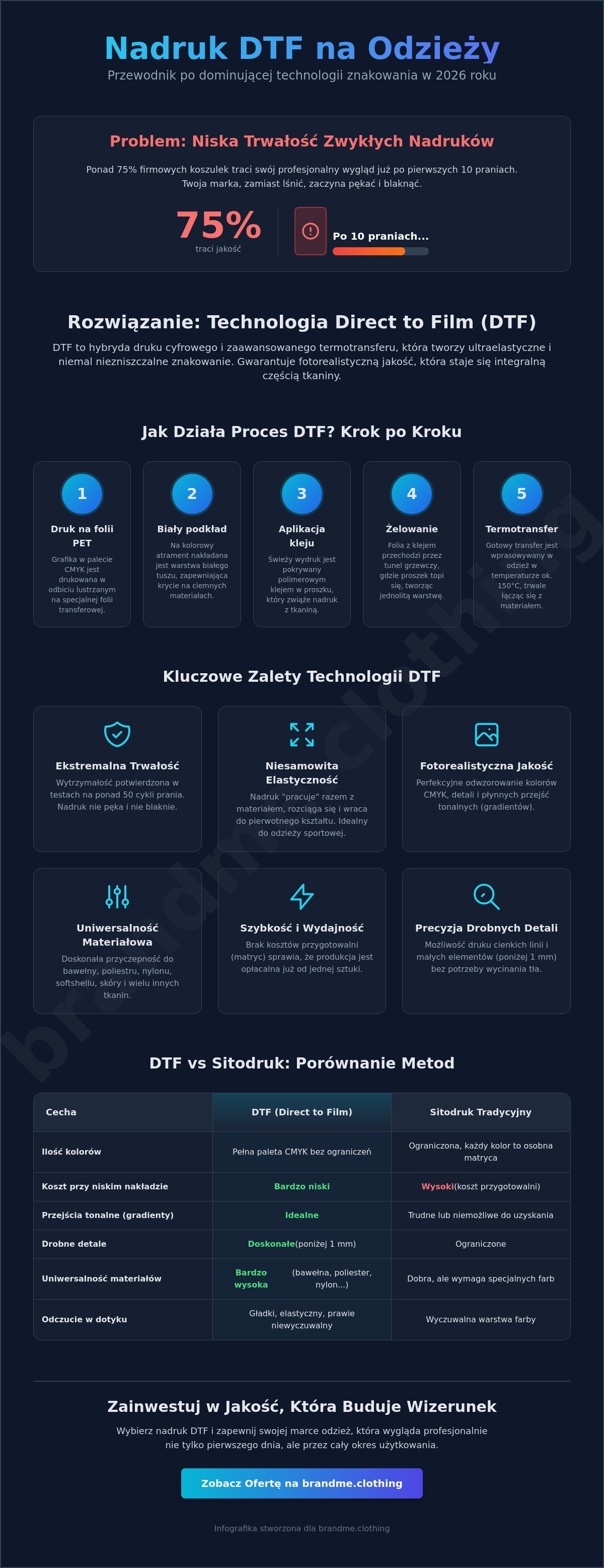
The production of a professional transfer requires surgical precision at every stage. It all starts with a graphic file saved in the CMYK color space, which ensures the color fidelity of the design. Then, the plotter prints a mirror image on PET film. A key moment is the application of a white mask over the colored ink, which creates a base for the adhesive. The fresh print goes into an automatic shaker, where it is covered with thermotransfer powder. The final stage is gelling in a special heating tunnel. The sheet prepared in this way is ready to be pressed onto clothing, which takes only a dozen seconds at a temperature of about 150 degrees Celsius.
Why DTF beats traditional pressing?
- No background cutting required: Unlike flex foil, DTF does not require tedious weeding of small elements (plotting). Only the graphic is transferred, allowing for the creation of details less than 1 mm thick.
- Extreme flexibility: The print "works" with the material. You can stretch it, and it will return to its original shape without cracking. This is crucial for sportswear and products from our premium collection.
- Material versatility: DTF knows no bounds. It adheres perfectly to cotton, polyester, nylon, and even difficult materials such as softshell or leather.
In 2026, the textile industry in Poland is focusing on on-demand personalization. Customers no longer want to wait weeks for order fulfillment. DTF technology meets this need, combining production speed with quality that defines the professional image of a modern company. It is a tool that allows you to dress your brand in quality without any technical compromises.
Advantages of DTF printing: Why choose this method in 2026?
The choice of marking technology directly affects the brand image and the durability of corporate apparel. In 2026, DTF printing on clothing dominates the market thanks to a unique combination of precision and unrivaled durability. This method eliminates the limitations known from older techniques, offering the flexibility required by modern companies that prioritize premium quality.
Durability and resistance to use
Durability is the foundation of professional clothing. DTF prints show excellent resistance to intensive use, confirmed by durability tests covering over 50 wash cycles. Unlike traditional thermal transfer, the graphic does not crack or crumble under mechanical stress.
- Temperature resistance: Prints retain their properties even when washed at 40-60 degrees Celsius.
- UV protection: The use of modern pigments means that colors do not fade under strong sunlight, which is crucial for outdoor clothing.
- Flexibility: The print layer works with the material, preventing deformation on elastic fabrics.
DTF is a technology that, thanks to the polymer structure of the adhesive, maintains flexibility even after repeated washing at 40 degrees.
Aesthetics and color reproduction
Detail precision is another advantage that makes DTF printing on clothing superior to screen printing for complex designs. The ability to reproduce tonal transitions, gradients, and small texts less than 0.5 mm thick allows for the realization of the most creative artistic visions. The high density of the white underlayer ensures that colors are saturated and vibrant, whether they are on a black sweatshirt or a bright T-shirt.
The print structure is smooth and satiny. It does not create a rough feeling, which significantly increases the comfort of wearing clothes throughout the day. In 2026, the use of special effects, such as fluorescent or reflective pigments, also became standard, increasing logo visibility in poor lighting conditions.
Cost-effectiveness and versatility of application
DTF redefines the concept of cost-effectiveness in promotional clothing production. The lack of expensive matrices and screens means that production preparation is quick and inexpensive. This is an ideal solution for short runs and personalized orders, where each piece of clothing can have a different number or employee name. A single transfer prepared on film can be successfully applied to various types of textiles:
- Baseball caps and accessories,
- Classic cotton T-shirts,
- Technical polyester sweatshirts,
- Promotional bags and backpacks.
Such versatility allows for full visual consistency of the entire corporate collection while minimizing logistical costs. If you plan to refresh your team's image, check out our complete clothing collections, which have been selected for best cooperation with modern marking methods.
DTF or screen printing? Comparison of clothing marking methods
The choice between DTF and screen printing is not just a matter of aesthetics. It's pure mathematics and logistics. Screen printing requires matrix preparation, which generates initial costs. In Polish market realities of 2026, the cost of preparing one matrix oscillates between 60 and 120 PLN net for each color. For a logo consisting of five colors, you invest several hundred PLN even before starting the machine. DTF completely eliminates this stage. There are no matrices, no screen exposure, no tedious cleaning of equipment after work.
That's why DTF printing on clothing wins wherever personalization and short runs are important. However, the profitability threshold for screen printing shifts with large orders. When the quantity exceeds 500 pieces with a simple, one or two-color design, screen printing becomes unrivaled in terms of price. It is worth remembering about technological limitations, however. Screen printing relies on Pantone colors, which guarantees perfect reproduction of brand colors. DTF uses the CMYK palette, which offers unlimited possibilities in creating tonal transitions and details that the screen simply cannot handle without complex halftoning.
Lead time is another domain of digital technology. DTF is a savior for "yesterday" orders. The graphic file goes to print within minutes of approval. In screen printing, the drying and form preparation process takes valuable hours, sometimes days. Additionally, DTF has no competition in marking difficult areas. Seams, button areas, or pocket edges are an insurmountable barrier for screen printing. The thin, flexible DTF transfer can be precisely pressed almost anywhere.
When to choose DTF, and when screen printing?
- Complex graphics: If your design contains shadows, highlights, and hundreds of colors, choose DTF. This guarantees photorealistic quality.
- High-volume productions: For orders over 500 pieces with simple graphics, screen printing will reduce the unit cost to a minimum.
- Brand strategy: You can find more about building a professional image through the selection of techniques in our article on marking clothing for companies.
DTF vs DTG: Clash of digital technologies
Although both methods are digital, there is a huge difference in terms of efficiency. DTF handles dark materials much better. In DTG (Direct to Garment) technology, it is necessary to use so-called pre-treatment, i.e., chemical impregnation of the fabric before printing. It often leaves visible, stiff edges on dark T-shirts. Modern DTF printing on clothing does not require this process. The ink does not soak directly into the fibers, but forms a durable layer on the surface.
The difference is also visible in color saturation on synthetic fabrics. DTG works best on 100% cotton. On polyester, colors often fade or migrate. DTF, thanks to the powder adhesive layer, creates a barrier that makes prints on sportswear vibrant and resistant to multiple washes at 40 degrees Celsius. This makes DTF the most versatile tool in a modern textile printing house.
On which materials does DTF printing work best?
DTF is a technology that has finally broken down the barriers between screen printing and thermal transfer. Its greatest strength is versatility. You can forget about limitations regarding fabric composition. DTF printing on clothing works equally well on natural cotton, as well as on completely synthetic polyester or demanding nylon. The flexibility of the polymer adhesive means that the graphic works with the material. It does not crack or crumble, even with intensive use.
In the case of hooded sweatshirts, the fabric weight is crucial. For thick materials of 300 g/m2 and more, transfer requires precise selection of pressing force. Proper "melting" of the adhesive into the dense weave ensures that the print will withstand dozens of wash cycles. In turn, with thin sports materials, DTF wins with its lightness. It does not create the effect of a stiff "plate" on the chest, which directly translates into freedom of movement during training.
DTF on premium cotton
Combed cotton is the foundation for the highest quality T-shirts. In this combination, DTF printing on clothing looks best. Thanks to the second phase of heating, the graphic almost completely merges with the fibers. The rough effect disappears, and the print becomes soft to the touch. This is crucial for fashion brands that focus on user comfort. If you are looking for an ideal base for your projects, check out the offer of all Brandme products and choose textiles designed for professional marking.
Synthetic and difficult materials
The use of DTF on polyester requires experience. The main challenge in 2026 remains dye migration, i.e., the penetration of fabric color into the print. The solution is modern powders with a so-called sublimation blocker. These allow you to maintain the pure white of the logo even on intensely red or black sports shirts. DTF is also a savior for accessories. Baseball caps, polyester bags, or softshell jackets gain details that could not be achieved with embroidery or screen printing.
Preparing files for printing on synthetics does not forgive mistakes. The standard is 300 DPI resolution and perfectly smoothed vector edges. Every unfinished pixel will be visible on the smooth structure of technical clothing. However, DTF forgives a lot in terms of flexibility. The polymer layer stretches up to 100 percent of its length and returns to its original shape without any aesthetic damage.
Professional clothing with DTF print from Brandme
The combination of our own Polish sewing factory with modern machinery is the foundation of our market advantage. At Brandme, we do not limit ourselves to applying graphics to ready-made products from a catalog. We produce clothing from scratch, which allows us to have full control over the fabric structure even before marking begins. DTF printing on clothing requires a perfectly smooth surface to maintain the sharpness of details and depth of colors. Thanks to the close cooperation between the sewing factory and the printing house, we eliminate problems with fabric pilling or dye migration.
Our quality control is a multi-stage process. We start with the selection of cotton yarn of appropriate weight. Each prototype undergoes rigorous durability tests. We check the print's resistance to multiple washes at 40 degrees and its elasticity when stretched. This gives you the certainty that the graphic will not crack or lose saturation after several months of intensive use. This is quality that builds a professional image for your business.
We support your vision at every stage. Our design team not only verifies the technical parameters of the files but also advises on how to optimize the graphics for DTF technology. We help select the appropriate placement of the logo so that it harmonizes with the style of the clothing. Thanks to the possibility of personalization from just one piece, you can create limited series or personalized gifts for employees without financial risk. You build your brand slowly and wisely, testing the market without having to order hundreds of kilograms of goods.
Your brand at its best
We use DTF printing on clothing to create unique merchandise collections that stand out from mass production. This technology allows for the perfect reproduction of tonal transitions and complex graphics, which is crucial for modern streetwear designs. The ordering process at Brandme is maximally simplified. After an initial consultation, we prepare a visualization, and after its approval, we start production. If you plan broader activities, read our comprehensive article on How to start a clothing brand in 2026.
Why trust us?
Our experience is based on the activities of Unicat Sp. z o.o., a company that has been supplying textiles for years to the most demanding corporate clients and fashion brands. We have invested in a new generation machine park that guarantees 100% color repeatability. Your company color will look identical on every batch of goods, regardless of the order date. We focus on partnership and transparency. We do not seek savings at the expense of durability, because we know that your clothing is your business card.
Want to take your branding to the next level? Create your collection with Brandme and rely on Polish production supported by the latest marking technology.
Build a strong brand image with DTF technology
Choosing the right marking method is a strategic investment in image, which in 2026 relies on uncompromising precision and durability. This technology revolutionizes the textile market, offering photographic quality details and flexibility that traditional methods cannot provide. At Brandme, we combine modern DTF printing on clothing with local production in Poland, based on certified, top-class knitwear. Our products undergo rigorous washing tests, which confirms their exceptional resistance to cracking and fading even after many cycles of use. We handle projects from just 1 piece, which eliminates entry barriers for smaller companies and creators of limited collections. Your brand needs a setting that communicates professionalism and attention to detail from the first glance. Opt for proven solutions that effectively combine modern aesthetics with the highest functionality. We are ready to help you turn your vision into concrete and tangible results that will stay with your clients for years.
Order personalized clothing with DTF print at Brandme
Frequently asked questions about DTF printing
Does DTF print crack after washing?
Professionally made DTF print on clothing does not crack, because it is characterized by exceptional flexibility and high elasticity. This technology uses a specialized powder adhesive that creates a durable and flexible bond with the fabric fibers. Properly applied graphics withstand over 50 washing cycles at 40 degrees Celsius without visible damage or loss of color vibrancy. By choosing this method, you gain confidence that the branding will retain its original shape even with intense stretching of the material.
How much does DTF printing on a T-shirt cost?
The unit cost of printing depends mainly on the graphic format and the size of the order. For single pieces, the price for a small chest logo is usually between 15 and 25 PLN net, while an A3 format print costs between 35 and 55 PLN net. For wholesale orders exceeding 100 pieces, prices can drop by over 40 percent. The final quote also takes into account the type of backing and the working time of the heat transfer press, which allows for cost optimization for larger series.
What is the minimum order quantity for DTF printing?
This technology allows for orders from just one piece, which is its greatest advantage compared to traditional screen printing. You don't have to invest in expensive matrix preparation, so personalizing a single T-shirt becomes fully cost-effective. This is an ideal solution for small businesses needing clothing for a few employees or for brands testing new designs. The flexibility of production means you can order missing sizes exactly when you need them.
Can DTF print be ironed?
The print should not be ironed directly with a hot iron plate, as high temperatures can permanently damage the polymer structure. Always iron clothing inside out or use baking paper as a protective barrier for the graphic. Most manufacturers recommend setting the iron to a low temperature, which is sufficient to smooth cotton without the risk of melting the embellishment. Following these simple care rules will extend the life of your logo by many months.
What is the difference between DTF and market iron-on transfers?
The main difference lies in durability and aesthetics, as professional DTF print on clothing is an advanced system with a dedicated white backing and industrial adhesive. Market iron-on transfers often crack after two washes and have a thick, unpleasant-to-the-touch structure resembling oilcloth. DTF is significantly thinner, works better with the material, and allows for reproduction of details as thin as 0.2 millimeters. Industrial machines guarantee precision that cannot be achieved with homemade methods using a regular iron.
Is DTF print suitable for workwear?
Yes, DTF print is perfectly suited for workwear due to its high resistance to friction and mechanical damage. This method is commonly used for marking softshell jackets, reflective vests, and thick sweatshirts with a grammage above 300 g/m2. The prints retain their color saturation even after exposure to harsh weather conditions and frequent washing at 60 degrees Celsius. The distinct edges of the logo ensure that your employees' visual identification remains professional throughout the season.
What files are needed for DTF printing?
For the best quality, vector files in PDF, EPS, or AI format are needed, which allow for arbitrary scaling of the graphic without loss of sharpness. We also accept raster files, such as PNG, provided they have a resolution of at least 300 DPI and a transparent background. All text in the design should be converted to curves, and the color scheme prepared in the CMYK palette for accurate color reproduction. A properly prepared file guarantees that every detail of your brand will be precisely transferred to the fabric.
Is DTF printing ecological?
DTF technology is considered a more ecological alternative to traditional methods because it generates 60 percent less waste than screen printing. This process uses a minimal amount of water and does not require the use of aggressive solvents for screen washing. The pigment inks used are water-based and often have safety certificates such as OEKO-TEX Standard 100. By choosing this solution, you support sustainable production and build an image of a brand responsible for the natural environment.