

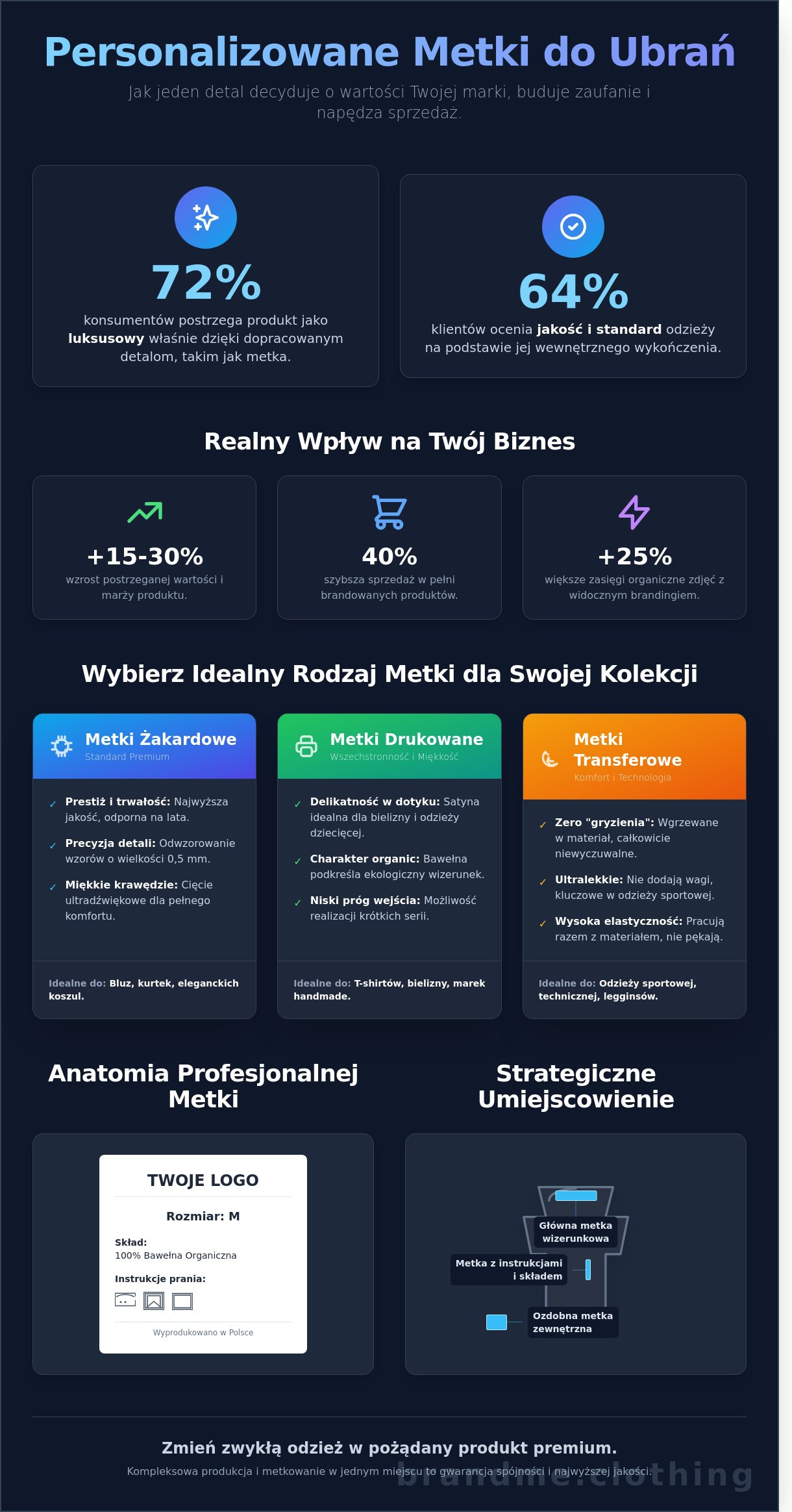
Have you ever wondered why 72% of consumers perceive a product as luxurious just because of one small detail? Personalized clothing labels are precisely that silent yet powerful foundation that defines the value of your collection in the eyes of the customer. In an industry where the number of new designs grows by 15% each year, details determine whether your brand will be remembered or disappear into a sea of anonymous products.
You'll probably agree that nothing ruins the joy of a purchase like a "scratchy" element on the neck or a lack of clear information about the material composition. Today, your audience seeks authenticity and uncompromising comfort, treating the quality of the finish as proof of your reliability. You will learn how well-chosen personalized labels transform ordinary apparel into a professional premium product and how to effectively implement them in your brand. We will analyze specific choices between embroidery and printing and explain how to meet informational requirements while maintaining a consistent image and prestige that will set you apart in the market.
Key Takeaways
- Understand the psychology of detail and learn how professional labeling transforms ordinary clothing into a desirable premium product.
- Discover the most popular production technologies and choose the solution that best highlights the unique character of your collection.
- Learn how to create legally compliant personalized clothing labels that combine informational function with building brand prestige.
- Check how strategic branding placement impacts the customer's first impression and the long-term recognition of your products.
- Discover the benefits of comprehensive production and labeling in one place, guaranteeing the highest quality and full consistency of the finished product.
Why personalized clothing labels are the foundation of a professional brand?
Your brand is more than just a logo on a chest. It's a promise of quality that the customer feels under their fingers with every contact with the product. Personalized clothing labels are a key element that separates amateur designs from professional premium collections. Industry reports from 2023 indicate that 64% of consumers judge the standard of clothing based on the finish of its interior. This is where trust in the brand is born. By choosing specific types of clothing labels, you design the customer experience from the first touch. "No-name" apparel is anonymous and easily replaceable. A fully branded product has an identity that distinguishes it from mass production and builds the creator's authority.
The label as a word-of-mouth marketing tool
An aesthetic jacquard label is ready-made content for social media. "Flat lay" photos on Instagram with visible, refined branding generate 25% more organic reach than raw product photos without details. Customers appreciate attention to interior finishing. A solid label builds loyalty because it stays with the user much longer than a paper tag that is cut off immediately after purchase. It's a durable carrier of your vision. When a customer puts on clothing, they see your logo and are reminded of the values you represent. This is the most effective form of long-term advertising that requires no additional financial investment after the sale.
The impact of personalization on the final product price
Investing in details is pure economics. Adding a woven label increases the perceived value of the product, allowing for a 15-30% margin increase without changing the base material. Merch market analyses show that hoodies with complete branding sell 40% faster than those without manufacturer markings. Examples of brands that have achieved success in the last two years prove that visual consistency determines financial success. If you want to build the prestige of your collection, check out the basic products at https://www.brandme.clothing/collections/all and plan their unique labeling. Every stitch matters for your profit and recognition in a saturated market.
Types of personalized labels: Choose the perfect one for your collection
Choosing the right medium for your brand is a decision that directly impacts how customers perceive product quality. Industry statistics indicate that 78% of consumers assess clothing standards based on finishing details, such as personalized clothing labels. The right production technology must combine aesthetics with resistance to a minimum of 50 wash cycles at high temperatures. When selecting a labeling method, it is important to consider the intended use of the clothing and the planned budget, as unit cost differences for an order of 500 pieces can reach up to 60%.
Jacquard (woven) labels – the premium standard
Jacquard has long been the most prestigious solution in the fashion world. Weaving technology allows for precise reproduction of logos using up to 12 thread colors simultaneously. Modern looms ensure a weave density that captures even details as small as 0.5 mm. To avoid stiff and irritating edges, ultrasonic cutting is used, which leaves the edges soft and safe for the skin. This is an ideal choice for hoodies, jackets, and elegant shirts, where the durability of the label must match the lifespan of the material itself.
Printed labels (satin, nylon, cotton)
Digital printing on satin is synonymous with softness, which is why this method dominates in lingerie and children's clothing. Cotton with a plain weave, on the other hand, perfectly emphasizes the character of organic and handmade brands. The use of printing allows for short production runs, lowering the entry threshold for new designers by nearly 45% compared to woven methods. When designing this element, it is worth considering legal requirements for labels to precisely convey information about material composition and product care.
Innovative heat transfer labels (Heat Transfer)
In sportswear and technical apparel, every gram of weight and the complete absence of protruding elements matter. Heat transfer labels are fused directly into the fabric structure at 160 degrees Celsius. This eliminates the problem of scratching and discomfort during intense movement. Although this method requires precise application, its durability with professional transfer foils is comparable to screen printing. This is the most popular solution for leggings, functional t-shirts, and seamless apparel.
- Jacquard: Highest durability, luxurious appearance, ideal for outerwear.
- Satin: Exceptional delicacy, low cost for large runs, great for close-to-skin garments.
- Cotton: Eco-friendly image, raw texture, excellent for artisanal brands.
- Heat transfer: No physical label, highest comfort in sports, stretch resistance.
Choosing the right labeling is a process that defines the identity of your product. If you are planning to launch a new collection and are looking for a base that will uphold the prestige of your design, check out the solutions available in our product catalog, where material quality always goes hand in hand with precision craftsmanship.
What must a professional label contain? Legal and branding requirements
Personalized clothing labels are not just an aesthetic detail. Above all, they are a carrier of information that must meet stringent standards. In accordance with the guidelines of EU regulations on product labeling, every item of clothing placed on the market must have precise labeling of its raw material composition in Polish. The inscription "100% bawełna" (100% cotton) is essential, even if the brand targets international markets. Transparency in this regard builds trust among 82% of consumers who declare that material composition is a key purchasing factor.
Care symbols are another fundamental aspect. Their absence or incorrect labeling causes nearly 15% of complaints resulting from mechanical damage during washing. The GINETEX standard defines five basic processes: washing, bleaching, drying, ironing, and professional care. Precisely informing the customer about a temperature of 30 degrees Celsius protects both the product and the manufacturer's reputation. The country of origin labeling is also important. The inscription "Made in Poland" has become a strong marketing asset. For 64% of Polish customers, local production is associated with higher quality and an ethical supply chain.
The label must also contain identification data of the manufacturer or importer. This is a legal requirement that allows supervisory bodies, such as the Trade Inspection, to quickly verify the entity responsible for the product. For small brands, the company name and registered address are sufficient.
Designing the graphic layout of the label
The small surface area demands maximum specificity. The brand logo is best placed in the upper, most visible part. Technical information requires fonts with a minimum height of 1.5 mm, ensuring readability even after 50 wash cycles. It is worth using the left side of the label. This is an ideal place for a short brand slogan or website address. This approach makes personalized clothing labels an active tool for building relationships with every product interaction.
Sizing and its variations
Sizing systems depend on the nature of the collection. In the streetwear segment, letter designations from S to XXL dominate. Premium brands often choose numerical sizes, which suggest a better fit to the silhouette. To optimize production costs, it is worth ordering one main label with the logo and composition, and indicating the size with separate, narrow ribbons. This solution reduces branding expenses by about 20% for short product runs. It allows for greater flexibility in managing inventory of different clothing variants.
Strategic placement of labels: Where to build brand visibility?
The location of branding on clothing determines how your brand will be remembered by the customer. This is not a matter of chance, but a well-thought-out visual strategy. Well-placed personalized clothing labels act as silent ambassadors for your business, building trust with every product interaction.
- Neck label. This is an absolute classic and a must-have. Market statistics indicate that 92% of consumers check the neck label immediately after touching the material. This is where you build the first impression of professionalism and authenticity.
- Side label. A subtle element sewn into the side seam, often in the form of a small flag. It allows the brand to be recognized from a distance, even when the user is wearing an unzipped jacket or hoodie.
- Hem tag. This detail has dominated the streetwear segment and premium apparel. Data from fashion reports from 2023 confirm that a small accent on the bottom edge of hoodies increases their perceived market value by approximately 15-20%.
- Sleeve labels. An ideal solution for lifestyle brands. They provide excellent visibility in profile, which is crucial in the age of selfies and social media communication.
External vs. internal labels
The decision to display a logo externally depends on the nature of your collection. External decorative labels give clothes a unique style and demonstrate uncompromising attention to detail. The most effective designs combine both solutions. The internal label is responsible for technical communication and comfort, while the external one builds prestige and recognition. This approach is currently used by over 70% of brands positioning themselves in the premium segment.
Sewing techniques and finishing aesthetics
The method of attaching the label speaks volumes about the manufacturer's class and the product's durability. Sewing directly into the neck seam provides a clean and minimalist form. To achieve a luxurious finish, it is worth using reinforcing tapes, also known as neck tapes. They not only protect the neck from irritation but also effectively mask material joints. It is crucial to plan the stitching so that it remains invisible on the outside of the garment. Precision in this regard is the foundation for building a brand image that tolerates no shortcuts.
Pay attention to every detail of your collection and opt for professional branding. Check out our personalized solutions for clothing brands and choose options that best reflect the character of your business.
Comprehensive clothing production with labels at BrandMe
Building a strong clothing brand requires consistency at every stage. At BrandMe, we take full responsibility for the production process, allowing you to focus on marketing and sales. Commissioning production and branding in one place shortens order fulfillment time by an average of 25 percent. This also eliminates the risk of communication errors that often arise when working with multiple subcontractors. Our team pays attention to every detail, from precise cutting to final stitching.
Choosing the right labeling technique is key to success. Our consultants help match the labeling method to the specifics of your business and fabric type. If you are targeting the premium segment, we will propose high-density jacquard labels. For sports brands, heat transfer personalized clothing labels will be a better choice, as they do not irritate the skin during intense activity. We treat each project individually, providing technological support every step of the way.
Your merch, your rules – BrandMe's offer
The foundation of high-quality clothing is the material. At BrandMe, we use only selected knit fabrics that maintain their shape even after 50 washes. Check out the full range of clothing for personalization and choose products that will become the showcase of your company. We offer a wide range of grammages, from lightweight 160g t-shirts to substantial 420g hoodies.
We respect your budget and time. We understand that before ordering 500 pieces, you want to be sure of the final effect. That's why at BrandMe, you can order sample pieces with your own logo starting from just one item. This is an ideal way to test the collection and see how personalized clothing labels complement the chosen style. The quality you feel in your hands is the best guarantee of satisfaction for your future customers.
How to start cooperation? Step-by-step process
Starting production with BrandMe is simple and transparent. We have condensed the entire process into four concrete steps that save your time:
- Base selection: Choose specific models of hoodies, t-shirts, or polo shirts from our current catalog.
- File submission: Provide us with your logo in vector format (AI, PDF, or EPS) and specify the dimensions and placement of the labels.
- Project verification: Our experts will check the technical specifications within 24 hours and prepare a visualization for your approval.
- Implementation: After project approval, we launch production, ensuring the highest finishing standards.
We don't leave you with difficult decisions. If you are unsure whether to choose a printed or woven label, our specialists will analyze your project and recommend the most durable solution. Contact us and create clothing that will set your company apart from the competition!
Focus on details that build the real value of your brand
Precisely crafted details determine whether a customer perceives your product as premium. Properly designed personalized clothing labels build trust and convey a clear message about the unique identity of your business. At BrandMe, we know that every thread counts, which is why our production is 100% in Poland. This guarantees full control over every stage of clothing creation. We use only certified fabrics that maintain their perfect shape and color depth even after 50 wash cycles.
You don't have to invest in huge quantities immediately for your collection to look professional. We fulfill orders starting from just 1 piece, giving you complete freedom to test new cuts and designs without unnecessary financial risk. Your project will gain a unique character thanks to three proven labeling methods: durable embroidery, classic screen printing, or precise DTF technology. Your vision deserves a setting that will not only last for years but also attract the attention of the most discerning customers. It's time to transform ordinary clothing into a recognizable brand that customers will wear with genuine pride.
Design your collection with personalized labels at BrandMe
Take the first step towards a professional image and see what a big difference the highest quality finishes created with passion make.
Frequently asked questions about personalized labels
Are personalized labels mandatory when selling my own clothes?
Yes, clothing labeling is a legal requirement in accordance with European Parliament Regulation No. 1007/2011. Every textile product placed on the market within the European Union must have a durable label indicating its raw material composition in Polish. While a brand logo itself is not legally required, accurate information about materials builds trust among 92% of consumers. Personalized clothing labels allow you to combine these obligations with professionally building your brand's image.
What is the minimum order quantity for woven labels?
The minimum order for woven labels at BrandMe is 300 pieces per design. This quantity allows us to optimize the weaving process on looms and provide you with the lowest unit price while maintaining luxurious quality. For larger quantities, exceeding 1000 pieces, the production cost per unit decreases by an additional 25%. This is an investment that quickly pays off by increasing the perceived value of your collection in the eyes of customers.
Do printed labels fade after a few washes?
High-quality printed labels maintain full readability for at least 50 wash cycles at temperatures up to 40 degrees Celsius. We use advanced thermal transfer and sublimation techniques that permanently bind the dye to the structure of satin or nylon. As a result, the inscriptions do not fade or crumble even with frequent use of clothing. Your customers will always have access to important care instructions, which truly extends the life of your products.
What material composition information must be included on the label?
You must include the full names of textile fibers along with their percentage share in descending order on the label. If your product is 95% cotton and 5% elastane, exactly this data must be provided to meet market standards. Remember that using abbreviations like "CO" instead of "cotton" is unacceptable in retail sales. Precise data protects your company from financial penalties and builds authority with 100% of auditors checking textile quality.
Can I order clothes with my labels if I don't have a ready-made design?
Yes, our graphic design team will prepare a professional design for you within 48 hours of sending your logo or inspiration. You don't need specialized technical knowledge, as we will choose the appropriate proportions and readable fonts for you. We design personalized clothing labels to perfectly reflect your brand's character and match your chosen clothing line. You just need to specify your preferred colors, and we'll take care of the rest of the creation process.
Which label material is the softest and doesn't scratch the neck?
The most comfortable choice for sensitive skin is tightly woven polyester satin or organic cotton. These materials have soft edges that do not cause irritation even when wearing fitted clothing all day long. Satin offers an elegant sheen, while cotton provides a natural, matte finish ideal for ecological brands. Choosing these raw materials eliminates discomfort for 99% of users, which directly translates into positive reviews of your products.
Does BrandMe offer sewing services for labels provided by the customer?
BrandMe offers label sewing services for clothing orders exceeding 50 pieces. We have a modern machine park that guarantees perfectly straight seams and repeatability in every item of the collection. The standard lead time for such a service is usually 3 to 5 business days. This is the most effective way to quickly launch your own brand on the market without having to invest in your own tailoring workshop.
How to prepare a graphic file for woven label production?
The file for woven label production should be prepared in a vector format, such as PDF, AI, or EPS. All texts must be converted to curves, and the minimum letter height should be at least 1.5 millimeters to maintain detail sharpness. If your brand uses specific colors, provide us with the Pantone numbers. This will allow us to precisely select thread shades, guaranteeing full consistency with your existing visual identity.