

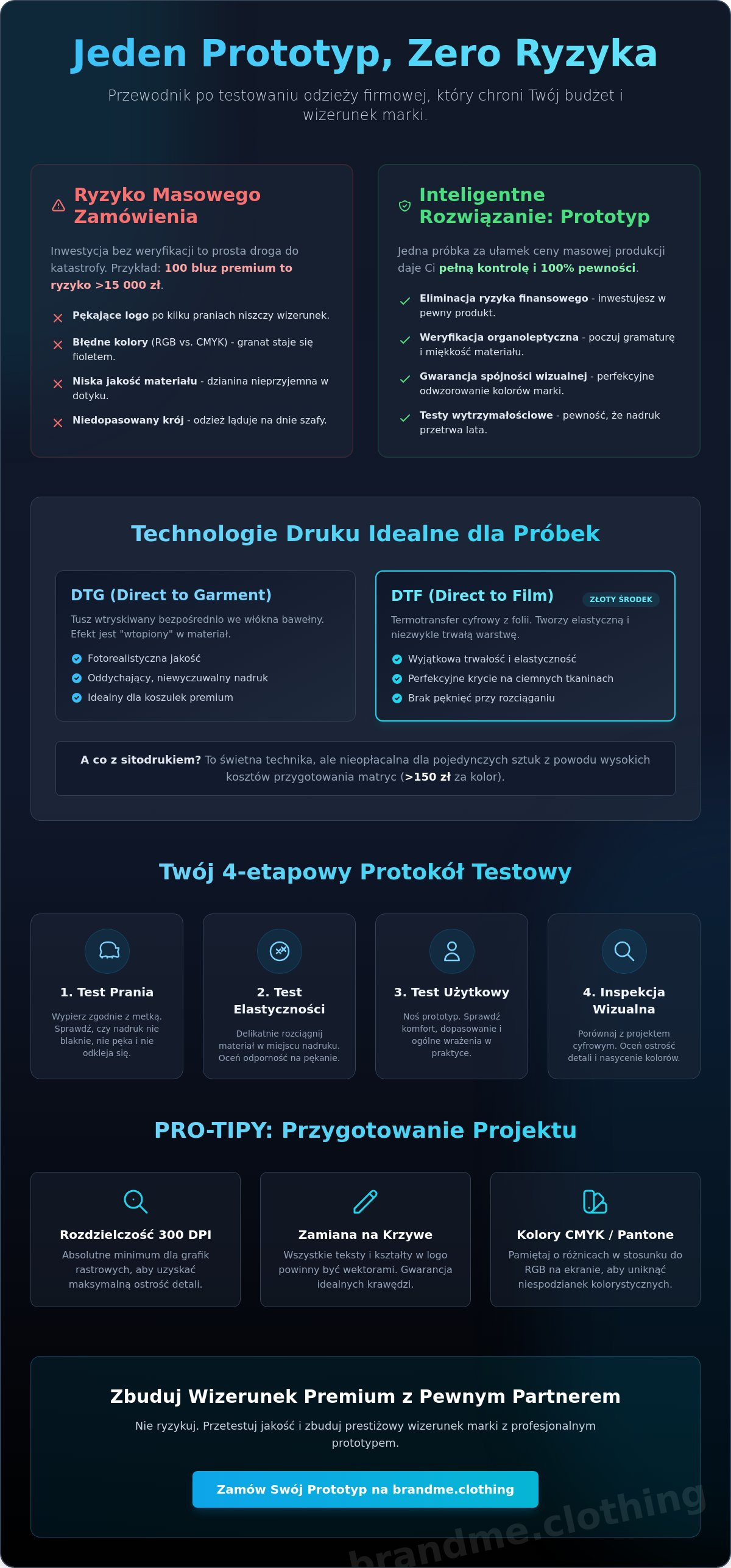
Investing in 500 company t-shirts without prior quality checks is the fastest route to a brand image disaster and a loss of thousands of zlotys. Every marketing manager dreads the moment when the logo starts cracking after the third wash, and the prestigious navy turns out to be a faded purple in real life. It's natural to demand clothing that will withstand years of intensive use and maintain an impeccable appearance. That's precisely why, by ordering individual custom-printed garments for testing, you are prioritizing the safety and professionalism of your brand.
Instead of risking your budget, you gain the assurance that your visual identity will be reproduced with surgical precision. You'll learn how to effectively test the durability of the print and the density of the cotton weave to ultimately receive a premium product that builds true authority for your team. In this guide, you'll discover proven methods for verifying size charts in practice and selecting the branding technique that will best "dress" your brand for success. Prepare for a prototyping process that eliminates errors and transforms ordinary clothing into a powerful business tool.
Key Takeaways
- Learn how to effectively eliminate financial risk by verifying fabric quality and grammage before placing a final order for corporate apparel.
- Utilize individual custom-printed garments for testing to check the photorealistic quality of digital printing on your design without costly matrices.
- Discover a professional testing protocol that will allow you to independently assess the print's resistance to washing and cracking before approving mass production.
- Master the technical aspects of graphic preparation, from 300 DPI resolution to conversion to curves, ensuring perfect sharpness and a professional logo appearance.
- Understand how a strategic approach to prototyping with a premium partner helps build a coherent and prestigious image for your brand.
Why order individual custom-printed garments for testing?
The decision to introduce a new line of merchandise or corporate clothing is a process that does not tolerate haste. Investing in a batch of 100 premium hoodies can incur a cost exceeding 15,000 PLN. By ordering individual custom-printed garments for testing, you gain real control over this budget. It is the simplest way to eliminate financial risk. One prototype for a fraction of that cost allows you to catch errors before mass production begins. In business, certainty, not guesswork, is what counts.
Organoleptic verification is another argument that no digital visualization can replace. A grammage of 280 g/m² sounds solid on paper, but only touching the fabric allows you to assess its softness and how the material moves. Physical tests allow checking the differences between an oversized and a regular cut in practice. In 2026, quality standards are higher than ever. Customers and employees expect comfort. Prototyping guarantees that the final product will be worn with pride, not cast aside in a closet.
Avoiding errors in brand visual identity
Colors on a monitor work in the RGB space, while professional textile printing techniques are based on the CMYK palette or the Pantone system. The difference can be drastic. Natural cotton absorbs dye differently than synthetic polyester, which directly affects the saturation and sharpness of the logo's edges. A physical test allows verifying whether your logo maintains legibility on dark material. You avoid situations where an entire batch is scrapped due to an incorrect shade or insufficient contrast. Details build professionalism.
Advantages of prototyping in a professional sewing workshop
By choosing to collaborate with an experienced partner, you gain access to certified materials that form the basis for later mass production. All product bases available in our offer can be tested for durability and aesthetics. This allows for checking non-standard print placements, such as cuffs, hood edges, or around the neckline. Professional individual custom-printed garments for testing guarantee that the parameters maintained for the prototype will be replicated for a scale of 500 pieces. This provides a secure foundation for scaling your brand.
Branding techniques ideal for single pieces and prototypes
Traditional branding methods, such as screen printing, require the preparation of costly stencils. For print runs of one hundred pieces, this cost is spread across many items, but in the prototyping process, it generates unnecessary expenses often exceeding 150 PLN for each color used. Modern machinery allows these financial barriers to be bypassed. When choosing individual custom-printed garments for testing, we rely on digital and computer technologies that guarantee high profitability from the very first piece. This allows the designer to focus on aesthetics, not on optimizing prepress costs.
Digital printing allows photorealistic graphics to be transferred directly from the computer onto the material. We are not limited by the number of colors or complex tonal transitions. In 2026, combining various techniques has become standard in professional prototyping to achieve a unique visual effect that will distinguish a brand in a saturated market. However, each method has its specific characteristics, which are worth verifying at the trial stage.
DTG and DTF digital printing – precision in details
DTG (Direct to Garment) technology involves directly spraying ink onto cotton fibers. This results in a print that is almost imperceptible to the touch, breathing with the material, which is crucial when testing premium t-shirts. DTF (Direct to Film), on the other hand, has revolutionized sample creation on dark fabrics and difficult polyester materials. DTF is a heat transfer method that uses film and adhesive powder, ensuring exceptional print durability.
Why has DTF become the gold standard in prototyping? Primarily due to its flexibility and repeatability. The print does not crack when stretched and maintains color saturation even on dark backgrounds, where traditional digital printing can be less effective. The choice between these two methods depends on the desired texture; DTG is soft and sinks into the material, while DTF creates a smooth, very durable coating with high contrast.
Computer embroidery – testing elegance and durability
Embroidery is synonymous with the premium segment and building brand prestige. We usually choose it when testing corporate apparel or streetwear collections designed to withstand years of intensive use. When creating a prototype, it's worth checking how stitch density affects the puckering of a specific material. However, embroidery has its technical limitations; small details or letters less than 5 mm high may become illegible after embroidering.
Therefore, individual custom-printed garments for testing in the form of embroidery allow for a realistic assessment of whether the logo is too complex for the needle. This technique looks best on thick, stable products. A high-quality hoodie is an ideal example for such tests, as its grammage perfectly withstands thread tension.
Choosing the right technique is a strategic decision that defines the character of your entire brand. Check out our full collection of clothing for branding and select the base that best reflects the quality of your design.
How to conduct durability tests on the received sample?
Before approving a large order, you need to know how individual custom-printed garments for testing will perform after intensive use. A professional testing protocol is the foundation for building a premium brand image. Focus on three key parameters: wash resistance, print elasticity, and fabric shape stability. Quality standards for 2026 require corporate apparel to retain at least 90% of its original color intensity after 30 wash cycles. Check material certifications. Labels such as OEKO-TEX Standard 100 or GOTS ensure that the fabric is free from harmful substances, which directly impacts employee health and comfort.
Print feel analysis is equally important. A print layer that is too stiff, resembling a plastic shell to the touch, reduces wearing comfort and makes the garment drape poorly. Ideal graphics should work with the material, be soft and pleasant to the skin. If micro-cracks appear on the print after strong stretching of the fabric, it means that the decorating technology or the curing process was not optimally chosen for the material's grammage.
Home washing and drying test
Most users do not follow strict washing instructions. Test the prototype at 40 degrees Celsius, turning it inside out. This is a standard recommendation that helps verify pigment durability. After removing from the washing machine, assess whether the print is migrating or losing saturation. A critical indicator is material shrinkage. In the premium apparel segment, the permissible norm is a maximum of 5%. If a T-shirt shrinks by 4 centimeters after the first wash, abandon that model. Also, check if white graphic elements have bled onto dark fabric, which often happens with low-quality textile dyes.
Assessment of fabric and finish quality
Wear individual custom-printed garments for testing for at least 3 working days before making a decision. Observe how the seams under the armpits behave and whether the collar ribbing loses elasticity. High-quality combed cotton is characterized by a smooth structure and a minimal tendency to pill. If small balls appear on the surface after a short time, it means inferior quality fibers were used. Pay attention to details: protruding threads or crooked seams disqualify the product in the eyes of your customers and employees. You can find more about materials in our article on promotional clothing.
- Seam stability: No twisting of the T-shirt after washing.
- Ribbing quality: Returns to original shape after stretching.
- Pilling resistance: Smooth surface without fuzzing after intensive rubbing.
Preparing your design for test printing – professional tips
Precise file preparation is the foundation of a successful prototype. Even the best printing machine cannot fix errors in low-quality graphics. By ordering individual custom-printed garments for testing, you get the chance to verify details that are not visible on the monitor screen. Resolution is a key parameter. Raster files must have a minimum of 300 DPI at a 1:1 scale. Lower values result in blurry edges and visible pixelation, which disqualifies the product as premium apparel.
The next step is to convert all text to outlines. This eliminates the risk that the print shop's system will substitute your unique font with a standard Arial or another replacement. In PNG files, pay special attention to so-called "dirty pixels." These are semi-transparent remnants after background removal, which appear as unsightly smudges or gray halos in digital printing. The design must be perfectly masked. Remember to consider scaling as well. A 10 cm wide logo looks completely different on a size S T-shirt than on an XXL hoodie. Prototyping allows you to choose proportions that will look consistent across the entire size chart.
File formats and color management
Vector graphics saved in PDF, AI, or EPS formats are the gold standard in the textile industry. Vectors allow for unlimited scaling of graphics without loss of sharpness, which is crucial for large prints on the back. If your goal is computer embroidery, prepare a design based on closed paths, which will facilitate the machine programming process. For DTG or DTF digital printing, the color profile is critical. Most professional machines operate in the CMYK space. Converting from RGB to CMYK yourself before sending the file will help avoid disappointment when the bright blue on the screen becomes a dull navy on cotton.
Choosing logo placement and size
Testing individual pieces is an ideal time for experimenting with brand placement. Instead of the standard chest placement, try printing on the nape of the neck, sleeve, or bottom edge of the T-shirt. Modern corporate merchandise emphasizes subtlety. The "less is more" principle dominates designs for 2026. Often, a small, precisely executed detail builds greater brand prestige than a huge graphic covering the entire chest. Check out our entire collection and get inspired by cuts that will best showcase your design.
Brandme – Your partner in creating professional merchandise
Choosing the right contractor is a crucial stage that determines the market success of your brand. Brandme is a unique combination of a modern digital printing house and an experienced premium apparel sewing workshop on the Polish market. We are not an intermediary; we control the entire product creation process, which allows us to offer individual custom-printed garments for testing while maintaining mass production standards. This approach eliminates the risk of error in large quantities and gives you full freedom to refine every detail of the graphic or cut.
Our philosophy is based on flexibility and technical advice. The Brandme team not only fulfills orders but actively supports you in choosing the branding technique. Will screen printing, durable computer embroidery, or perhaps modern DTF printing be better for your project? We analyze the graphic structure and the intended use of the clothing to propose an optimal solution in terms of aesthetics and costs. We scale your business with you: from a single test piece to thousands of production series.
Polish production and uncompromising quality
The heart of our operations is Krzemienica, where our sewing workshop is located. Local production guarantees that every batch of goods will maintain identical parameters. We use only certified, Polish fabrics of high grammage, most often 280g/m2 or 340g/m2, which translates into exceptional durability and wearing comfort. Every product undergoes rigorous quality control, including cutting precision, seam durability, and print color saturation. If you want to learn more about strategic business planning, check out our guide on how to launch a clothing brand, which will guide you through the process from idea to sale.
- We use fabrics with OEKO-TEX Standard 100 certification.
- We ensure color repeatability for reorders.
- Every stage of production takes place in one location in Poland.
From prototype to full collection of corporate apparel
Speed is our domain. At Brandme, you move smoothly from the prototype testing phase to order fulfillment for your entire team or clients. By ordering individual custom-printed garments for testing, you receive a tangible product that you can subject to washing and intensive use tests. This builds brand trust right from the start. We offer personalization that goes far beyond standard printing; we design and sew woven labels, add dedicated side tags, and prepare personalized polybag or eco-box packaging.
A professional image is about consistency. We help companies build a strong visual identity through corporate apparel with a logo that combines functionality with modern design. Your employees become brand ambassadors, and the quality of the clothes they wear directly reflects the standards of your company. Choose a partner who understands that details create the whole.
Transform your vision into tangible quality
Prototyping is the foundation of your brand's professional image. Instead of risking your budget on unverified batches of goods, opt for technical precision and peace of mind. Choosing the right branding method and verifying material grammage under real-world conditions is the only way to eliminate design errors before official sales begin. By ordering individual custom-printed garments for testing, you gain 100% certainty that the final product will delight your customers and stand the test of time.
At Brandme, we focus on concrete values that genuinely build your business. Our production takes place in Poland, which shortens the supply chain and ensures full control over every stitch. We use only certified premium materials that retain their properties even after 50 wash cycles. We fulfill orders starting from just 1 piece, making the process of building professional merchandise accessible to every ambitious creator. Your vision deserves a setting that will last for years and build a strong identity for your brand in the market.
Design your first test piece and check out Brandme's quality
Start creating without compromise and experience the difference that professional support at every stage of production brings. Your brand is ready to enter the real world.
Frequently asked questions about apparel prototyping
Is it profitable to order a single piece of clothing with a custom print?
Yes, prototyping is an investment that protects your budget from costly errors in large print runs. The cost of a single piece is usually 40 or 60 percent higher than the wholesale price, but it protects you from a faulty batch of 100 garments. This gives you confidence that the final product will meet your brand's standards and helps you avoid financial losses resulting from an erroneous concept.
What are the most common mistakes when ordering apparel samples?
The biggest mistake is sending graphics with a resolution below 300 DPI, which results in blurry print edges. Customers also often forget to check the material composition; cotton absorbs ink differently than polyester. Failure to verify the size chart before testing leads to choosing a style that does not fit the target group, making the sample marketing-useless.
How long does it take to fulfill an order for single test pieces?
Fulfilling an order for single pieces of clothing with custom prints for testing usually takes 3 to 5 business days. This time includes file preparation, machine calibration, and the precise labeling and drying process. During peak periods, such as November's pre-holiday campaigns, the deadline may extend to 7 business days due to the large number of projects in the queue.
Will the print on the test T-shirt be the same as in a wholesale order?
Yes, if you choose DTG digital technology or computer embroidery, which guarantee 100 percent pattern repeatability. In the case of planned screen printing, prototypes are often made using digital technology to avoid the cost of preparing matrices for a single piece. This may cause minimal differences in color saturation, which we always inform about before starting mass production.
What printing method should I choose for a single prototype piece?
The best choice for single pieces is DTG digital printing or modern DTF technology. They allow for precise reproduction of tonal transitions and fine details without the need to create expensive printing screens. These methods are ideal for testing complex logos on cotton T-shirts and sweatshirts, ensuring photographic quality from just one piece.
Can I order a clothing sample without a print to check only the material?
Of course, sending blank apparel is a standard step in the process of building a professional collection. This allows you to assess the material's grammage, for example, 190g/m2, and check the fabric's shrinkage after the first wash at 40 degrees. Such physical verification is crucial before applying the target graphic, as it allows you to feel the product's quality firsthand.
What if the print on the received sample does not meet my expectations?
Contact our customer service representative to thoroughly analyze the reason for the unsatisfactory result. If the problem is color, we adjust the ICC profile in the printer settings or change the parameters of the source file. Prototyping serves precisely to eliminate all technical shortcomings before launching a full production line for your company.
Does Brandme help with preparing graphic files for testing?
Yes, our graphic designers verify each file technically before applying it to single pieces of clothing with custom prints for testing. We check vectors, remove unnecessary backgrounds, and adjust the graphic dimensions to the specific clothing size. This ensures that the prototype will look professional and aesthetic, making it easier to decide on further production.