

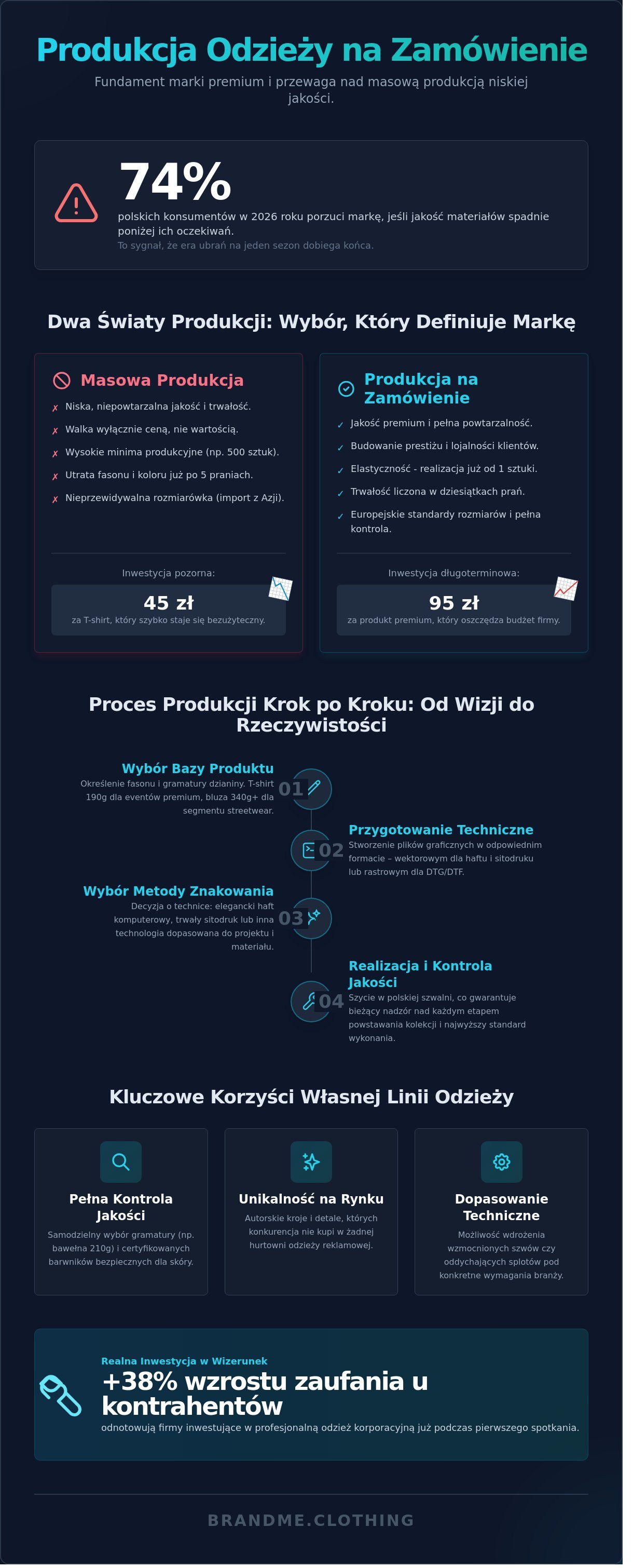
In 2026, as many as 74% of Polish consumers declare they will abandon their favorite brand if the quality of materials falls below expectations in favor of mass, low-quality production. This is a clear signal that the era of single-season clothing is finally coming to an end. Professional custom apparel production is becoming the only effective foundation for companies that want to truly stand out in a saturated market and build an authentic identity. Instead of competing solely on price, it is worth focusing on a product that speaks for itself through its durability and precision craftsmanship.
You are probably well aware of the frustration when a sewing factory imposes production minimums of 500 pieces or communication stops exactly when you need to approve a sample model. We understand these concerns because we know that your brand needs a partner, not just a contractor. In this guide, you will learn how professional custom apparel production will transform your vision into a premium product that builds prestige and genuine customer loyalty. We will guide you through a seamless process from design to shipping, providing you with the substantive support needed to create a unique collection that will dominate the market in the coming seasons.
Key Takeaways
- Professional custom apparel production is the foundation for building a premium brand, allowing you to transform your vision into a product with the highest standard of craftsmanship.
- You will learn how to go step-by-step through the process of creating a collection - from selecting the cut and fabric weight to preparing technical graphic files.
- You will discover the differences between computer embroidery and screen printing, which will allow you to choose the most durable and economical branding method for your project.
- You will discover how to design modern merch in the spirit of minimalism and oversized styles that customers will wear with pride, building your company's natural prestige.
- You will understand why local production in a Polish sewing factory guarantees full quality control and unique flexibility in fulfilling orders from as little as one piece.
What is custom apparel production and why does your brand need it?
Custom apparel production is a comprehensive system for creating clothing from scratch, going far beyond simply applying a logo to an off-the-shelf product from a wholesaler. It is an advanced and precise cut and sew production process, where every element, from the choice of a specific knit weave to the thread color and type of finish, is tailored to your brand's unique vision. Unlike mass production, where speed and cost reduction take precedence over durability, dedicated sewing in a Polish factory guarantees full repeatability and the highest standard of craftsmanship. By choosing this solution, you take complete control over the product life cycle, eliminating the risk of purchasing clothing that does not meet your quality expectations.
Many entrepreneurs still view employee uniforms as an operational cost, which is a serious mistake in building an image strategy. Market data from the first quarter of 2024 shows that companies investing in professional corporate apparel see an increase in contractor trust by 38 percent during the first business meeting alone. This is a real investment in your team's authority. When your employees present themselves in impeccably tailored clothing, they send a clear message that you care about details as much as you care about the quality of services provided. Cheap alternatives often lose their shape and color after just 5 washes, necessitating further expenses. Solid custom apparel production means durability measured in years. Instead of spending PLN 45 on a T-shirt that quickly becomes unusable, it's better to invest PLN 95 in a premium product that will retain its properties for dozens of wash cycles, genuinely saving the company's budget in the long run.
Apparel as a carrier of brand identity
Clothing is the fastest visual communication channel that reaches your surroundings. A cohesive clothing collection builds a strong sense of unity within the organization and increases credibility in the eyes of business partners. The psychology of color and appropriate cut play a key role here. Navy blue instills instinctive trust, and deep black emphasizes the brand's exclusivity, which is worth using when designing a collection. Company merchandise also becomes a powerful loyalty tool. An employee or brand fan who wears a stylish and comfortable hoodie outside working hours becomes a natural ambassador for your success in the public sphere.
Advantages of having your own clothing collection
Having your own clothing line offers complete freedom from rigid catalog schemes. You don't have to compromise on the restrictions imposed by suppliers of ready-made clothing. By opting for dedicated solutions, you gain tangible benefits:
- Full quality control: You independently choose the fabric weight, for example, 210g combed cotton, and certified dyes safe for the skin.
- Uniqueness in the market: Your designs feature original cuts and details that competitors cannot buy from any advertising clothing wholesaler.
- Technical adaptation: The ability to adjust parameters, such as reinforced seams in workwear or breathable weaves for the sports industry, to the specific requirements of your industry.
Polish custom apparel production allows for ongoing supervision at every stage of collection creation. This eliminates problems with sizing, which can be unpredictable in the case of mass imports from Asia. Thanks to local cooperation, you can be sure that size M will always comply with European standards, which is crucial for your team's comfort. Professionalism starts with what you wear, which is why it's worth choosing solutions that reflect your business aspirations.
The apparel production process step-by-step: From idea to finished product
Custom apparel production is a process that does not forgive planning errors. Everything begins with a precise definition of the base. Step 1 is the selection of the cut and fabric weight, which determines the product's character. A 190g T-shirt is a market standard for premium event wear, while hoodies weighing 340g and above position the brand in the streetwear segment. The appropriate material weight affects how the garment drapes on the body and how long it retains its original shape.
Step 2 focuses on technology. Preparing graphic files requires distinguishing between vectors and rasters. Logos for computer embroidery or screen printing must be provided in vector format (AI, EPS, PDF), allowing for arbitrary scaling without loss of quality. For complex multi-color graphics, we use high-resolution rasters, minimum 300 DPI, to maintain detail depth. Step 3 is the selection of the personalization technique. Screen printing is cost-effective for orders above 50 pieces, while computer embroidery adds prestige to polo shirts or jackets, regardless of the quantity ordered.
Step 4 is the verification stage, i.e., prototyping. Before machines start, we prepare a visualization that the client must approve within 24 hours to maintain the schedule. The final, 5th step, takes place in a Polish sewing factory. This is where cutting, sewing, and final branding occur. Quality control at each of these stages ensures that the complaint rate in professional facilities falls below 0.5% of total production.
Construction and material selection
The standard that must be absolutely demanded is OEKO-TEX Standard 100 certified fabrics. They guarantee that the material is free of over 100 harmful substances. The choice of weight depends on the intended use: light 160g cotton is ideal for summer, but 190g ensures durability with frequent washing. It's worth paying attention to admixtures. The addition of 5% elastane in ribbing prevents stretching, and 20% polyester in sweatshirts significantly increases resistance to pilling and facilitates moisture wicking.
Detail personalization: Labels and finishes
Details build the perceived value of a product. Woven labels with a logo on the neck or side of a T-shirt signal to the customer that they are dealing with a premium product. Legal aspects are also important, so it's worth knowing the EU textile labeling requirements, which stipulate the obligation to inform about the raw material composition. Personalization also includes the color of drawstrings in hoods or engraved zippers. Such elements create a coherent "unboxing experience" that makes 85% of recipients more likely to return to a given brand.
If you plan to create your own collection, it is worth focusing on proven technical solutions. Check how our custom apparel production can help you stand out in the market by paying attention to every seam and finishing detail.
Branding techniques and material selection - key to durability
The quality of the final product depends on details that are not visible at first glance. Professional custom apparel production is a process where the choice of decoration technique must be in harmony with the fabric's weight and weave. Not every graphic suits every fabric. Choosing the wrong method results in cracking prints after the third wash or deformation of the material under heavy embroidery. At Brandme, we focus on solutions that build your brand's value for years, not just until the first encounter with the washing machine.
Computer embroidery remains synonymous with luxury and reliability. This technique works best on thick hoodies weighing over 280g and elegant polo shirts. Viscose or polyester threads used for embroidery are resistant to bleach and high temperatures, making this method unrivaled in the gastronomy and hotel industry. Screen printing, on the other hand, is a powerhouse of economy for large orders. For orders exceeding 50 pieces, the unit cost drops drastically, while offering saturated colors from the Pantone palette that will withstand dozens of wash cycles at 40 degrees Celsius.
For projects requiring photorealistic precision, we choose DTG digital printing or modern DTF technology. DTG allows direct penetration of ink into cotton fibers, making the print almost imperceptible to the touch. DTF (Direct to Film), in turn, is a revolution in customizing polyester and difficult surfaces. Thanks to film transfer with powdered adhesive, we obtain a flexible print that works with the fabric, not cracking even with intensive stretching of sports apparel.
Which printing method will last the longest?
Durability is a measurable parameter. Computer embroidery wins in the longevity category, withstanding up to 150 washes without visible damage. Screen printing comes in second, provided plastisol inks cured in a heating tunnel at 160 degrees Celsius are used. If your priority is budget for a complex, multi-color logo, DTF technology will suffice, offering a lifespan of 40-50 washes. Choose the best solutions from our full product range to match durability with your collection's purpose.
Premium materials in custom production
The basis of comfort is the type of fiber used. Combed cotton differs from standard ring-spun cotton in the process of eliminating short, protruding fibers. The result is an extremely smooth surface that does not pill and provides an ideal base for digital prints. Customers will immediately feel the difference in softness, which directly translates into perceiving your brand as premium. For sportswear and softshells, polyester with a micro-tear structure or a breathable membrane that wicks moisture away is crucial.
For custom apparel production to bring long-term benefits, users need to be educated on care. Here are three golden rules:
- Always wash inside out at a maximum temperature of 30-40 degrees Celsius.
- Avoid tumble dryers, which damage the adhesive structure in heat transfer prints.
- Iron only on the reverse side or through an additional layer of material.
Precise selection of material for the branding technique is an investment in your image. Clothing that looks new after a year is the best business card for your business. At Brandme, we choose parameters so that you don't have to choose between aesthetics and durability. We treat each project as an individual technological challenge.
Personalization and image building: How to create merch people want to wear?
Effective custom apparel production ceases to be merely a technical process and becomes an element of marketing strategy. The modern consumer is sensitive to aesthetics. They don't want to be a "walking billboard." If your goal is for employees and customers to wear your clothes with pride, you must focus on utilitarian design. In 2024, key trends are minimalism and oversized cuts. According to market research conducted in the first quarter of this year, as many as 78% of recipients are more likely to choose corporate clothing that has subtle, aesthetic branding instead of flashy graphics. A well-designed product speaks for itself. The quality of the material and modern cut ensure that the garment stays in the wardrobe for years, building a lasting relationship with the brand.
Avoiding common mistakes in clothing design
The biggest mistake is an oversized logo. A giant print in the middle of the chest often disqualifies the garment from everyday use. Modern merch focuses on details. A small embroidery on the heart or a discreet print on the back of the neck builds prestige. Another pitfall is ignoring color contrasts. A dark print on a dark material becomes unreadable after a few washes. Technical parameters must also be monitored. Branding placed too low, at waist height instead of chest, distorts the body's proportions. The standard in professional production is to place graphics approximately 10-12 centimeters below the collar line.
Planning a collection for the company
Image building requires consistency. Instead of random products, create a well-thought-out set: a classic T-shirt, a hoodie with a minimum weight of 280g, and a technical softshell. Such a base allows for layering, which is crucial in Polish weather conditions. When ordering sizes, it's worth sticking to proven statistics. In a typical team, demand is distributed as follows: 15% S, 25% M, 35% L, 20% XL, and 5% XXL. Precise tailoring to the specific work requirements increases comfort. Technical teams need reinforced seams and flexibility, while office workers will appreciate high-quality combed cotton.
Professional custom apparel production allows for the transition from a single design to a full private label collection. An example is a Warsaw creative agency that in 2022 started with 50 black T-shirts for its team. Thanks to high-quality craftsmanship and a unique cut, their clothing gained recognition from external clients. In 2023, this agency already had a line of 15 different products, including sweatpants and caps, generating additional revenue and strengthening its employer branding. Appropriate workwear can reduce employee turnover by 12% annually, as it builds a strong sense of belonging to a group.
Matching clothing to the target group is the foundation of success. An office worker expects elegance and discretion. A technician needs functional pockets and abrasion-resistant materials. By investing in high quality, you invest in an image that will not fade after the third wash. Remember that every item of clothing is your company's business card in the real world.
Why choose Polish production at Brandme?
Choosing a local production partner is the foundation for building an authentic and strong brand. Our main office and logistics facilities are located in Krzemienica, near Rzeszów. It is here, in Subcarpathia, that we directly supervise every stage of your collection's creation. Such a location allows us to completely eliminate intermediaries. This shortens the path from the initial sketch to the finished product by 60% compared to imports from Asian markets. Every seam and every print is created under the watchful eye of specialists who take full responsibility for the final result.
Professional custom apparel production is often associated with the necessity of ordering thousands of pieces. At Brandme, we change these rules, focusing on maximum flexibility. We fulfill your original ideas from as little as 1 piece. This solution is ideal for young creators testing the market, as well as for established companies needing limited premium series for key business partners. You don't have to tie up capital in inventory that sits in a warehouse. You produce exactly what you need, while maintaining the highest standards of craftsmanship.
Our experts share knowledge gained during 12 years in the textile industry. We are not just a contractor; we become your strategic partner. We advise on selecting the appropriate fabric weight, for example, suggesting a substantial 280g/m2 cotton for hoodies, or the optimal branding technique. Thanks to this support, you avoid costly design errors. Our local supply chain ensures that the realization process usually closes within 10 to 14 business days. In a business where time is money, such quick responsiveness gives you a huge competitive advantage.
Our approach to quality in Krzemienica
We invest in modern machinery, using Japanese Tajima embroidery machines and precise digital printing plotters. Every garment undergoes rigorous, three-stage quality control before shipping. We check the precision of stitches, color saturation, and the wash resistance of prints. Process transparency is our calling card. You know exactly under what conditions and by whom your clothes were sewn. This builds trust that you can pass on to your customers, promoting ethical and local production.
Start cooperation with Brandme
The starting process is simple and concrete. Send an inquiry for an individual quote via our form, and you will receive a calculation within 24 hours. We always recommend ordering samples before starting a large series. This allows you to evaluate the quality of the weave and the fit of the cut to the silhouette in person. Check out our available models of hoodies and t-shirts and start building your brand today. Remember that reliable custom clothing production is an investment in an image that works for your success every day.
Build a brand that will stand the test of time
Building your own clothing brand in 2026 requires a strategy based on the foundations of quality and ethics. The selection of certified materials with the OEKO-TEX certificate and precise marking techniques is now the absolute minimum. Local production in Krzemienica near Rzeszów ensures full control over every stage of collection creation. Professional custom clothing production allows you to turn a vision into a real product that builds customer loyalty from the very first touch.
At Brandme, we focus on flexibility tailored to the needs of modern business. We fulfill orders from just 1 piece, which allows for safe market testing without the risk of overproduction. Your brand deserves a setting that will emphasize its unique character and professionalism. We know how to dress your values in top-class textiles, creating merchandise that people actually want to wear every day. Choose a partner for whom precision is the standard, not an additional option.
Create your own collection with Brandme - Check the offer!
Opt for proven solutions and start designing the future of your brand now.
Frequently Asked Questions about Clothing Production
How much does custom clothing production cost?
The cost of custom clothing production depends on the chosen quantity, type of material, and the complexity of embellishments. Prices for basic premium t-shirts start from 35 PLN net per piece, while high-grammage hoodies cost around 110 PLN net for an order of 50 pieces. Each quote is individual, as it includes specific marking techniques and tailoring accessories.
What is the minimum order at the BrandMe sewing factory?
At BrandMe, custom clothing production is available from 20 pieces of one model and color. Such a low threshold allows smaller brands and companies to create a professional collection without having to freeze large capital in goods. For larger orders, exceeding 100 pieces, we offer additional quantity discounts that significantly reduce the unit price of the product.
How long does it take to produce hoodies or t-shirts with a logo?
The standard order fulfillment time is 14 business days from the moment of project acceptance and advance payment. For more complex orders, involving non-standard cuts or intricate stitching, this process may extend to 21 days. We always meet agreed deadlines because we know that your marketing strategy relies on a specific action schedule.
Do I need to have a ready graphic design to place an order?
You don't need a professional design, as our team of graphic designers will help you transform your idea into a finished product. 85 percent of our clients only send initial inspirations or logos, based on which we create technical visualizations for approval. We advise on the placement of prints and the selection of colors to ensure the clothing looks modern and consistent with your brand.
What materials do you use for clothing production?
We use only selected fabrics, mainly combed cotton with a weight of 180g to 340g with an OEKO-TEX Standard 100 certificate. These materials are characterized by exceptional durability, do not shrink in washing, and are pleasant to the skin. For clients looking for ecological solutions, we have prepared an offer based on organic cotton and recycled polyester.
Do you send clothing samples before fulfilling the entire order?
Yes, preparing a pre-production sample is a standard step that guarantees full satisfaction with the final result. The cost of preparing such a sample is usually 150 PLN net, and this amount is deducted from the final order after its approval. This allows you to personally check the quality of the material, the precision of the embroidery, and the fit of the cut before mass production begins.
Do you also handle labeling clothes with my brand?
We provide a comprehensive branding service, which includes sewing woven labels, printed labels, and heat transfer labels with your logo. We can also remove the manufacturer's labels and replace them with your own markings, which gives the products a fully authorial character. Such personalization makes the clothing look like it came from a professional boutique, building the prestige of your brand in the eyes of customers.
What printing techniques are best for small quantities?
For orders below 50 pieces, the most effective and cost-efficient method is DTF digital printing or computer embroidery. DTF technology allows for the reproduction of a full range of colors and tonal transitions without the need for costly matrix preparation. Embroidery, in turn, gives the clothing an exclusive look and is practically indestructible, making it an ideal choice for elegant corporate wear.