

Will your clothing brand stand the test of time if you choose a branding method that doesn't match the scale of your business? When preparing a new collection of premium t-shirts or printed sweatshirts, you face a dilemma that will directly impact your budget and image. You probably fear cracked designs after a few washes or high setup costs that can kill the profitability of any project in short runs.
We agree that in 2026, quality cannot be a matter of chance, and print durability is the foundation of your audience's trust. This comprehensive comparison of screen printing vs. DTF will clear your doubts and show you which technology will best capture the essence of your graphics while maintaining a premium standard. We will analyze specific parameters of durability, production flexibility from a single piece, and the moments when technology begins to limit your artistic vision. With this knowledge, you will choose a solution that combines uncompromising aesthetics with the economic sense of your production.
Key Takeaways
- You will understand why screen printing remains the standard for large runs, while DTF technology opens the door to profitable personalization from just one piece.
- You will discover how to match the technique to specific products to maintain the lightness of Premium T-shirts and durability on thick Hoodie Oversize fabrics.
- A detailed comparison of screen printing vs. DTF will help you avoid unnecessary setup costs and choose the method that best renders the details of your design.
- You will learn how Polish production and no minimum orders (No MOQ) can accelerate the growth of your clothing brand or event merchandise.
Screen Printing vs. DTF – fundamental differences in branding technology
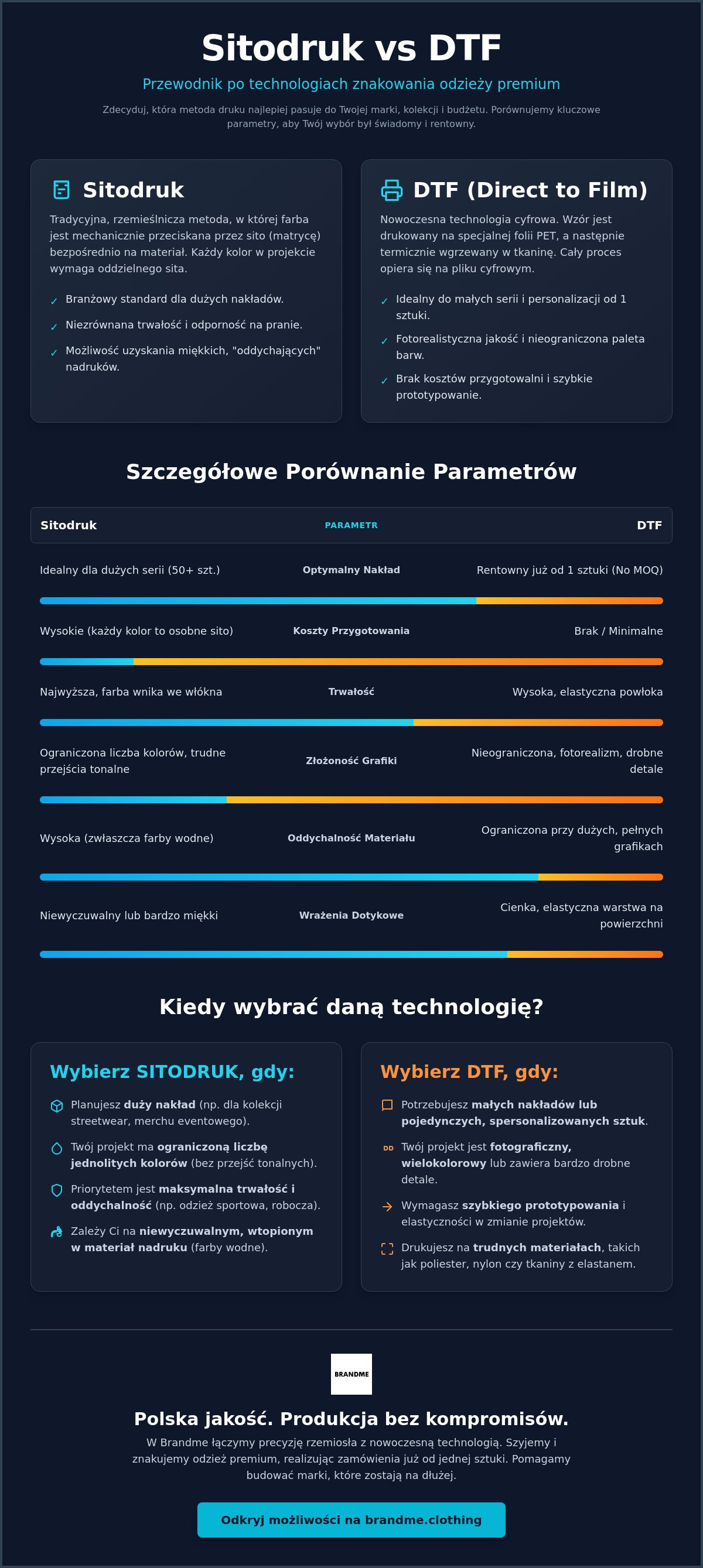
The choice between tradition and modernity in textile decoration is not just a matter of aesthetics. It's a strategic business decision. A reliable screen printing vs. DTF comparison begins with understanding the fundamentals of both processes. Screen printing is a craft based on a physical stencil, where ink is mechanically pushed through a fine mesh directly onto the material. DTF (Direct to Film), on the other hand, is a digital technology. Here, the design is first transferred to a special PET film and only then applied to the fabric using high heat and pressure. The difference is fundamental. In screen printing, we create a physical pattern for each color. In DTF, we work with a digital file, which completely changes the rules of the game regarding production start time.
In our Polish sewing factory, we emphasize precision. The preparation process in screen printing is time-consuming and requires precise exposure of screens. Any error at this stage affects the entire series. DTF eliminates this stage, allowing for almost immediate transition from design to finished print. This drastically lowers the entry barrier for new brands.
How does traditional screen printing work?
This method dominates the world of professional streetwear. The process begins with color separation. If your design has five colors, we need to prepare five separate screens. We use different types of inks to achieve the desired effect. Water-based inks are ideal for those who value ecology and a soft feel. Plastisol inks, on the other hand, produce incredibly vibrant, saturated colors that are resistant to multiple washes. There are also discharge inks, which remove the dye from the fabric, replacing it with a new color. This makes the print almost imperceptible to the touch. Remember, however, that each additional color means another stencil and an additional stage of work, which directly affects the unit cost for small orders.
Modern DTF printing from the inside out
Direct to Film technology is design freedom enclosed in a digital format. The printer applies a full CMYK color palette along with a white underbase to the PET film. The key element is the powder adhesive, which is applied to the still-wet ink. Then, the whole thing goes into a heating tunnel where the gelling process takes place. The transfer prepared in this way is heat-pressed onto Premium T-shirts or sweatshirts using a heat press. DTF handles situations where screen printing encounters difficulties. Complex tonal transitions, tiny details measured in fractions of a millimeter, or photorealistic graphics pose no challenge for this method. We don't have to worry about color registration because everything happens in one pass of the printer.
Durability and Aesthetics: Print Quality Comparison in Practice
The aesthetics of premium apparel are not just about saturated colors. It's primarily about tactile sensations and the certainty that the product will not lose its character after a few months. When conducting a reliable screen printing vs. DTF comparison, we must focus on how both technologies react to everyday use. Screen printing has been synonymous with indestructibility for decades. The ink, especially water-based, penetrates deep into the fibers, becoming part of the fabric's structure. DTF, on the other hand, creates a thin, flexible layer on the surface that works perfectly with materials with a high elastane content. This ensures that the print does not crack even when the material is heavily stretched.
Wearing comfort is another aspect where clear differences can be seen. Water-based inks used in screen printing allow the material to "breathe," which is crucial for large graphics on the back. DTF print, although modern and very thin, forms a barrier to air. For large-area designs, this can be felt as a "stiff" element on the chest or back. Therefore, at Brandme, we always analyze the graphic design before choosing the technology, ensuring that our Premium T-shirts retain their natural softness and breathability.
Print durability after 50 washes
In long-term tests, screen printing usually comes out on top. Well-cured screen print ink withstands dozens of wash cycles without noticeable loss of saturation. DTF also shows high resistance, provided you adhere to strict care guidelines. Temperature is key. PET film and powder adhesive are sensitive to high temperatures, so DTF printed apparel is best washed at 30 or a maximum of 40 degrees Celsius. Screen printing is a bit more forgiving in this regard, although in both cases, we recommend washing inside out to avoid mechanical damage to the design from the washing machine drum.
Color reproduction and graphic details
DTF is the undisputed leader in photorealism. If your design contains complex gradients, shadows, or photos, this method will reproduce them with surgical precision. Screen printing for such designs requires the use of halftones. At lower line screens, this can lead to a "stair-stepping" effect of colors, where tonal transitions become visible dots. However, screen printing is unparalleled in working with the Pantone palette. If your brand requires perfect reproduction of a specific color code, a screen printing stencil will allow for precise ink mixing. If you are unsure which method will best render your design, see how our sample ordering process allows you to test both techniques live.
Cost analysis: When does screen printing or DTF become profitable?
Money in clothing production is not just the price of ink and material. It's primarily about time, process flexibility, and the risk of freezing capital in unsold goods. When conducting a reliable screen printing vs. DTF comparison in the context of budget, we must look at the cost structure from the ground up. Screen printing requires the creation of physical stencils. Each color in the design means a separate screen, which generates a fixed setup cost. If you plan to print only ten t-shirts with a five-color logo, the cost of the stencils can exceed the value of the clothing itself. This is where DTF technology revolutionizes the market. It eliminates startup fees and allows for profitable production of even single pieces.
At Brandme, we understand that modern clothing brands need agility. DTF allows for an on-demand production model where you don't have to invest in large inventories. On the other hand, screen printing, despite its high entry threshold, becomes unrivaled for large runs. Once the stencils are ready, the unit cost of printing drops drastically with each subsequent piece. This makes the traditional method still the most economical choice for runs of hundreds of pieces.
The economics of small orders and samples
Before investing in a full collection, it's crucial to see how the design looks in person. Using DTF for sample production is the safest way to test the market. You can create several color variants without incurring the cost of screen exposure for each. Digital technology also allows for full personalized naming. If your company needs apparel for employees with their names, DTF will accomplish this task without unnecessary logistical complications. This is an ideal solution for event merchandise projects where time and uniqueness are top priorities.
Scaling production to hundreds and thousands of pieces
For orders exceeding several dozen pieces, the break-even point begins to shift towards traditional methods. Screen printing wins in machine speed. Modern carousels can print hundreds of t-shirts in an hour, which would be impossible to achieve with DTF technology in the same time. However, it's worth remembering the operating costs. Screen printing requires precise machine setup and ink mixing, which takes a lot of time for complex graphics. In DTF, the printing process on film is almost maintenance-free. See how our ordering system makes it easy to choose the right production scale to match your budget.
Choosing the Technique vs. Type of Clothing: Hoodies, T-shirts, and Polos
Branding technology is not just a matter of budget. It's primarily about how the graphic works with the material. If your goal is to position your brand in the premium segment, you must understand that the screen printing vs. DTF comparison looks different on a thin t-shirt than on a heavy oversized sweatshirt. The material composition also dictates the terms. While 100% cotton is an ideal substrate for both methods, polyester blends in sportswear often necessitate the use of DTF. This is due to the lower heat pressing temperature, which protects the fabric structure from thermal deformation and unsightly sheen.
In the case of Piqué knit Polo shirts, the matter is even more complex. The porous structure of the material makes large prints look unsightly and uneven. Here, a small, precise logo made with DTF technology or classic embroidery works best. Such details emphasize the business character of corporate apparel without compromising the elegance of the cut.
Branding hoodies and crewneck sweatshirts
Thick, heavy-weight fabrics are a natural environment for screen printing. The ink penetrates deep into the material structure, which is particularly evident in products such as a solid hoodie. The high grammage stabilizes the print, preventing it from wrinkling during wear. DTF on sweatshirts works perfectly for smaller logos on the chest or intricate designs on the sleeves. There, digital precision beats the limitations of a screen printing stencil. Remember, however, that for very large graphics on the back, water-based screen printing will provide much better plasticity and softness to the entire product.
T-shirts and summer apparel
With thin summer materials, we must exercise particular caution. A large DTF print area on a light t-shirt can create a shield effect. This is an impermeable layer that causes discomfort on hot days. In such cases, screen printing with a soft hand effect is unrivaled. It leaves the fabric breathable and natural to the touch. On the other hand, for brands building a modern and technical image, DTF on a product such as a black light oversized t-shirt allows for sharp edges and saturated colors. Such effects often cannot be achieved with traditional methods while retaining very fine graphic details.
In the premium segment, detail is everything. Choosing a method that not only looks good but also preserves the functional properties of the material is fundamental to building customer loyalty. If you want to see how specific techniques look on our blanks, check out our full range of premium apparel and choose the ideal solution for your vision.
Branding at Brandme: Polish quality without compromise
Choosing between technologies is only half the battle. True value is created when advanced machinery meets artisanal precision and a strategic approach to brand building. At Brandme, we are not just a printing house. We are a partner who will guide you through the entire process of creating premium apparel. Our screen printing vs. DTF comparison is always based on your real business needs. We select the method so that your budget works efficiently, and the final product makes your customers proud. The foundation of every order is OEKO-TEX certified materials. They guarantee that the print is safe for the skin and permanently bonded to high-quality fabric.
We support the dynamic growth of modern brands, which is why we offer no minimum order (No MOQ). You can start with a single piece, test the market, and quickly scale production as your project gains popularity. This is the flexibility that traditional sewing factories lack, and which in 2026 is key to success in the fashion industry. Regardless of whether you are creating concert merchandise or corporate apparel, we provide technical advice at every stage of the project.
Why is it worth sewing and printing in Poland?
Local production means, first and foremost, full quality control. Every Premium T-shirt and every hoodie goes through our hands. We leverage 14 years of experience from the Unicat sewing factory, which allows us to maintain standards unavailable with mass imports from Asia. Short lead times are another advantage. We respond instantly to your needs, eliminating the risk of multi-week delivery delays. By supporting Polish craftsmanship, you invest in a product that stands out with its details, precise stitching, and color saturation that doesn't fade after the third wash.
Your brand, your rules – rebranding and White Label
Building a visual identity requires consistency. That's why we offer comprehensive rebranding services. We remove manufacturer labels and replace them with your own jacquard labels or heat transfer prints. This gives your clothing a fully authorial character. We can create a unique collection for you from scratch, adjusting the cut, colors, and branding method to your artistic vision. This is an ideal solution for creators who want to go beyond the typical ready-made products and are looking for uniqueness in a saturated market. Start producing your brand with Brandme and see how Polish quality translates into real profits and customer loyalty.
Choose quality that defines your brand
The choice between tradition and modernity doesn't have to mean giving up excellence. This reliable screen printing vs. DTF comparison proves that the key to success is matching the technology to a specific vision and scale of the endeavor. Screen printing still dominates where large runs and classic prestige are important, while DTF revolutionizes the market with its flexibility and surgical precision in rendering even the finest graphic details.
At Brandme, we understand that every brand has a unique story to tell. With 14 years of experience running a Polish sewing factory and using only certified premium fabrics, we deliver solutions that stand the test of time and repeated washing. We offer production starting from just one piece, allowing you to boldly test new ideas without unnecessary setup costs or financial risk. Your vision deserves a setting that highlights its professionalism and uncompromising attention to every detail.
Create your collection with professional branding at Brandme and see how the combination of modern machinery and artisanal precision can accelerate your business growth. We are waiting to work with you to give your designs a real, exclusive shape that will delight your audience.
Frequently Asked Questions
Which is more durable: screen printing or DTF?
Screen printing is considered the most durable branding method because the ink penetrates directly into the structure of cotton fibers. DTF offers very high resistance, but its lifespan depends on avoiding extremely high washing temperatures. In a fair comparison of screen printing vs. DTF, the traditional method fares better for very intensive use of work or sports clothing.
Does DTF printing crack in the wash?
Properly executed DTF printing does not crack because it uses a flexible powder adhesive that works with the fabric. Problems with the design crumbling usually result from errors in the heat pressing process or the use of cheap component substitutes. When washed at temperatures up to 40 degrees Celsius, the graphic maintains its integrity for many seasons.
From how many pieces is it worth ordering screen printing?
Screen printing becomes cost-effective for runs exceeding 50 pieces of a single design. The cost of preparing physical screens is constant, so it is spread over a larger number of copies, drastically lowering the unit price. For orders of hundreds of pieces, no other method offers such a favorable price-to-quality ratio.
Can I order just one piece with DTF printing?
Yes, DTF technology allows for orders starting from just one piece without additional setup costs. This is an ideal solution for creators building their own clothing brands who want to test a design before larger production. The lack of a minimum order threshold provides complete freedom in creating limited editions or personalized gifts.
Which method is better for high-grammage sweatshirts?
For thick hoodie-style sweatshirts, we recommend screen printing, which perfectly penetrates the dense weaves of heavy fabrics. Screen printing ink forms a cohesive whole with the material, which is standard in the premium segment. DTF works well on sweatshirts mainly for smaller logos where digital precision and sharp detail edges are required.
Does screen printing allow printing a photo on a t-shirt?
Screen printing allows for photo printing using halftone separation, but this requires preparing many screens and extensive printer experience. DTF is a much better choice for photorealistic graphics, as it offers smooth tonal transitions without the effect of visible dots. The choice depends on whether you expect a vintage effect or perfect reproduction of a photograph.
What graphic files are needed for screen printing, and what for DTF?
Screen printing requires vector files, such as .ai, .eps, or .pdf, with clearly separated colors. For DTF technology, .png files with a transparent background in high resolution, at least 300 DPI, work best. Proper graphic preparation guarantees saturated colors and no frayed edges on the finished product.
Is DTF printing palpable to the touch?
DTF printing is felt as a smooth, very thin layer on the surface of the material, resembling a flexible film to the touch. Water-based screen printing is almost completely imperceptible because the ink dyes the fiber itself. Nevertheless, modern digital transfers are soft enough not to limit wearing comfort even on light t-shirts.