

Your brand deserves more than a cheap gimmick that will go out of style after the first event. The lowest price in offers is often a costly trap, resulting in a cracking logo and damaged contractor trust. When you analyze the current screen printing on t-shirts price list, you must remember that you are paying for durability that builds your professionalism every day. You will probably agree that nothing is more annoying than sudden, hidden pre-press costs that you only learn about at the time of payment.
In this article, we will show you how to read quotes without stress and how to avoid mistakes that unnecessarily burden your marketing budget. You will learn the specific factors affecting the per-piece rate and understand why the number of colors is so crucial for the economics of multi-run production. We will analyze market standards for 2026 so that your team presents itself impeccably regardless of the industry. You will learn how to choose parameters that guarantee print durability for a minimum of 50 wash cycles while maintaining full color saturation. This is your complete guide to consciously investing in a premium image, where every zloty spent works to build your brand's recognition.
Key Takeaways
- You will identify the key parameters affecting labeling costs, allowing you to consciously plan your corporate apparel expenses for 2026.
- You will understand how the number of colors and print run shape the screen printing on t-shirts price list and why each color requires a separate screen.
- You will learn the "magic threshold" of 50 pieces and find out when screen printing becomes unrivaled in terms of unit costs.
- You will discover project optimization techniques that allow you to maintain premium quality while reducing pre-press costs.
- You will see how BrandMe's modern machine park guarantees the highest print durability tailored to your business budget.
Screen printing on T-shirts: What determines the price list in 2026?
Screen printing is the oldest yet most reliable clothing labeling technique, which in 2026 forms the foundation for brands focusing on premium quality. This process involves mechanically pressing ink through a specially prepared mesh. This creates a layer of color that physically binds to the cotton fibers. It is this technology that defines durability standards in the textile industry, offering parameters unattainable for fast digital methods.
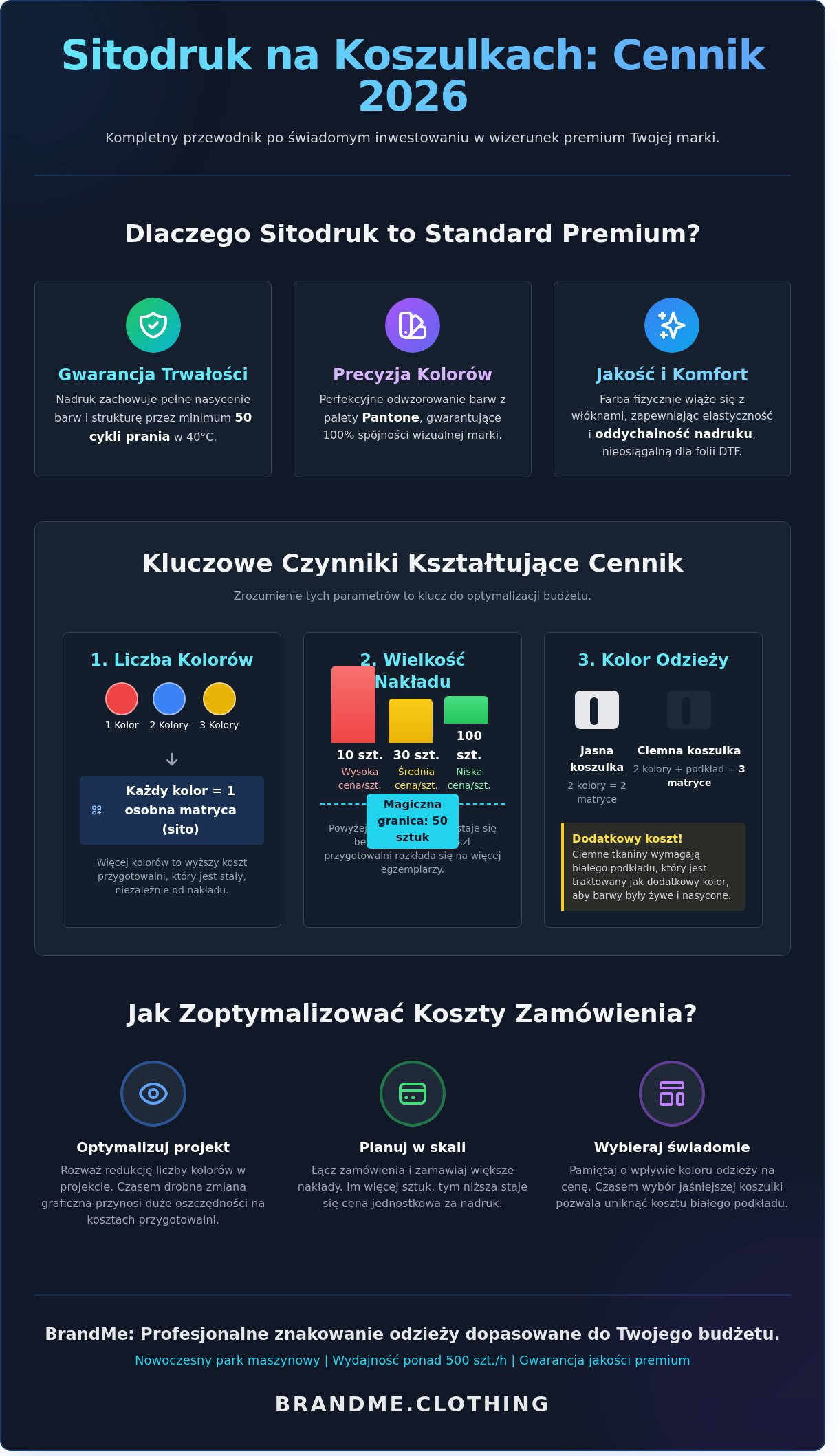
Many entrepreneurs wonder why the screen printing on t-shirts price list is not a fixed value. The answer lies in the specifics of the preparatory process. Each design requires creating a separate screen for each color used in the graphic. This generates fixed costs that are independent of the number of garments ordered. If you plan a run of 10 pieces, the cost of preparing the screens will make the unit price high. The situation changes dramatically with larger series. Then, the pre-press costs are spread over hundreds of pieces, making this method unrivaled in terms of economics.
In 2026, screen printing beats digital printing (DTG) wherever scale and repeatability are important. While digital printers work slowly, modern carousel screen printing machines can print over 500 t-shirts in one hour. This translates into shorter lead times and significantly lower operating costs for wholesale orders. Choosing this method is a conscious decision to invest in an image that will last for years of intensive use.
Why is screen printing the standard for premium corporate apparel?
Premium apparel requires solutions that do not lose value after a few wash cycles. Screen printing guarantees resistance that transfer methods cannot match. Plastisol and water-based inks used in professional printing houses retain color depth even after 50 washes at 40 degrees Celsius. Another key advantage is the precise reproduction of Pantone colors. This allows brands to maintain 100% visual consistency, which is impossible with standard CMYK printing. This color saturation makes the logo look professional in any lighting.
When to choose screen printing instead of embroidery or DTF?
Market analysis shows that the screen printing on t-shirts price list becomes most cost-effective for runs exceeding 50 pieces. Unlike computer embroidery, screen printing does not burden the material. This is crucial for light Premium T-shirts with a grammage of 150 to 180g. Large, uniform print areas made with screen printing remain flexible and allow the skin to breathe better than thick DTF films. If your brand needs a large graphic motif on the back, screen printing will provide wearing comfort that no other technique can. Check out our offer at https://www.brandme.clothing/collections/all to see how we execute projects for the most demanding clients.
Key factors affecting print cost: Colors and run size
Understanding the pricing mechanism is the first step to optimizing your marketing budget. Screen printing is a technology that absolutely rewards planning and scale. Each element of the graphic directly affects how the screen printing on t-shirts price list ultimately appears in your cost breakdown. A professional approach to clothing production requires an awareness that the price does not come out of thin air, but results from precise technological processes.
The number of colors is the most important parameter. In screen printing, each color requires a separate screen to be created. If your design contains five colors, we need to prepare five separate screens. On dark fabrics, the situation becomes more complex; an additional white underbase is necessary. This is the technical foundation that ensures colors are saturated and do not "soak" into the material. In practice, this means that printing on a black t-shirt will always be more expensive due to the cost of one additional screen and one machine pass.
The scale of production drastically changes the profitability of the project. For a run of 30 pieces, the pre-press costs are spread over a small number of products, which increases the unit price. The situation changes dramatically for orders over 100 or 500 pieces. Then, the cost of the screens becomes marginal, and you mainly pay for the printing service itself and the ink. Another factor is the print size. The standard A4 format is the base, but large-format prints (A3 or larger) require larger screens and more material consumption, which usually increases the rate by 15 to 25 percent.
Understanding pre-press (screen) costs
The pre-press fee includes film production, screen exposure, and carousel machine setup. In 2026, standard rates in the Polish market range from PLN 80 to PLN 160 net per screen. This cost is a one-time fee. When reordering with the same configuration, many printing houses offer discounts for re-setting the machines because the films are already ready. This is a strategic saving for brands that build permanent collections and regularly replenish their stock.
Impact of ink type on final price
The choice of ink defines the character of the product. Plastisol inks are the market standard; they are durable and provide excellent coverage. However, if you are aiming for the premium segment, it is worth considering water-based inks. They are about 10 percent more expensive but offer a "soft hand," meaning the print is almost imperceptible to the touch. For brands seeking uniqueness, we have prepared special effects options. Puffy (3D), fluorescent, or metallic inks add prestige to clothing, although they require an additional charge for the specialized component. When planning your collection, check out our ready-made product solutions that work best with advanced printing techniques.
- Color scheme: More colors mean a higher starting cost.
- Run size: The more pieces, the lower the price per print.
- Substrate: Dark materials require a white underbase (additional cost).
- Format: XL prints require more work and raw materials.
Economies of scale: When does screen printing become unbeatable in price?
When choosing a decoration technology, you must understand a simple rule: screen printing loves high volumes. This is a technique where the greatest cost is generated by the process of preparing printing forms and precisely setting up the machines. Once this stage is behind us, each subsequent piece of clothing costs a fraction of the initial amounts. This is where the greatest power of advertising budget optimization is hidden.
The threshold of 50 pieces is the moment when the screen printing on t-shirts price list becomes most attractive to business customers. For smaller series, the costs of screens are spread over too few products, which increases the unit price. Analyzing the market realities in 2026, the cost differences are colossal:
- 20 pieces: Pre-press costs can account for as much as 45 percent of the total order value.
- 100 pieces: The share of fixed costs drops to about 12 percent, making the offer very competitive.
- 500 pieces: The unit cost of printing reaches a minimum, and screen printing outperforms other methods in terms of profitability.
The lead time for screen printing orders is closely related to machine preparation. Setting up a carousel for 4-color printing takes 60 to 90 minutes. However, once production starts, the machine prints hundreds of pieces per hour. This speed goes hand in hand with absolute repeatability. Each logo, whether on the first or the five hundredth t-shirt, will have identical color saturation and edge precision. This is a key argument for brands that care about visual identity consistency.
Screen printing for small businesses vs. corporate orders
Smaller brands are often concerned about the barrier to entry for screen printing. At BrandMe, we use transparent flat rates for small series, allowing local businesses to enjoy premium quality without having to order thousands of pieces. The key to budget management for multi-color graphics is conscious design. Each additional color means another screen and a separate machine pass. If you are planning an economical start, check out our full clothing offer and opt for 1 or 2-color graphics that look extremely professional on high-quality cotton.
Hidden costs you'll avoid at BrandMe
Transparency is the foundation of building trust in B2B relationships. Many printing houses add extra charges for every minute of consulting or technical file preparation. Our process is different. Graphic file verification for screen printing requirements is included in the service price. You will not encounter sudden surcharges for packaging goods or a lack of clarity regarding transportation costs. You receive a concrete offer where the screen printing on t-shirts price list is clear from the first inquiry. This allows you to precisely plan your company's expenses without worrying about exceeding the assumed budget.
How to optimize order costs without sacrificing quality?
Optimizing your budget in 2026 doesn't mean looking for the cheapest contractors, but rather eliminating unnecessary technical costs. A key factor influencing the screen printing on t-shirts price list is the number of colors used. Each color requires a separate screen and machine setup. If your logo has subtle tonal transitions or unnecessary outlines, simplify them before sending them to the printer. Reducing from three colors to two can lower pre-press costs by almost 33%.
A clever design trick is to use the color of the fabric itself as an element of the graphic. When designing a white print on a black t-shirt, do not print black logo details. Leave these areas blank, allowing the material to "show through." This way, you save one screen while maintaining the full depth of the design. Also, remember order logistics. Grouping orders once a quarter is much more cost-effective. The cost of screen preparation is then spread over a larger number of pieces, which drastically lowers the unit price.
Choose standard marking locations. Printing on the chest or back is a basic option that every print shop executes fastest. Marking on seams, sleeves, or at the very bottom edge requires specialized tables and longer machine setup time. Such non-standard placement can increase the price per piece by up to PLN 4 net.
Designing for screen printing: Tips for graphic designers
The clarity of the print depends on the quality of the source file. Provide vector graphics only in AI, EPS, or PDF formats. Avoid rasters and tonal transitions for low print runs, as they require costly color separation. The minimum line thickness should be at least 0.2 mm. Elements that are too thin may be "flooded" with ink or disappear during screen exposure, which will ruin the final visual effect of your brand.
Choice of apparel base and final price
Cheap promotional clothing with low grammage often shrinks after the first wash, causing unsightly ink cracking. Investing in a Premium T-shirt with a grammage of 180g or higher ensures dimensional stability. A solid base holds the print better and makes the garment look professional even after 40 wash cycles. You can read more about choosing appropriate textiles in our article: Corporate apparel with logo: A complete guide.
Brandme: Professional garment branding tailored to your budget
Brandme is not just another ordinary printing house. It is a modern competence center where the clothing creation process begins with conception, goes through professional sewing, and ends with precise, final printing. In 2026, full control over every stage of product creation is becoming the market standard. Our production located in Krzemienica allows us to maintain rigorous quality standards while shortening order fulfillment times. Local production means no delays resulting from global logistics and certainty that goods will arrive on time.
We have a modern machine park that in 2026 offers precision unavailable with older technologies. We use advanced automatic carousels and drying systems that guarantee perfect reproduction of Pantone colors and exceptional print durability. We understand that the screen printing on t-shirts price list depends on many variables, such as the number of colors or the size of the print run. That is why we forego rigid, customer-unfavorable tables in favor of an individual valuation for each project. This strategy allows us to optimize costs where others impose high margins.
Your brand deserves premium quality
Choosing high-quality promotional clothing is the simplest way to build authentic customer loyalty. Dozens of marketing agencies and well-known brands that sought durability beyond a single season have already trusted us. Our products stand out with color saturation and resistance to repeated washing at 40 degrees Celsius. This directly translates into perceiving your company as professional and detail-oriented. We invite you to send your graphics for a free quote that will consider the specifics of your brand.
Start collaborating with Brandme
The ordering process at Brandme is transparent and geared towards speed. It all starts with your request for a quote. Within 24 hours, we prepare a detailed quote that includes the optimal branding technique. The next step is a professional visualization. It allows you to see the final effect and make corrections before starting the machines. After your project approval, we begin production, taking care of every centimeter of the print.
If you are planning a larger investment and want 100% certainty about your choice, we offer the possibility of ordering samples before the full run. This is a safe solution that eliminates the risk of error and allows you to check the fabric grammage and ink quality in practice. Our team of consultants will help you select parameters so that the screen printing on t-shirts price list fits within your marketing budget without sacrificing premium aesthetics.
Build a market advantage with professional clothing
Choosing the optimal marking method is an investment that pays off in the form of a strong image for your company. Analysis of trends for the upcoming seasons clearly shows that the screen printing on t-shirts price list becomes most favorable for orders exceeding 50 pieces, where the unit cost significantly decreases. We focus on production in Poland, using only certified, high-grammage fabrics. This approach eliminates the risk of quick damage and fading prints, which is crucial for building your brand's authenticity.
At BrandMe, we know how important it is to match solutions to a specific budget without sacrificing premium aesthetics. Our many years of experience in creating merchandise for market leaders allow us to effectively optimize production processes. We offer exceptional flexibility, fulfilling orders from just 1 piece for selected marking techniques. This allows for free testing of new designs before commissioning a large print run. Your brand will gain a professional setting that will distinguish it from the competition and emphasize attention to detail.
Check out our clothing offer and request a screen printing quote
Choose a proven partner and create products that truly support your business and make your team proud.
Frequently Asked Questions about Screen Printing on T-Shirts
How much does screen printing on 100 T-shirts cost?
The cost of screen printing on 100 T-shirts mainly depends on the number of colors in the design and the quality of the selected apparel. For such a volume, the unit price of a single-color print usually ranges from 5 to 12 PLN net per piece. The larger the order volume, the lower the unit price becomes, making screen printing on T-shirts unbeatable for series exceeding 50 pieces.
What is the minimum order quantity for screen printing?
The minimum order quantity in professional print shops is usually 20 to 30 pieces of one design. This is due to the high costs of preparing stencils and setting up the machine, which are simply not cost-effective for the customer for smaller quantities. For single orders or very small series, digital techniques are a better solution, as screen printing only shows its economic advantage in mass production.
Is the cost of preparing stencils a one-time fee?
Yes, the cost of preparing stencils is a fixed fee charged for the first run of a specific graphic design. Each color in your logo requires a separate screen, which generates an expense of 60 to 110 PLN per stencil. Many print shops store ready-made stencils for 6 months, so when reordering the same design in a short time, this fee may be completely waived or significantly reduced.
Is screen printing on dark T-shirts more expensive?
Printing on black and dark textiles is more expensive because it requires an additional underbase layer for the actual colors. White underbase ink ensures proper color saturation and prevents them from "soaking" into the dark material, which is technically counted as an additional color in the printing process. In practice, this means exposing one more stencil, which increases the unit cost by about 15 to 25 percent compared to printing on white apparel.
How to prepare a graphic file to lower the printing price?
The best way to reduce costs is to provide a vector graphic with a limited number of colors. Each additional shade in the design necessitates the creation of another stencil, which directly impacts the screen printing on T-shirts price list and the final invoice. Avoiding complex tonal transitions in favor of solid colors from the Pantone palette shortens production preparation time and avoids fees for additional graphic processing.
Is screen printing more durable than DTF printing?
Screen printing is considered the most durable method of garment decoration, lasting over 100 wash cycles without visible loss of color saturation. Screen printing inks penetrate deep into the fabric structure, making the print extremely resistant to stretching and mechanical damage. Although DTF technology handles details well, screen printing is the standard for workwear and premium apparel, where multi-year product lifespan is crucial.
What is the maximum number of colors that can be screen printed?
Most modern automatic carousels allow for precise printing of 6 to 12 colors in one cycle. For photographic-style designs, color separation or CMYK techniques are used, allowing for hundreds of shades with just a few stencils. However, it should be remembered that each color beyond the standard palette increases the complexity of machine setup and raises the cost of production preparation.
How long does it take to fulfill an order for screen printed T-shirts?
Standard order fulfillment time is 5 to 10 business days from the moment of design approval and advance payment. This process includes stencil exposure, ink selection, and the printing and thermal curing process in the heating tunnel. During periods of increased demand, such as the pre-holiday or event season, these deadlines may extend to 14 days, so it is worth planning larger campaigns well in advance.