

Did you know that 84% of recipients form an opinion about your professionalism based on the quality of clothing your team wears? In an era of mass production, screen printing on T-shirts remains the only solution that will stand the test of time and over 60 cycles of intensive washing without losing its original clarity. This is not just ordinary branding; it's an investment in durability that, in 2026, defines the standards of modern branding and effectively distinguishes market leaders from companies that cut corners on quality.
You're probably tired of worrying about graphics washing out or logo shades that significantly deviate from your official Pantone palette. In this article, we'll show you exactly why this classic method still outperforms the competition and how to strategically manage your budget for orders over 50 pieces, so that every zloty spent contributes to your company's prestige. We will examine specific technical parameters, discuss the optimization of prepress costs, and prove that perfect detail reproduction is the shortest path to building an authentic and consistent visual identity for your brand.
Key Takeaways
- You will discover why screen printing on T-shirts remains unrivaled in terms of durability and cost-effectiveness for large orders in 2026.
- You will learn the differences between plastisol and water-based inks, enabling you to consciously choose the finish effect perfectly suited to your brand's character.
- You will find out in which situations screen printing outperforms computer embroidery and the DTF method, providing projects with maximum flexibility and resistance.
- You will understand how intelligent optimization of color count and selection of a premium base allow you to reduce unit costs while maintaining a prestigious look.
- You will see how a strategic approach to apparel branding builds a professional image and a real competitive advantage in the market.
Why is screen printing on T-shirts the gold standard for your company?
Choosing the right branding method is a strategic decision that affects the perception of your brand for years to come. Screen printing on T-shirts remains the undisputed leader in the corporate apparel industry, combining artisanal precision with modern efficiency. This technology involves mechanically forcing dense ink through a specialized matrix, or screen, directly onto the fabric structure. Although the history and technique of screen printing have evolved over decades, the fundamental principle has remained unchanged: it's a physical bond of pigment with the fiber that guarantees indestructibility.
In 2026, despite the expansion of digital printing, screen printing wins in the professional sector due to its unique texture. Screen printing ink is palpable to the touch, creating a raised, substantial texture that immediately positions the product in the premium segment. This is not the thin, "sticker-like" layer known from cheap alternatives. It's a solid coating that withstands over 150 wash cycles at 60 degrees Celsius, a result unattainable by other methods under conditions of intensive corporate use.
Scalability and economies of scale in business
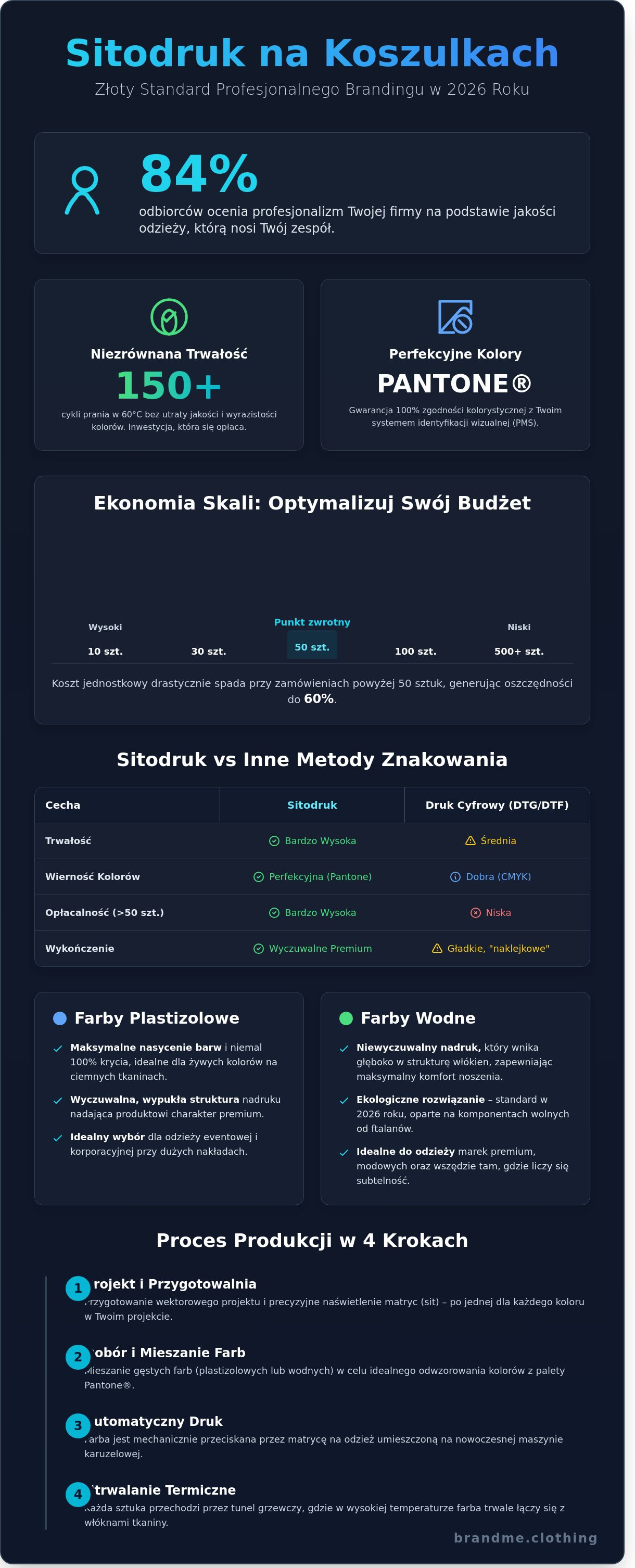
For operational managers in Poland, the key argument is production mathematics. Screen printing on T-shirts becomes competitively priced when the order threshold of 50 pieces is exceeded. This is because the largest cost is prepress, which involves exposing screens and setting up carousel machines. Once this process is completed, the cost of printing each subsequent item drastically decreases. For runs of 500 or 1000 pieces for corporate events, savings compared to digital printing can reach up to 60% of the budget, while also shortening the lead time by 3 business days.
- Fixed prepress cost regardless of the number of project repetitions in the future.
- Ability to print up to 800 T-shirts per hour on modern automatic machines.
- No hidden operating costs for large batches of goods.
Pantone color fidelity – the key to a consistent brand
Professional visual identity tolerates no compromises when it comes to color. In screen printing, inks are mixed according to strict Pantone Matching System (PMS) recipes. This means that your company's logo on a cotton polo will have exactly the same shade as on business cards or the website. CMYK digital printing often struggles with inaccuracies in the saturation of primary colors, especially with difficult shades of navy blue or bright green.
Visual consistency builds trust. A team dressed in uniform, high-quality apparel from the range available in our clothing collections presents itself as a cohesive organism, not a group of random individuals. By choosing screen printing, you invest in color saturation that won't fade after the first summer season due to UV rays. This is the standard required by the largest Polish corporations concerned with their prestige in 2026.
The screen printing production process: From design to finished T-shirt
Screen printing on T-shirts is a process where advanced technology meets artisanal precision. Everything begins with the preparation of screens, which are the heart of this method. Each color in the design requires a separate screen, which, for multicolored graphics, means perfect alignment of elements with an accuracy of 0.1 mm. This precision determines whether the final logo will look professional. Although this technique has historical roots, as described by The Metropolitan Museum of Art's article on the artistic screen printing process, modern industrial production relies on full automation and polymer chemistry.
Choosing the right ink is key to achieving the desired "hand" of the fabric. Plastisol inks offer unparalleled color saturation and almost 100% opacity, which works perfectly for large runs of event apparel. In contrast, modern water-based inks penetrate deep into the fiber structure, leaving the print almost imperceptible to the touch. In 2026, ecology is becoming the standard; currently, 85% of our projects are based on phthalate-free and harmful solvent-free components.
In a modern sewing factory, the heart of the machine park is the automatic carousel. This device allows for printing up to 500 T-shirts per hour, maintaining repeatability that cannot be achieved by hand. The last, critical stage is the drying tunnel. The print must be subjected to a temperature of exactly 160 degrees Celsius for about 120-180 seconds. Such polymerization of the ink ensures that screen printing on T-shirts withstands over 50 wash cycles without visible loss of quality or cracking of the graphic.
Preparing graphics for screen printing
Forget about .jpg or .png files downloaded from the internet. Professional production requires vector graphics (.ai, .cdr, or .pdf). Each line in the design must be at least 0.2 mm thick for the mesh openings to properly allow pigment through. When printing on dark fabrics, a white underbase plays a crucial role. Without this additional layer, colors would lose their intensity and appear dull. This is an essential investment that ensures your corporate colors will look identical on every material.
Special effects that will make your merch stand out
Standard printing is just the beginning of possibilities. You can enhance the value of your collection by using premium solutions:
- Puff Print: A special foaming additive makes the print "grow" in the drying tunnel, creating an impressive 3D structure.
- Metallic Inks: High-gloss gold and silver add elegance to fashion brands.
- Reflective Prints: Utilize glass microbeads that reflect light, which is crucial for safety and a "wow" effect on social media.
If you're planning to launch a new collection and are looking for a base that can handle these advanced techniques, check out our high-grammage products, perfectly suited for professional branding.
Screen Printing vs. Embroidery vs. DTF: What to choose for your brand?
When to opt for computer embroidery?
Embroidery is synonymous with elegance and the premium segment. Choose it for corporate image apparel, such as polo shirts or thick sweatshirts with a grammage above 280g. Its mechanical durability is the highest among all methods; the embellishment will withstand even 250 wash cycles at high temperatures without losing color saturation. This solution is ideal for the HoReCa and logistics industries, where workwear is subject to extreme wear. Remember that embroidery has its limits. It cannot reproduce fine details thinner than 1 mm or complex tonal transitions, which screen printing on T-shirts executes with photographic precision using halftones.
Modern DTF printing – when is it a better alternative?
Direct to Film technology revolutionized the apparel personalization market after 2023. It's a lifesaver for small brands and single-item orders. DTF allows for printing from 1 piece without incurring prepress costs. Choose this method when your design includes multi-color tonal transitions or photos. Where screen printing would require preparing 8 or 10 separate screens, digital printing handles it in one pass. However, remember the difference in the "feel" of the print. DTF creates a thin polymer layer on the fabric surface, which is less breathable than screen printing inks. For large designs on the chest, this can reduce the user's thermal comfort on hot days.
How to plan your order to optimize your budget?
Effective budgeting for corporate apparel in 2026 requires an understanding of the technology. Screen printing on T-shirts is unrivaled in terms of price for large orders, but its cost depends on precise screen preparation. Each additional color in your logo means a separate screen, directly increasing the prepress cost by about 120 to 180 PLN for each color. If you genuinely want to save, limit your design to 2 or 3 key colors from the Pantone palette. This technique can reduce the unit price by as much as 25% for orders of 100 pieces.
Scale is crucial. The process of setting up a carousel machine takes the same amount of time for 20 as for 500 T-shirts. Consolidating orders into one larger run instead of ordering smaller batches quarterly is the simplest way to optimize. Statistics from the Polish market show that ordering 200 pieces at once is nearly 40% cheaper per T-shirt than executing four separate orders of 50 pieces. Before starting mass production, always demand verification of a color swatch on the target material. This way, you avoid costly corrections if the ink shade reacts with the fabric dye.
Choosing fabric weight and composition
The material is the foundation. Combed cotton with a smooth weave provides an ideal surface for plastisol and water-based inks. Screen printing on T-shirts done on a base of 190g or higher ensures that the print will not negatively interact with the fabric after a few washes. Polyester fabrics require the use of additional color migration blockers, which increases production costs by about 15%. By choosing a higher quality base, you invest in the durability of branding that will not fade for at least 50 wash cycles. Check out our Premium T-shirt offer, which has been selected for optimal compatibility with screen printing.
Logistics and timeliness in 2026
Under current market conditions, the standard lead time is 10 to 14 business days. Planning ahead avoids surcharges for express service, which can increase the invoice by 20%. The key to smooth cooperation is a professional brief. Prepare files in vector format (AI, EPS, or PDF) and specify the exact print dimensions in centimeters. Cooperation with a Polish manufacturer eliminates the risk of customs delays and allows for immediate communication. Local production also means a lower carbon footprint and support for the domestic textile industry, which is increasingly becoming a requirement in ESG reports of modern companies.
Want to optimize corporate apparel costs without compromising quality? Choose proven Premium bases and request a quote today.
BrandMe: Your center for professional apparel branding
BrandMe has been fulfilling its mission of "dressing for success" for the biggest players on the Polish market for years. We operate as an integral part of Unicat Sp. z o.o., giving our clients direct access to certified materials and technologies that set industry standards in 2026. Our modern machine park allows us to carry out screen printing on T-shirts with a capacity exceeding 5000 pieces per day, while maintaining precision down to a fraction of a millimeter. We are not just a contractor; we are an advisor who will match the branding technique to the specifics of your industry. We know that a dynamic tech startup has different requirements than a construction company needing special purpose workwear.
Unicat Sp. z o.o.'s quality guarantee is not just an empty slogan. It's real security for your marketing budget. Every batch of goods undergoes rigorous quality control, eliminating the risk of defective prints. We use inks with increased abrasion resistance, so logos retain color saturation even after 50 wash cycles at 40 degrees Celsius. This approach has earned us the trust of hundreds of businesses across Poland, from local manufacturers to nationwide retail chains.
Apparel production from scratch
Many companies limit themselves to ready-made catalog products, which often involves compromises in terms of cut or material quality. We go a step further. We offer tailoring of dedicated styles that are created with your project in mind from the very first thread. Such clothing perfectly showcases screen printing on T-shirts, as we can plan prints in places inaccessible to standard machines, for example, on seams or sleeve edges.
We personalize every element of the product. You can decide on the cotton weight, thread color, and even the unique finish of the cuffs. Creating your own clothing brand with BrandMe becomes simpler thanks to comprehensive support in sewing in custom labels and branding accessories. This way, your company doesn't just hand out ordinary gadgets but offers a product that employees and customers want to wear every day. Learn more about how professional promotional clothing production is created and how it builds your business's value.
Your brand deserves premium quality
Cheap promotional clothing is often a hidden cost that burdens a company's image. Faded colors and cracked prints after a few weeks of use are the worst calling card for a professional business. At BrandMe, we treat clothing as an investment that should work for your prestige for years. We use only ecological water-based and top-grade plastisol inks that are safe for skin and the environment.
Do you want to see how your logo will look on our premium products? Contact our team of experts. We will prepare a free, detailed project quote for you within 24 hours. We will help you choose the optimal branding technique to ensure the final result exceeds your expectations. Contact us and create professional merch for your company that will become the foundation of your visual communication.
Build a strong image with quality that doesn't fade
Choosing a branding technology is more than just an aesthetic decision; it's a strategic investment in the longevity of your brand. Screen printing on t-shirts in 2026 continues to dominate as the most economical and durable method for bulk orders, ensuring saturated colors for years of use. At BrandMe, we produce apparel in Poland, specifically in Krzemienica, where we daily support market leaders in creating a consistent visual identity. We use only certified, high-grammage fabrics, guaranteeing that the finished product will withstand the test of time and intensive use.
A professional team appearance is the foundation of customer trust. Instead of seeking savings in half-measures, opt for proven solutions that genuinely contribute to your success. Our experience in executing thousands of projects allows us to optimize costs without compromising premium quality. Your brand deserves a presentation that highlights its unique character and professionalism in every detail.
Design and order premium screen-printed t-shirts
Take the first step toward creating apparel that you and your team will be proud of every day.
Frequently Asked Questions about Screen Printing on T-shirts
How much does screen printing on 100 t-shirts cost?
The price of screen printing on 100 t-shirts starts at approximately PLN 9.50 net per color print. For more complex designs requiring four colors, the cost increases to PLN 18.00 net per piece. Remember that the final quote includes matrix preparation, which at BrandMe we charge as a one-time fee. Larger quantities drastically lower the unit price, making this method the most cost-effective for your brand.
What is the minimum quantity for screen printing at BrandMe?
The minimum quantity for screen printing at our print shop is 30 pieces from a single design. This number allows us to optimize the costs of screen preparation and matrix exposure, ensuring an attractive price for you. For smaller quantities, we recommend other techniques, but screen printing provides unrivaled durability and quality for medium and large production runs.
Does screen printing crack after washing?
Properly executed screen printing does not crack even after 100 wash cycles, provided you follow the manufacturer's recommendations for temperatures of 30 or 40 degrees Celsius. At BrandMe, we use only certified inks that permanently bind to the fabric structure. The high curing temperature in the drying tunnel makes the print flexible and resistant to stretching. It is the most durable marking method available on the market in 2026.
What are the differences between water-based and plastisol inks in screen printing?
Water-based inks penetrate deep into the cotton structure, providing a soft hand feel, while plastisol inks create a palpable, very durable layer on the surface. By choosing water-based inks, you prioritize ecology and maximum breathability, which works great for lifestyle collections. Plastisol inks, in turn, offer ideal color reproduction from the Pantone palette and the highest mechanical resistance to damage.
Does screen printing allow for printing photos on t-shirts?
Yes, screen printing allows for printing photos using the halftone separation technique or the CMYK process. This achieves smooth tonal transitions and high image detail on textiles. However, it requires precise matrix preparation and the use of dense screen printing meshes with high resolution. The final effect is a professional graphic with photographic quality that retains its color depth for many years of use.
How to prepare a graphic file for screen printing?
Prepare the graphic file preferably in a vector format, such as PDF, AI, or EPS. Convert all fonts to outlines, and define colors according to the Pantone Solid Coated swatches so we can reproduce them perfectly. If you are submitting a raster graphic, ensure it has a resolution of at least 300 DPI at a one-to-one scale. Precise file preparation is the foundation that allows us to apply screen printing on t-shirts with attention to every detail.
Can screen printing be used on hoodies and polyester?
Screen printing works perfectly on thick hoodies and polyester apparel when using appropriate inks that block dye migration. For polyester, we use special underbases that prevent the fabric color from bleeding through the applied print. Hoodies, in turn, require precise positioning due to seams and pockets, which at BrandMe we have mastered to perfection thanks to our modern machinery.
How long does it take to fulfill an order for screen-printed t-shirts?
The standard order fulfillment time is 7 to 10 business days from the moment of visualization approval and invoice payment. During periods of lower production load, your products may be ready for dispatch in as little as 5 days. We always ensure strict adherence to deadlines, as we know that punctuality is a key element in building your business's professional image.