

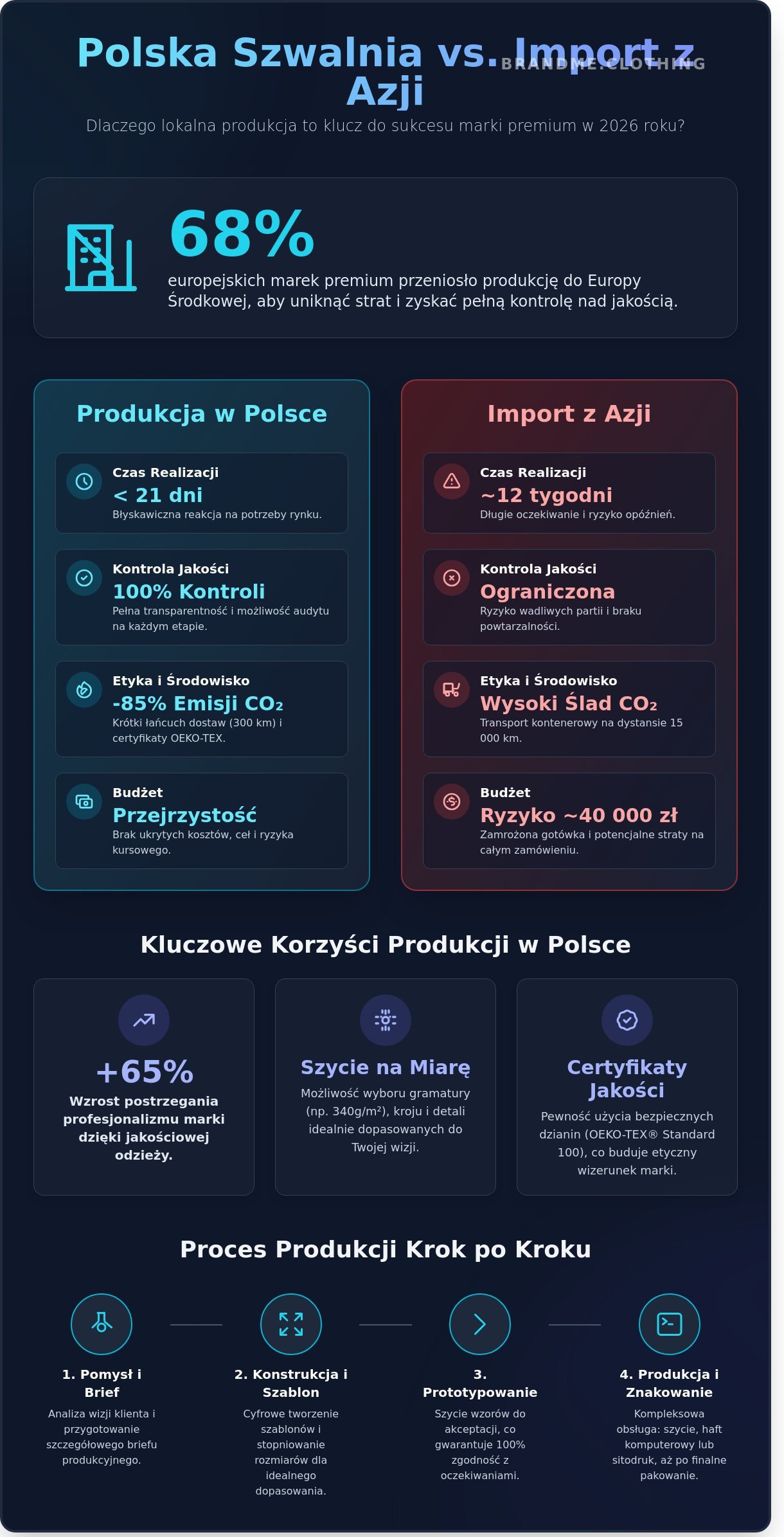
Did you know that as many as 68% of European premium brands have moved their production to Central Europe in the last year to avoid losses resulting from faulty imported batches? A professional apparel factory in Poland today is not only logistical convenience but, above all, a guarantee that your merchandise will not lose its shape after two washes. Instead of risking a budget of PLN 40,000 on goods from Asia that you cannot touch before shipment, more and more companies are opting for local precision and process transparency.
You probably feel frustrated when, after 12 weeks of waiting for delivery, it turns out that the shades of the material differ in each item, and communication with the subcontractor resembles wandering in a fog. We understand that your brand deserves more than mediocrity. In this guide, you will learn how to choose a partner who will deliver high-quality company clothing in less than 21 days, taking care of every detail of your logo. We will analyze the real production costs in Polish zloty, technological standards for 2026, and check how to effectively audit Polish factories so that your team looks impeccable and builds customer trust from the first glance.
Key Takeaways
- Discover why local production is the foundation for full quality control and building an ethical image for a modern premium brand.
- Learn about the key stages of garment construction and prototyping that guarantee the perfect fit and repeatability of your products.
- Explore techniques for selecting top-quality materials and the benefits of computer embroidery in creating prestigious company clothing and merchandise.
- Check how to prepare a professional production brief so that every apparel factory in Poland can become your strategic business partner.
- Understand how to optimize costs through the right approach to MOQ and choosing comprehensive service from design to final branding.
Why an apparel factory in Poland is key to your brand's success
A modern apparel factory in Poland is no longer just a place where pieces of material are joined. It is an advanced technological center integrating precise tailoring, original garment construction, and innovative branding methods such as screen printing or computer embroidery. In 2026, the market underwent a drastic transformation. Companies are massively giving up ready-made, no-name products that lose their shape after three washing cycles. Today, dedicated sewing that allows full control over every stitch is what counts. Choosing a local partner is a guarantee that your team will represent the brand with pride. This way, you avoid the image of a company dressed in stretched, shapeless t-shirts.
Local production provides an advantage that no import from Asian markets can offer. Shortening the supply chain from 15,000 kilometers to just 300 kilometers allows for a rapid response to market needs. The Polish clothing industry currently focuses on full transparency and the highest technical standards. The quality of clothing is the first signal your customer receives. If the material is substantial and the logo is executed with surgical precision, the perception of your company's professionalism increases by 65% at the first visual contact. This is an investment in visual capital that works for your profit every day.
Ethics and sustainable development in Polish tailoring
In 2026, CSR strategy is no longer an optional addition but the foundation of modern business. By choosing a Polish apparel factory, you gain the assurance that your clothes are made from certified OEKO-TEX Standard 100 fabrics. This guarantees skin safety and a complete absence of toxic substances. Production in Poland also radically reduces the carbon footprint. Giving up container transport in favor of local logistics reduces CO2 emissions by nearly 85%. Your brand becomes part of the solution, not the environmental problem, which conscious consumers appreciate.
Made-to-measure vs. catalog clothing
Investing in a unique cut is a milestone for building visual identity. While catalog clothing offers only a rigid standard, a professional apparel factory in Poland allows you to choose the material weight perfectly suited to a specific project. You can opt for premium hoodies with a weight of 340g/m2 with a dense weave, which will last for years of intensive use. This approach builds authentic employee loyalty. People want to wear clothes that are comfortable, fashionable, and durable. Well-tailored company clothing becomes their favorite everyday wardrobe item, not an unpleasant work obligation.
By choosing Polish production, you bet on agility. Instead of waiting 4 months for delivery from China, you receive a finished product in 4 weeks. This allows you to freeze less cash in goods and better manage your marketing budget. At Brandme, we know that quality is not just a word; it is the foundation of your credibility. We dress brands that do not compromise and want to be seen in the best possible light.
Apparel production process step-by-step: From concept to finished collection
Apparel production is a process where technical precision meets creative vision. Each stage, from the first sketch on the design to the packaging of the finished product, determines the final market success. A professional apparel factory in Poland not only sews pieces of material together but also acts as a technological advisor, ensuring that the product is durable, aesthetic, and repeatable. According to data contained in the report Polish fashion industry overview, our country is a key production hub in Central Europe, which results from high quality control standards and access to modern machinery.
Construction and pattern: The foundation of good clothing
It all starts with the construction. This is the stage where the constructor translates the graphic sketch into flat pattern elements. A good specialist considers not only the style but also the weight and elasticity of a specific material bolt. A key element is size grading. In Polish apparel factories, the standard is to create a full size chart (from XS to XXL) in such a way as to maintain body proportions in every variation. Currently, over 85% of professional design offices in Poland use digital archiving of projects. This allows for quick implementation of corrections and guarantees that a sweatshirt ordered a year from now will have an identical cut to the one from the first batch.
Sample production: Why it should not be skipped?
Skipping the prototyping stage is the easiest way to financial losses, which can reach up to PLN 15,000 for a medium-sized batch. Producing a sample allows verifying how the material behaves after washing. We test shrinkage then, which for high-quality cotton should not exceed 3-5%. On the prototype, we also check the placement of logos. Shifting the print by just 12 millimeters can completely disrupt the aesthetics of the t-shirt. This is the last moment to optimize costs before starting mass production. If the prototype meets expectations, it becomes the production standard against which the entire batch will be evaluated.
The next steps are pure technology and logistics:
- Branding: The choice between computer embroidery, screen printing, and heat transfer depends on the clothing's purpose. For workwear, we choose embroidery with a density of at least 5000 stitches; for event merchandise, durable screen printing is often better.
- Cutting and sewing: Precise cutting using a cutter minimizes material waste, which directly affects the unit price. Actual sewing is performed on specialized machines: overlocks, lockstitch machines, and coverstitch machines.
- Quality control: Each item passes through the hands of a controller. Seams, symmetry, and finish cleanliness are checked. At BrandMe, we believe that details build authority, which is why it is worth choosing proven solutions in apparel production that eliminate the risk of complaints.
- Garment finishing: Finished clothes are steam pressed, tagged, and packed in individual plastic bags or ecological cartons. Such prepared goods are ready for immediate shipment to the end customer or to a distribution warehouse.
By choosing a partner such as an apparel factory in Poland, you gain full control over each of these stages. Shortening the supply chain and the possibility of a personal visit to the factory are advantages that no production from Asia can replace. The transparency of the process translates into real value for your brand, building customer trust from the first touch of the material.
Materials and branding techniques: How to create premium apparel?
The choice of appropriate raw materials and embellishment methods determines whether your product will reach the premium shelf or be forgotten after the first wash. A solid apparel factory in Poland should offer access to certified fabrics and modern machinery. This is the foundation upon which customer trust is built. Quality is not a matter of chance; it is the result of conscious fiber selection and precise logo application.
Fabric selection: Weight is not everything
Many brands mistakenly judge quality solely by the grammage. A 180g T-shirt made of combed cotton will be significantly more durable than a 220g one made of cheap yarn. For T-shirt production, single jersey works best, while hoodies require loopback fabric. It is worth opting for fabrics with 10 to 20% polyester blend. Such a composition ensures that the clothing does not stretch at the elbows and maintains its shape even after 50 washing cycles. Look for certificates such as OEKO-TEX Standard 100. In 2024, these are already a market requirement for high-end products.
Embroidery, screen printing, or DTF? A branding guide
The branding method must match the character of the collection. The Polish clothing industry has been renowned for high-quality embellishments for years, attracting foreign contractors seeking precision. Each technique has its specific application:
- Computer embroidery: The most prestigious choice. Ideal for logos on hoodies weighing over 280g and polo shirts. It is practically indestructible and builds a premium brand image.
- DTF (Direct to Film) printing: A true revolution of the last 2 years. It allows for the reproduction of tonal transitions with a precision of up to 0.1 mm. This is an excellent option for smaller runs and complex graphics.
- Screen printing: The most economical for runs exceeding 100 pieces of a single design. It offers excellent color saturation and the highest mechanical resistance for large print areas.
Details that build a brand
True quality lies in the details. A professional apparel factory in Poland will help you choose woven labels that do not irritate the neck, and cotton drawstrings with metal tips. The use of ready-made Brandme clothing bases in image campaigns shows that even merchandise can have a boutique standard. Pay attention to finishing details like a contrasting material inside the hood or precisely matching thread color to the fabric. These small elements increase the perceived value of the product by 30 to 40%. This allows for higher margins and builds customer loyalty, who return for proven solutions.
Remember that details such as custom neck tapes with a logo or personalized buttons are not a cost but an investment in authenticity. In an era of mass production, these nuances distinguish market leaders from seasonal brands.
How to prepare for cooperation with an apparel factory and avoid mistakes?
The success of your collection depends on precision at the planning stage. A professional apparel factory in Poland will not guess your expectations; it needs specific technical data. Errors in specifications typically cost between 15% and 25% of the prototyping budget. Every ambiguity in the brief is a risk that the final product will not meet your quality standards.
Brief and technical documentation
Focus on details. Embroidery files must be prepared in vector format (.ai, .eps, or .pdf), which guarantees ideal sharpness of the embroidery machine's edges. For prints, demand rasters with a minimum resolution of 300 DPI at a 1:1 scale. Defining the target group determines the choice of material. Clothing for the construction sector must withstand 50 washing cycles at 60 degrees, while for the creative industry, the noble feel of cotton and an oversized cut are primarily important. The size chart is your most important contractual document. A difference of just 2 cm in shoulder width can generate 30% returns in the e-commerce channel.
Understanding the concept of MOQ (Minimum Order Quantity) is crucial for project profitability. In Polish realities, production thresholds usually start from 50 pieces of one model or color. For an order of 100 t-shirts, the unit price can drop by as much as PLN 15 compared to a micro-series of 20 pieces. Budgeting must be transparent. The final product price is usually the sum of raw material cost (45%), labor (35%), and accessories and branding (20%).
Logistics and lead times
Plan production at least 3 months in advance. Seasonality in the textile industry is ruthless. If you plan to sell a winter collection in October, your apparel factory in Poland should receive the final order no later than June. A standard production cycle lasts from 4 to 9 weeks, depending on the availability of fabrics in wholesalers. A huge advantage of local production is the speed of reaction in crisis situations. When a specific model sells out in 72 hours, a Polish partner can deliver a reorder within 14 working days. Container transport from Asia would take at least 6 weeks in such a case.
Modern cooperation goes beyond just sewing. It is worth looking for partners offering full garment finishing services. Services such as steam pressing, labeling, and packaging in individual biodegradable bags relieve your warehouse. Statistics show that outsourcing these processes saves the operational team about 45 hours of work for each batch of 500 clothing items. This is time you can invest in marketing and scaling sales.
Brandme: Your Polish apparel factory and partner in building your image
Choosing the right contractor is not just a matter of comparing price lists, but primarily finding a partner who understands the business goal of your collection. Brandme, operating within the structures of Unicat Sp. z o.o., is a modern apparel factory in Poland that takes the entire burden of the production process off your shoulders. Our headquarters in Krzemienica serves as a strategic operational center. Thanks to this location, we provide lightning-fast logistics throughout the country and direct access to the best raw materials from local producers. We are not just an ordinary subcontractor; we act as architects of your image, ensuring that every stitch contributes to the prestige of your brand.
We offer comprehensive services, which in practice means saving time and money. The entire process begins with professional advice on design and the selection of the appropriate fabric weight. Then we move on to precise cutting and sewing, ending with final branding and packaging. Such integration of all stages in one place eliminates the risk of communication errors and shortens the order fulfillment time by about 20% compared to dispersed models. Production flexibility allows us to adapt to the scale of your business. We serve both dynamic clothing brands needing short test series and large corporations ordering thousands of corporate apparel items annually.
Unicat Sp. z o.o.'s experience in creating clothing that genuinely builds brand value translates into concrete results for our clients. We know that high-quality corporate apparel can increase employees' sense of belonging to an organization by as much as 65%. Therefore, we treat each project as a marketing tool, not just a textile product. Our apparel factory in Poland is a place where technology combines with craftsmanship, and your vision takes real shape.
Why trust us?
We focus on transparency and quality that stands the test of time through many months of intensive use. We use only proven, certified fabrics with the Oeko-Tex Standard 100 certificate, which we order from reputable Polish suppliers. We have our own modern machinery park for computer embroidery and screen printing and DTF printing. This guarantees the highest precision in logo reproduction. We approach each client individually; we help choose solutions that fit within the assumed budget without compromising aesthetics. For example, for orders over 100 pieces, we suggest embellishment techniques that optimize the unit cost by PLN 3 to 5, while maintaining the luxurious appearance of the product.
Your brand deserves the best setting
Apparel is the strongest carrier of visual identification you can give your clients or employees. Our portfolio includes hundreds of successful projects: from thick, substantial event hoodies with raised embroidery, to elegant polo shirts made of high-quality pique cotton for company executives. Every piece of clothing leaving our sewing factory undergoes rigorous quality control, which reduces the risk of complaints almost to zero. If you want to see how we combine style with functionality, check out our full offer on the Brandme website. We invite you to contact us by phone or email; together we will create your new collection, which will become the showcase of your professionalism.
Build the Future of Your Brand with Polish Craftsmanship
The success of your collection in 2026 depends on quick reaction to trends and impeccable quality of workmanship. By choosing local production in Krzemienica, you gain direct insight into every stage of clothing creation. Our team of experts uses only certified premium materials, which effectively eliminates the risk of complaints and builds the prestige of your brand from the first day of sale. A professional clothing factory in Poland is the foundation on which you will base the development of your business without fear of costly delays or tailoring errors. At Brandme, we carry out comprehensive orders; from template construction to advanced marking techniques and precise packaging. Concentrating the entire process in one modern facility allows us to maintain the highest standards that conscious consumers expect today. Your brand is your unique identity. Do not let random contractors weaken its market message. Bet on proven solutions and Polish craftsmanship, which has been successfully conquering demanding European markets for years. We are ready to work with you to create a product that will become a new standard of quality in your industry.
Create your unique collection with Brandme, ask for a quote!
Your vision deserves uncompromising execution. We have the tools to achieve it.
Frequently Asked Questions about Clothing Manufacturing in Poland
How much does it cost to sew a hoodie with a logo in a Polish sewing factory?
The cost of sewing a hoodie with a logo usually ranges from 85 to 160 PLN net per piece for an order of 50 units. The final price depends on the fabric weight, type of embellishment, and complexity of the cut. By choosing a professional clothing factory in Poland, you invest in durability that builds the value of your brand for years.
What is the minimum order quantity in a clothing factory?
The minimum order quantity in most Polish production facilities ranges from 20 to 50 pieces of one model or color. Smaller batches are possible, but their unit price increases by about 35%. Cost optimization begins with orders above 100 units, which allows for better utilization of raw materials and machine operating time.
How long does custom clothing production take in Poland?
Custom clothing production usually takes 4 to 8 weeks from the moment of full prototype approval. This period includes the import of fabric, the cutting process, sewing, and graphic application. During peak season, i.e., in September and March, the waiting time may extend by an additional 15 business days, so it is worth planning collections in advance.
Does the sewing factory help in selecting the right material?
A professional clothing factory in Poland always offers support in selecting raw materials and provides samples with over 150 types of weaves. Experts advise whether loop-back jersey with a weight of 280g or organic cotton interlock would be better for your project. The selection of the appropriate material is the foundation of quality, which determines how the customer perceives your brand.
Can I order a prototype before producing the entire batch?
Making a prototype, or so-called initial sample, is a standard stage before starting serial production in any reputable company. The cost of sewing one test piece is usually 2 or 3 times higher than the wholesale price, but it effectively protects you from errors in the entire batch. A prototype allows you to check the fit of the cut and the precision of details in real conditions before spending the budget on 500 units.
What is the difference between computer embroidery and a logo patch?
Computer embroidery is performed directly on the material, which guarantees the highest durability and resistance to 60 or more washing cycles. A patch is a separate textile element that is sewn onto the clothing, allowing for a 3D effect or concealing minor fabric imperfections. Embroidery is considered the most prestigious form of branding, ideal for brands building a premium image.
What certificates should safe company clothing have?
Safe clothing should have the OEKO-TEX Standard 100 certificate, which confirms the absence of the 100 most harmful chemical substances in its composition. If you focus on ecology, look for sewing factories with the GOTS certificate, guaranteeing that at least 70% of the fibers come from certified organic crops. Such markings increase the credibility of your company in the eyes of 68% of conscious consumers in Poland.
Can a sewing factory in Poland send an order directly to my clients?
Many modern facilities offer fulfillment services, i.e., sending finished products directly to your end customers or company branches. The sewing factory then handles professional packaging, attaching your tickets, and full courier logistics. This solution shortens the supply chain by 3 days and allows you to focus exclusively on marketing and scaling sales.