

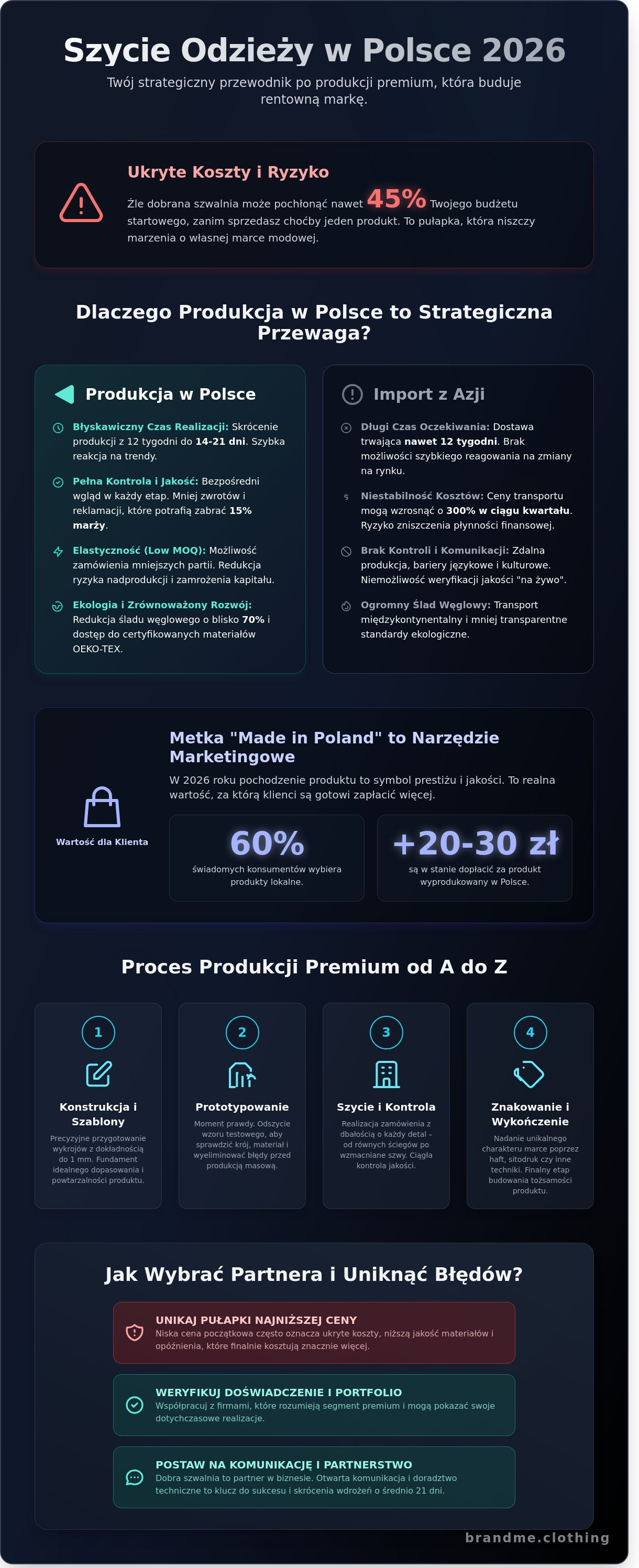
Did you know that a poorly chosen sewing workshop can consume up to 45% of your startup budget even before the first order is shipped? In 2026, the Polish fashion market no longer tolerates amateurism, which is why professional clothing manufacturing in Poland is becoming the foundation of every profitable business. You are probably concerned that a lack of technical knowledge or communication barriers with the manufacturer will turn your project into a logistical nightmare. That's understandable. Every ambitious creator wants their products to exude quality and build customer trust from the first touch.
This guide is your concrete roadmap. You will learn how to effectively manage production, from partner selection to advanced product labeling techniques. We will help you understand the real costs in PLN and avoid pitfalls that typically extend lead times by months. You will discover supplier selection methods that will allow you to shorten the implementation process for a new design by an average of 21 days. It's time to dress your vision in a premium standard that truly sells.
Key Takeaways
- You will learn why local production allows for rapid response to trends and supply chain optimization in 2026.
- You will get to know the complete collection realization process, proving that professional clothing manufacturing in Poland guarantees precision from pattern to finished design.
- You will discover how to select premium materials and labeling technologies, such as embroidery or screen printing, to give your brand a unique character.
- You will understand how to effectively verify production partners and avoid the trap of the lowest price, which often generates hidden costs.
- You will gain knowledge on how to combine traditional craftsmanship with modern technology to create clothing that is a powerful image-building tool for your company.
Why is clothing manufacturing in Poland the best choice for your business in 2026?
The fashion market in 2026 does not forgive delays or a lack of transparency. A decade ago, the sole priority was low unit cost, which massively directed production towards Asia. Today, the situation has changed dramatically. Intercontinental transport costs can increase by 300% in just one quarter, and the instability of global supply chains destroys the financial liquidity of many brands. In this context, clothing manufacturing in Poland becomes a strategic move that guarantees safety and predictability. Shortening delivery times from several months to several days allows for a rapid response to market trends. Your brand can launch a new collection while the competition is still waiting for container customs clearance.
Poland is currently one of the textile leaders in Central Europe. The strong Polish economy is based on modern technological facilities and a skilled workforce that understands the needs of the premium segment. By choosing local production, you gain direct insight into every stage of product creation. You can personally check the quality of the stitching or the softness of the fabric, which is practically impossible with remote production. This tangible control builds the foundation of a brand that wants to be associated with professionalism and attention to detail. Investing in Polish quality pays off faster due to a lower number of returns and complaints, which, in the case of cheap imports, can consume up to 15% of the margin.
Made in Poland as a powerful marketing tool
A "Made in Poland" label has ceased to be just information about origin; it has become a symbol of prestige. Market research from 2025 shows that over 60% of conscious consumers are willing to pay PLN 20-30 more for a locally made product. Using economic patriotism in a sales strategy is not just a trend; it is about building an authentic bond with the customer. Polish sewing workshops offer finishing standards that often exceed those from Southern Europe. Precise cutting, reinforced seams, and attention to the geometry of designs make BrandMe clothing a showcase for your business. A customer who once touches high-grammage Polish knitwear rarely returns to mass-produced items from chain stores.
Ecology and sustainable development in Polish production
In 2026, ecology is not just an image; it means strict ESG regulatory requirements. Clothing manufacturing in Poland reduces the product's carbon footprint by nearly 70% compared to imports from China or Bangladesh. A short transport route means less fuel consumption and lower emissions. Access to certified materials with the OEKO-TEX Standard 100 certificate ensures that clothing is free from toxic dyes and safe for the skin. Remember that the most effective form of environmental protection is durability. Clothing that retains its shape and color after 50 washes does not end up in a landfill after one season. This is a concrete value appreciated by modern customers looking for products for years, not just for a moment.
- Reduced production time from 12 weeks to 14-21 working days.
- Full control over working ethics and conditions in the sewing workshop.
- Possibility to order smaller batches of goods (low MOQ), which reduces the risk of overproduction.
- Easier communication and no language barriers when establishing technical details.
The clothing production process from A to Z: How your collection is created
Clothing production is a process that does not forgive mistakes. At Brandme, we know that every detail matters to your business. Clothing manufacturing in Poland guarantees full control over four key stages that transform raw material into a premium product. It all starts with precise construction. The pattern is the foundation, without which even the most expensive fabric will not fit well. Our designers prepare patterns with an accuracy of 1 mm, ensuring that the final product is repeatable and comfortable.
The next stage is prototyping. This is the moment of truth for every project. Creating a sample allows us to check how the selected material behaves in motion and whether the intended visual effect matches reality. Skipping this step is a risk that a professional brand cannot afford. At this stage, we eliminate errors that could generate losses of thousands of zlotys in mass production. According to market data, the Polish textile sector shows steady growth, and its growing role in international trade means that domestic sewing workshops are chosen by premium brands from all over Europe.
The choice of fabric is a strategic decision. A grammage of 180g is ideal for summer t-shirts, while hoodies require a solid weave weighing 320g or 340g. Prices for high-quality combed cotton start from around PLN 38 per kilogram, which translates into durability not offered by cheap substitutes from Asia. The last step is the actual sewing and rigorous quality control. Every seam and every finish goes through the hands of specialists, which eliminates the risk of complaints. Professional clothing manufacturing in Poland is an investment in an image that builds customer loyalty.
From idea to pattern: The foundation of a perfect cut
Ready-made patterns from catalogs rarely reflect the unique character of a brand. Custom sewing allows you to create a product tailored to your target group. Key is size grading, which ensures comfort for both S and XXL wearers. When preparing the technical specification (tech pack), we precisely define measurement points, thread types, and label placement. This approach shortens the collection implementation time by an average of 14 working days.
Contract sewing vs. comprehensive production
Supplying your own material (CMT model) seems cheaper, but full-service production offers the greatest peace of mind. By choosing comprehensive realization, you relieve yourself of the burden of logistics and raw material storage. A modern machine park, equipped with automatic cutting rooms and specialized overlocks, ensures precision that a small tailoring workshop cannot achieve. If you are looking for a partner who will guide you through the entire process, it is worth checking our production capabilities and opting for proven solutions.
Material and labeling technology selection: The heart of your brand
The foundation of any collection's success is the raw material. Your brand is not just a logo; it's a promise of quality that the customer feels on their skin with every touch. By choosing clothing manufacturing in Poland, you gain direct access to certified fabrics that meet stringent European standards. Combed cotton with a grammage of 210g is ideal for the premium segment, offering a substantial feel and resistance to pilling. In the sports industry, advanced polyester blends with silver ions dominate, ensuring thermoregulation. Polish production allows for precise selection of these components, as confirmed by an analysis of the Polish apparel market, which indicates the growing competitiveness of our domestic sewing workshops in the e-commerce and fashion sectors.
The choice of labeling technology must be in harmony with the nature of the material. Computer embroidery is synonymous with elegance and durability, retaining its properties even after 100 wash cycles. It is indispensable for thick hoodies with a grammage above 280g. Modern prints, such as screen printing or DTF, on the other hand, allow for the reproduction of complex tonal transitions on lighter t-shirts. The key to a professional image is consistency. If your design involves a minimalist aesthetic, opt for subtle embroidery. For large, colorful graphics for events, screen printing will provide the best value for money for runs exceeding 50 units.
Personalization is a process that builds customer loyalty. At BrandMe, we understand that details determine whether a garment becomes a favorite wardrobe item or ends up at the bottom of the closet. Clothing manufacturing in Poland allows us to test various technique combinations on specific fabric samples before launching full production. This eliminates the risk of error and ensures that the final product will be exactly as you envisioned.
Best apparel personalization techniques in 2026
In the upcoming 2026 season, we focus on durability and precision. Computer embroidery remains the leader in the premium category, especially for polo shirts and heavy hoodies, where the 3D effect and mechanical resistance are crucial. DTF and DTG printing are future technologies for short runs and multi-color designs, offering photographic quality details. For wholesale orders over 100 units, screen printing consistently wins in terms of process economics and color saturation that withstands years of intensive use.
Accessories that make a difference: Labels, patches, and packaging
Professional branding does not end with the main logo. Labeling clothing is the final touch that communicates attention to detail. Jacquard labels sewn into the neck or side seam increase the perceived value of the product by at least 25%. Personalized patches with your own logo are also very popular, adding a unique, artisanal character to clothing. Remember also about packaging standards. Aesthetic parchment and an ecological box with print are the customer's first point of contact with your brand, building a positive shopping experience from the moment the package is received from the courier.
How to choose a sewing workshop in Poland and avoid common mistakes?
Choosing the right production partner is a decision that will affect the profitability of your business for years to come. In Poland, there are currently over 15,000 entities involved in textile production, which makes selection a challenge. When looking for a contractor, focus on three pillars: specialization, transparency, and machinery. If your goal is clothing manufacturing in Poland with a premium character, do not choose a facility that primarily produces workwear. The difference in seam precision and the culture of working with delicate fabrics will be visible after the first wash.
The trap of the lowest price is the shortest path to an image failure. An offer that is PLN 5 cheaper per piece often generates hidden costs reaching 20% of the order value. Where do these differences come from? They usually result from the use of low-quality threads, lack of material stabilization, or skipping quality control at every stage of production. By choosing BrandMe, you are opting for transparency. Instead of freezing capital in thousands of units of goods, you can start with low minimum order quantities (MOQ). This allows you to test the market safely without the risk of unsold inventory accumulating in the warehouse. Before signing the contract, ask about the finishing standards of the garment interior and the method of securing seams; these are details that build customer loyalty.
Analysis of clothing production costs in Poland
The unit price structure of a product consists of several key variables. Approximately 40% of the costs are raw materials, i.e., high-quality cotton or technical blends. Another 35% is labor, which in Polish realities guarantees ethical working conditions and precision of execution. The remaining 25% covers branding, logistics, and packaging. Investing in a Premium T-shirt instead of a cheap substitute pays off instantly. A high-quality product retains its shape after 50 washes, which drastically reduces the complaint rate. Remember that increasing the run from 50 to 200 pieces can reduce the unit cost by nearly 15% thanks to the optimization of cutting processes and printing machine settings.
Common mistakes when ordering clothing manufacturing
- Skipping prototyping: Trying to save PLN 400 on a prototype is a mistake that, for a run of 100 pieces, can cost you PLN 10,000 in losses if the final cut does not meet expectations.
- Lack of color precision: Defining a color as "dark blue" is a simple path to misunderstandings. Always use Pantone numbers (e.g., 19-4052 TCX) to ensure that your brand maintains visual consistency.
- Incorrect calendar planning: The peak season in the Polish textile industry falls between September and December. An order placed in November with an "as soon as possible" deadline usually involves surcharges for express service or an extension of the realization by 3 weeks.
Professional clothing manufacturing in Poland requires a partnership approach and mutual trust. A good sewing workshop not only follows your instructions but also advises on how to optimize the design to make the product more durable and functional. Avoid companies that shy away from answering questions about the origin of fabrics or OEKO-TEX certificates. Transparency is the new currency in the world of fashion and corporate branding.
Do you want to avoid costly mistakes and immediately opt for proven quality? Build your brand with professional support from BrandMe.
Brandme: Your modern sewing workshop and partner in image building
Choosing a production partner is a decision that will affect the perception of your business for years to come. Brandme, operating under the wing of Unicat Sp. z o.o., brings over 15 years of experience in the textile industry to every project. Our headquarters and production hall are located in Krzemienica, where every day we prove that clothing manufacturing in Poland is synonymous with the highest quality. We are not just an anonymous subcontractor. We become part of your team, ensuring that the final product is a perfect reflection of your brand's values.
Production in Krzemienica is a unique combination of traditional tailoring craftsmanship with a new generation of machinery. We invest in precise automatic sewing machines and systems for computer-aided pattern design, which allows us to eliminate construction errors already at the prototype stage. Thanks to this, every seam is repeatable, and the sizing is consistent with European standards. It is this precision that has earned us the trust of hundreds of companies looking for durability, not just a low price.
What sets us apart is flexibility, which is rarely found on the market. While most large factories impose minimum production quantities of 100 or 200 pieces, we open our doors to smaller entities. We fulfill orders from just one piece, allowing young brands to safely test the market without freezing capital in inventory. At the same time, our production capacity allows for the smooth execution of wholesale contracts for thousands of items. Our mission is encapsulated in the slogan: "We dress your brand." We understand that clothing is not just material; it is a powerful marketing tool and an element of building visual identity.
Why customers choose Brandme?
We focus on absolute comprehensiveness, which relieves the client of the logistics burden. The process begins with substantive support in selecting the appropriate fabric with a grammage tailored to the garment's purpose. In our extensive product catalog, you will find, among other things, hoodies, elegant polo shirts, and classic t-shirts. We can personalize every element using durable computer embroidery or modern DTF printing, which perfectly reproduces complex graphics. This approach makes clothing manufacturing in Poland a simple, predictable, and satisfying process.
An individual approach is our standard, not an empty slogan. We treat every merch or event clothing project as a separate design challenge. We analyze the needs of your target group, suggest the best labeling techniques, and select accessories, such as jacquard labels or neck tapes, which enhance the prestige of the product. We create clothing that people want to wear every day, not just during company events.
Start creating your collection today
The process of collaborating with Brandme is transparent and free of unnecessary formalities. Everything begins with a request for a quote, which we usually respond to within 24 business hours. Our advisors will help you navigate through the maze of technical parameters, suggesting solutions that will optimize production costs without sacrificing quality. After accepting the quote, we prepare a sample, allowing you to touch and test the product before launching the full batch. We act quickly, reliably, and with a passion for Polish textiles.
Don't hesitate to raise your brand's standards. Contact us and create apparel that will make your company stand out! Our team in Krzemienica is waiting to turn your vision into a top-class finished product.
Build a real advantage for your brand through production in Krzemienica
The fashion market in 2026 no longer tolerates any compromises regarding quality or production ethics. Sewing clothing in Poland is today the most conscious business decision, allowing for immediate reaction to market changes and full control over every stage of collection creation. At Brandme, we provide concrete arguments: our modern machinery park in Krzemienica and exclusively certified knitted fabrics form a solid foundation for your success. Scaling your business becomes much safer when you can count on orders being fulfilled from as little as 1 piece. This approach eliminates the risk of costly overproduction and allows you to freely test new designs without unnecessarily tying up capital in inventory. Your brand needs professional presentation that will wordlessly communicate its unique character and highest standards. Bet on proven Polish craftsmanship and marking technologies that translate into customer loyalty and market prestige. It's high time to transform your creative ideas into a finished product that delights with precise execution.
Order a free quote for your collection from Brandme
Your next big step in the fashion industry starts right here, with the first, perfectly finished piece.
Frequently Asked Questions
How much does it cost to sew a T-shirt or hoodie in a Polish sewing factory?
Sewing a high-quality T-shirt usually costs from PLN 25 to PLN 45 net, while hoodie production is an expense of around PLN 80 to PLN 150 net per piece. The final price depends on the chosen cotton weight, the complexity of the cut, and the total print run. For orders exceeding 500 pieces, the unit cost of production significantly decreases, allowing for a better margin on retail sales.
At Brandme, we prioritize full financial transparency. Every client receives a precise cost estimate from us before machines are started, which eliminates hidden fees for preparation or packaging.
What is the minimum order quantity for custom clothing?
The minimum order in our sewing factory is 50 pieces of one model and color. This number allows us to maintain the highest quality standards while simultaneously keeping optimal costs for setting up the production line. Smaller batches are usually unprofitable for the client due to the high costs of preparing cutting patterns and printing matrices.
We focus on supporting brands that want to professionally establish themselves on the market. An order of 50 pieces is an ideal starting point for testing interest in a new collection without the risk of excessive warehousing of goods.
How long does clothing production take in Poland?
The standard production process takes from 4 to 8 weeks from the final approval of the prototype and graphic files. This time includes ordering dedicated knitted fabric, the cutting process, sewing, and applying embellishments such as embroidery or print. During periods of increased demand, especially before the autumn season, deadlines may extend by an additional 14 days.
Sewing clothing in Poland offers a huge logistical advantage over importing from Asia. While container transport from China takes a minimum of 6 weeks, finished products from our sewing factory reach your warehouse within 24 hours of production completion.
Does Brandme's sewing factory help with material selection?
Yes, we provide comprehensive material consulting and offer sample books covering over 300 types of knitted and woven fabrics. We cooperate exclusively with proven Polish manufacturers, which guarantees color repeatability and high durability of finished products. We will help you choose the material weight that best expresses the character of your design, from light singles to thick premium sweatpants.
Choosing the right raw material is the foundation of your brand's success. Our team analyzes the intended use of the clothing and suggests a material composition that will ensure maximum comfort for users and an aesthetic appearance after many washes.
Can I order a prototype before full batch production?
We start every new project by preparing a physical prototype so you can personally check the cut and finish quality. The cost of making a sample usually ranges from PLN 200 to PLN 500 net, depending on how complex the garment's construction is. After accepting the prototype and placing a production order, this amount is often deducted from the final settlement.
Prototyping eliminates the risk of errors in the entire production batch. This is the moment to introduce any corrections to sleeve length or collar width, giving you 100 percent certainty that the final product will match your vision.
Which clothing marking methods are the most durable?
Computer embroidery and traditional screen printing using plastisol inks are characterized by the highest durability. Embroidery is almost indestructible and withstands hundreds of washing cycles at high temperatures, which is why we recommend it for premium brands and corporate clothing. Screen printing, in turn, offers excellent color saturation and high resistance to cracking, which is crucial for large graphics on hoodies.
The choice of technique depends on the print run and the complexity of the graphics. The modern methods we use ensure that branding remains clear and aesthetic throughout the product's lifespan, building a professional image for your company.
Is sewing in Poland profitable for small clothing brands?
Sewing clothing in Poland is a strategic choice that allows small brands to achieve margins of 40 to 60 percent. By producing locally, you avoid customs duties, costly international transport, and the risks associated with a lack of quality control in Far Eastern factories. You can order a smaller batch of goods, which protects your capital and allows for faster inventory rotation.
Polish product origin is currently a strong sales argument. Over 70 percent of conscious consumers declare that they prefer to buy ethically produced clothing in the country, which allows your brand to be positioned in the premium segment.
How to prepare graphic files for printing or embroidery?
Graphic files must be provided in vector format, such as PDF, AI, or CDR, which guarantees perfect edge sharpness at any scale. All text should be converted to curves, and colors defined according to the Pantone swatch book or CMYK scale. For photos and raster graphics, we require a resolution of at least 300 DPI at a one-to-one scale.
Proper file preparation shortens preparation time and eliminates errors in detail reproduction. If you do not have files in the correct format, our graphic studio will help you with the professional vectorization of your logo or graphic.