

Most clothing brands make a costly mistake: they equate high grammage with luxury, while true premium class lies in fiber stabilization and precise finishing. If your collection loses its shape after the first wash, and customers return with complaints about pilling, the problem is not the design, but poorly chosen high-quality cotton for clothing production. In 2026, in the face of new EU ESPR regulations on textile durability, the quality of raw material ceased to be a choice and became the foundation for survival in the market.
We know that building a prestigious brand on materials that fail in everyday use is simply impossible. You probably agree that the pillar of professional merch and corporate clothing must be predictability: colors that do not fade, and styles that hold their shape for years. This guide will teach you how to recognize the best knits and how to verify OEKO-TEX certificates to avoid the risk of complaints. You will learn specific parameters that will allow you to create a durable premium collection, minimize the number of returns, and fully exploit the potential of production in Poland.
Key Takeaways
- You will understand why fiber length and OEKO-TEX Standard 100 certification are crucial for the safety and durability of your products.
- You will learn how high-quality cotton for clothing production should be selected in terms of weave and grammage to maintain the shape of T-shirts and sweatshirts.
- You will discover the technical aspects of enzyme treatment and stabilization that prevent pilling and guarantee a "peach skin" softness.
- You will see how local production in Poland facilitates quality control and allows for flexible orders starting from a single piece.
- You will discover how professional branding techniques and modern cuts build the prestige of your brand in the premium market.
What defines high-quality cotton for clothing production?
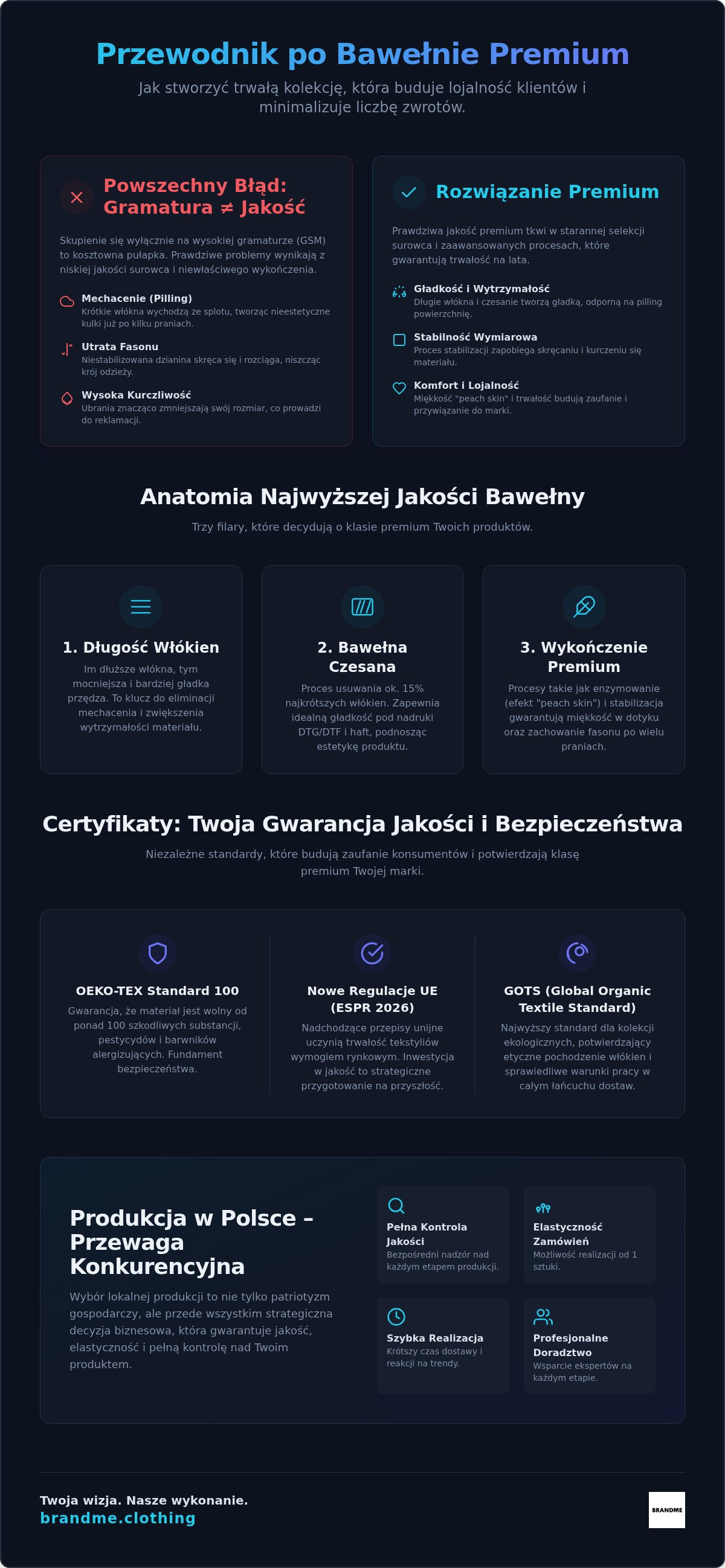
Choosing the right raw material is the most important business decision you will make when designing a collection. In 2026, when market prices for raw materials stabilize at around PLN 6.80 per kilogram, every mistake in material selection becomes a costly burden for a brand's budget. High-quality cotton for clothing production is not a subjective concept. It is a measurable technical standard that directly translates into your company's profit and customer loyalty. The foundation here is primarily fiber length. The longer they are, the stronger, more elastic, and less prone to breaking the yarn becomes. Short fibers, characteristic of cheap substitutes, quickly protrude from the weave, leading to unsightly pilling after just a few wash cycles.
The physical properties that characterize high-grade cotton eliminate the risk of microscopic defects. The raw material must be free of mechanical impurities and so-called dead fibers. Such defects do not absorb dye evenly, resulting in lighter spots on the finished garment. In the premium segment, there is no room for such compromises. Precise selection of raw material at the spinning stage ensures that your products will retain their deep color and smooth structure for years.
Quality certificates – why are they crucial?
Today, certification is no longer just a marketing add-on. It has become a market requirement. Since there are no top-down, government standards defining the parameters of raw cotton, it is independent certificates that define the premium level. The most important of these remains OEKO-TEX Standard 100. It gives your customers a guarantee that the material is free from harmful chemicals, pesticides, and allergenic dyes. This is the foundation of trust in the brand-consumer relationship.
It is worth following dynamic changes in regulations. From June 1, 2026, new, more stringent rules for OEKO-TEX® ORGANIC COTTON certification apply. All wet processes, such as dyeing or printing, must now have their own certificates throughout the supply chain. For your brand, this is a powerful selling point. A conscious consumer is more likely to invest in a product that is safe for the skin. If you plan an ecological collection, the GOTS (Global Organic Textile Standard) standard will be the best choice, confirming the ethical origin of fibers and fair working conditions.
Combed vs. carded cotton – a difference you will feel
Many manufacturers use carded cotton, which is cheaper but significantly rough to the touch. In professional tailoring, combed cotton is the standard. The combing process involves mechanically removing about 15% of the shortest and most brittle fibers. The result is an incredibly smooth, shiny, and durable yarn. The difference is palpable upon first contact with the skin.
This smoothness is crucial if you plan to personalize your collection. On a perfectly even surface, DTG or DTF digital prints look much better. The ink settles evenly, and details are sharp and clear. By using high-quality cotton for clothing production, you minimize the risk of embroidery pulling the material or causing it to tear. At Brandme, every production from scratch is based on carefully selected knits. This allows us to create clothes that will withstand dozens of washes without losing their original properties.
Grammage and weaves: How to choose material for the type of garment?
Grammage is a parameter often confused with the quality of the raw material itself. In reality, it defines the weight of one square meter of knitwear expressed in grams (GSM). Although higher grammage usually suggests greater durability and less transparency, it is only the dense weave that determines whether the garment will retain its shape. Good high-quality cotton for clothing production must be characterized by dimensional stability. This means that after washing, the T-shirt should not twist or stretch uncontrollably. The precise arrangement of fibers in the knitting process prevents deformations, which are the most common cause of returns in online stores.
For the premium segment, the foundation is a Single Jersey weave. This is a classic, smooth weave, which on one side presents small rows of stitches, and on the other is completely flat. Such a structure is ideal for personalization. In 2026, conscious brands are increasingly combining the technical parameters of the material with environmental care. Supporting initiatives for sustainable cotton production allows for building an image of a socially responsible company, which genuinely affects the purchasing decisions of modern consumers. When choosing a weave for your project, it is worth considering three key factors:
- Purpose: a light summer T-shirt requires a different density than an all-season sweatshirt.
- Branding: digital printing requires perfect smoothness, while embroidery needs a stable base.
- Comfort: loop-back knitwear wicks moisture better, while brushed knitwear provides more warmth.
Premium T-shirt – optimal grammage and weave
For T-shirts, the range of 180-240g is considered the sweet spot. This weight ensures that the product is substantial and solid, which is perfectly visible in the Oversize Heavy T-shirt model. The dense weave eliminates the problem of transparency, which is crucial for light colors. It is also worth paying attention to the ribbing. The addition of 5% elastane in the neckline ensures that the T-shirt does not lose its shape even with intensive use. This is a small detail that distinguishes fast-fashion clothing from the true premium segment.
Hoodies – a strong base is essential
Hoodie production requires even greater precision in material selection. Grammages above 300g are an absolute minimum for the hoodie category. You have two main types of finishes to choose from: loop-back knitwear (French Terry) and brushed. Loop-back is lighter and more breathable, while brushed cotton offers a characteristic, soft "fuzz" on the inside, which provides exceptional thermal comfort.
The thickness of the material directly affects the quality of the embellishment. If you plan heavy computer embroidery with high stitch density, you need a stable base that will not wrinkle under the needle. High-quality cotton for clothing production with a grammage of 340-380g perfectly maintains the embroidery structure, giving the whole a luxurious character. If you want to check how our knits perform in practice, you can order a sample and production with print to see their quality before launching the full collection.
Enzyme treatment and stabilization – secrets to the durability of premium apparel
Even the best raw material harvested from the field requires advanced processing to become a luxury product. In the world of premium fashion, it is the finishing processes that determine whether a garment will stand the test of time. High-quality cotton for clothing production undergoes refinement stages that change its structure at a molecular level. Thanks to this, the knitwear acquires properties that cannot be achieved by weave alone: it becomes resistant to pilling, incredibly soft, and dimensionally stable. In 2026, when the EU ESPR regulation places enormous emphasis on textile durability, these processes become the standard for every brand that wants to avoid costly returns and build a trustworthy image.
Investing in refined cotton is also about caring for ecology and ethics. Modern finishes are designed to minimize water and energy consumption. By tracking global quality standards for organic cotton, it can be observed that certified chemical and thermal processes are key to maintaining the authenticity and durability of fibers. At Brandme, every production from scratch takes these parameters into account, allowing us to deliver products ready for intensive use without losing their original aesthetic qualities.
No more pilling – how does biopolishing work?
Pilling is the biggest enemy of clothing brands. The enzyme treatment process, also known as biopolishing, effectively solves this problem. It involves the use of special cellulase enzymes that act like microscopic scissors. They remove protruding microfibers from the surface of the knitwear, which, during wear, curl into unsightly pills. The result? The material becomes perfectly smooth, shiny, and acquires a characteristic "peach skin" feel. This means that after twenty washes, the garment looks almost identical to the day of purchase. The customer feels the difference immediately, which builds the prestige of your brand.
Dimensional stabilization – why your T-shirts won't turn square?
The phenomenon of clothes shrinking after washing results from stresses created in the fibers during knitting and dyeing. Thermal and mechanical stabilization (sanforization) "blocks" these stresses. In the premium segment, acceptable shrinkage usually ranges from 1% to 3%, while cheap promotional clothing can shrink by as much as 10%. For a designer, this means certainty that the proportions of large-format prints will remain unchanged, and side seams will not twist after the first contact with water. High-quality cotton for clothing production subjected to stabilization is a guarantee that size M will remain size M throughout the product's life cycle.
Remember that refined cotton takes dyes much better. By removing impurities and smoothing the surface, pigments penetrate deeper and bind more permanently to the fiber. In practice, this means that your black hoodie will remain deeply black, and will not turn a faded gray after a few months. This is a concrete value that every conscious consumer in 2026 will appreciate.
Clothing production in Poland: Why a local sewing factory is a better choice?
Choosing a local production partner is not only a matter of economic patriotism, but primarily a hard business calculation. Importing finished clothing from distant markets often involves hidden costs, such as a high percentage of complaints or a lack of color consistency between batches. When your priority is high-quality cotton for clothing production, you must be absolutely sure that the raw material you are paying for actually goes to the cutting room. Sewing in Poland allows for physical verification of each bale of knitwear even before the first needle is inserted. This eliminates the risk that an entire batch of products will turn out to be defective due to material flaws that cannot be detected remotely.
Direct contact with the sewing factory shortens response time and eliminates communication barriers that are often crucial in the fashion industry. At Brandme, we focus on transparency and precision. Thanks to the fact that our entire production takes place in Poland, you have full control over the process of creating your collection. This is a security that no foreign intermediary offering anonymous imported products can provide.
Quality control at every stage
Our sewing factory Unicat, whose facilities we use, has been proving for 14 years that technical precision is the foundation of a premium brand's success. Cooperation with experienced Polish constructors guarantees that your designs will have ideal proportions, tailored to the requirements of your target group. In the local production model, we ensure the repeatability of shades for subsequent "drops" of the collection. We can precisely check the OEKO-TEX certificates of each batch of knitwear, which protects your brand from a reputational mishap related to low material durability.
Flexibility and no risk of overproduction
From July 19, 2026, the European Union will ban the destruction of unsold clothing and footwear. This change in regulations means that the model of mass production "in advance" has become not only ecologically unsustainable but also financially risky. A Polish sewing factory offers a unique opportunity to produce from 1 piece and small series. This allows for safe market testing and quick re-sewing of only those models and sizes that enjoy the greatest interest. Why is it worth sewing in Poland? Because it is the most effective way to optimize inventory and build a profitable business without unnecessary losses.
If your goal is to create clothing that will last for years and build the prestige of your company, production from scratch in the Brandme sewing factory will provide you with technological support every step of the way. We focus on what is most important: quality that speaks for itself.
Brandme: Your vision based on the best Polish knitwear
At Brandme, we believe that every piece of clothing is a message sent to the world. Therefore, we do not limit ourselves to just supplying raw material. Our high-quality cotton for clothing production becomes the foundation for modern cuts that define today's streets and offices. We combine the technical parameters of knits, which you read about in previous chapters, with the aesthetics of Oversize and Boxy. This approach means that our products are not just a background, but an active element in building a brand's image. We cooperate with both ambitious fashion brands and event agencies that are looking for boutique-standard merch.
The creation process at Brandme is comprehensive. We start with the precise selection of knitwear, taking into account its grammage and degree of stabilization. Then we move on to personalization, which goes beyond standard printing. We offer proprietary jacquard labels, neck tapes, and custom finishes that give products a unique character. Our bases are treated like a blank canvas. Thanks to the perfectly smooth surface after enzyme treatment, computer embroidery and screen printing look exceptionally precise on them. The use of high-quality cotton for clothing production guarantees that the embellishments will not lose quality even after many wash cycles.
Ready-made premium bases – time-saving without compromise
For brands that want to quickly introduce a product to the market, we have prepared an offer of ready-made bases. The model overview includes everything a modern brand needs: from a light Oversize T-shirt to substantial, heavy hoodies. Each of these products has been tested for shrinkage and color fastness. Before making a final decision, you can order samples. This will allow you to personally check the feel of the material and verify if the grammage meets your expectations. The White Label service allows you to completely remove our branding and replace it with your own.
Start creating with Brandme
Moving from an idea to a finished collection doesn't have to be complicated. At Brandme, we guide you through this process step by step. We start with a technical consultation, where we advise which marking technique will work best on the chosen material. Whether you are creating concert merchandise or a premium collection, our experience helps you avoid design errors. Contact us and see how professional company clothing with a logo can truly increase the value of your business. We are your strategic partner in the world of textiles, for whom quality is the starting point, not an end in itself.
Build on a foundation that will define your brand
Choosing the right raw material is not just a matter of aesthetics. It's a strategic decision that, in 2026, defines the profitability and prestige of your business. Remember that high-quality cotton for clothing production, subjected to enzymatic and stabilization processes, guarantees that your designs will retain their shape for years. Production in Poland gives you a unique advantage: full control over the supply chain and the ability to react quickly to market trends without the risk of costly overproduction.
Utilize our 14 years of experience in premium sewing and certified Polish knitted fabrics to create products that will delight your customers. Whether you are planning a large drop for a fashion brand or need precise production from 1 piece, we are ready to support your vision at every stage. Create your collection with the highest quality cotton at Brandme and build a brand image that makes no compromises on durability. It's time to turn your creative ideas into clothing that customers will wear with pride every day.
Frequently Asked Questions (FAQ)
Is 100% cotton always the best choice for clothing production?
100% cotton is valued for its naturalness and excellent breathability, but it is not always the optimal choice for every project. In the premium segment, small admixtures of elastane are often used, especially in neck and cuff ribbing. Such an addition makes the garment work better and not lose its original shape after many washes. The choice depends on the desired effect; pure cotton is ideal for classic T-shirts, but the stability of the weave is just as important as the raw material composition itself.
How to recognize high-quality cotton by "feel"?
High-quality cotton for clothing production is characterized by exceptional smoothness, richness, and a specific, cool touch. Premium material should not be rough or have visible "fuzz" on the surface, which often indicates the use of short, brittle fibers. If the knit fabric is dense, does not show through against the light, and immediately returns to its original shape after strong stretching, you can be sure that you are working with a high-grade raw material.
What does it mean for fabric to be enzyme-washed, and is it worth the extra cost?
Enzyme washing is an ecological biopolishing process that removes protruding microfibers from the material's surface. It is definitely worth investing in this process, as it effectively eliminates the problem of pilling, i.e., the bobbling of clothes. Thanks to enzyme washing, the fabric becomes shiny, extremely pleasant to the skin, and maintains its luxurious appearance for a very long time. For brands positioned in the premium segment, this is a standard that minimizes the risk of customer complaints.
What grammage of cotton is best for oversized t-shirts?
For oversized t-shirts, high grammages in the range of 210g to 240g work best. Such material density ensures that the T-shirt will be appropriately heavy and maintain its characteristic, boxy fit without unsightly sagging. A substantial knit fabric with a higher weight is also much more durable and provides an excellent base for advanced embellishment techniques, such as high-density embroidery or raised puff prints.
Why do premium cotton garments shrink less in the wash?
Higher resistance to shrinkage results from professional thermal stabilization and sanforization processes that high-quality knitted fabrics undergo. During these stages, the fibers are mechanically and thermally "locked," which removes stresses created during knitting. As a result, garments made from premium cotton show shrinkage levels of only 2-3%. In comparison, cheap promotional clothing without proper stabilization can lose up to 10% of its length after the first contact with warm water.
Is OEKO-TEX certification essential for a new clothing brand?
Although OEKO-TEX Standard 100 certification is not a legal requirement, in 2026 it has become a key tool for building trust. It confirms that the product is completely safe for the skin and free from harmful chemicals or pesticides. For a new brand, having certified raw material is the simplest way to authenticate the quality of its products. Customers are increasingly checking these labels before purchasing, treating them as a guarantee of responsible and safe production.
How to care for high-quality cotton to ensure prints last for years?
Proper care begins with washing clothes inside out at a temperature not exceeding 40 degrees Celsius. Avoid tumble drying, which can weaken the fiber structure and negatively affect the elasticity of prints. Because high-quality cotton for clothing production has a very smooth surface, paint pigments bind more permanently to the substrate. Following these simple rules will ensure that graphics remain vibrant and free from cracks for dozens of wash cycles.
Can I order material samples from Brandme before production?
Yes, ordering samples is an integral part of our collaboration process with brands and companies. We enable you to order finished products or material samples so you can personally verify their grammage, shade, and finishing quality. Live raw material verification helps avoid design errors and ensures that the final collection will be 100% consistent with your expectations. This professional approach protects your budget and guarantees satisfaction with the final product.

Article by
Konrad Nosek
Entrepreneur and expert in clothing production and brand building. For over 14 years, he has been developing the Unicat sewing factory, carrying out comprehensive production for Polish and foreign brands, including Dzik, OSHEE, and Relab. He specializes in designing production processes, selecting materials, clothing marking, and implementing collections from concept to finished product.
He is also the creator of the BrandMe brand, which enables brands, companies, and creators to order high-quality clothing with full personalization - even from a single piece. In his articles, he shares practical knowledge on clothing production, building one's own brand, marking technologies, and trends in the fashion and merch industry.