

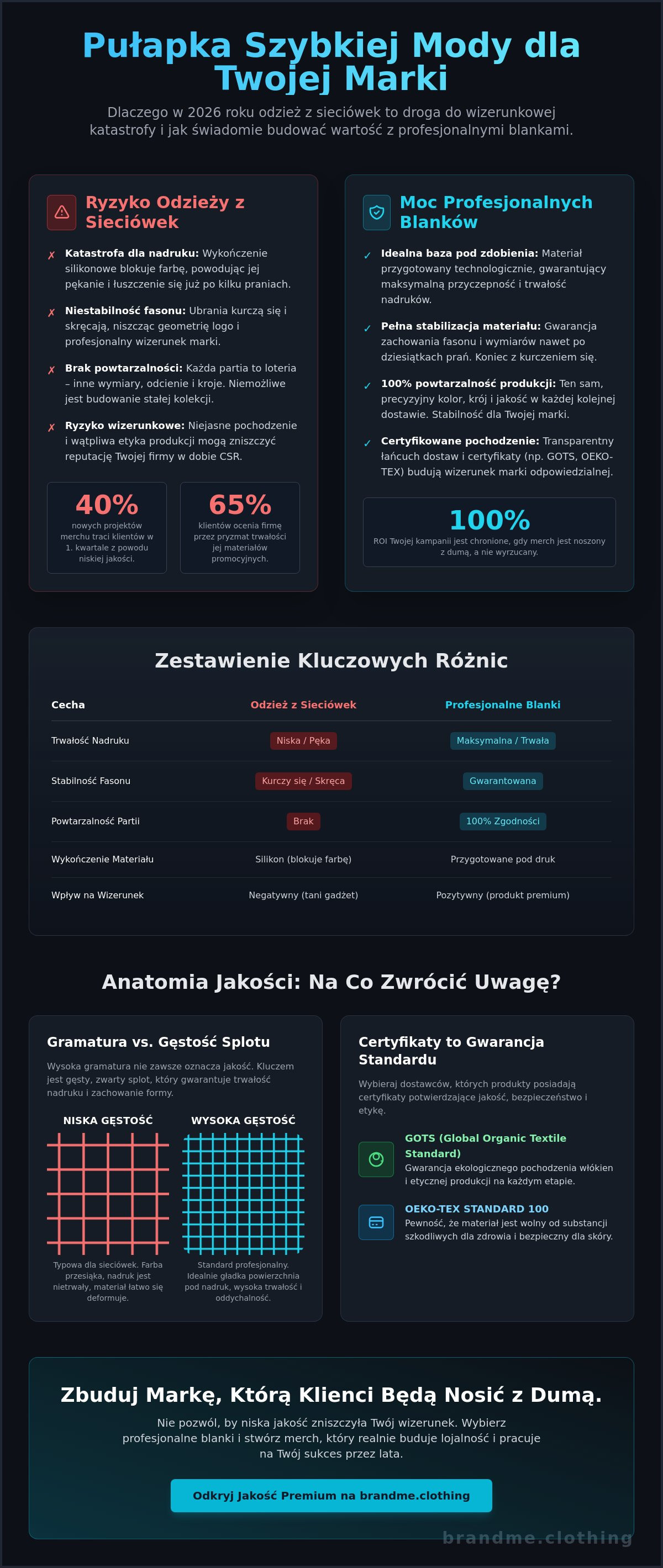
Can your brand truly afford to be associated with a fleeting fashion trend that loses its shape right after leaving the laundry? Choosing cheap, mass-produced clothing is a trap that, according to market analysis, nearly 40% of new merchandising projects in Poland fall into, losing the chance for returning customers in the first quarter of their operations. The truth is brutal. If the material shrinks and the seams twist after two wash cycles, your professional image disappears along with the product's quality. That's why high-quality blanks for branding – an alternative to chain stores – is the only right direction for companies that prioritize durability and authenticity in 2026.
You'll probably agree that merch should be a source of pride, not an embarrassing accessory that ends up at the bottom of the wardrobe. We'll help you avoid cracking prints and frustrating problems with the availability of the same models that disappear from popular chain stores' offerings month after month. In this article, you'll learn how to consciously select textiles to create a premium collection that genuinely builds your community's loyalty. We'll analyze specific technical parameters of materials and check why investing in a professional base is the foundation of your team's strong visual identity.
Key Takeaways
- Learn why silicone finishing on chain store clothing destroys the durability of embellishments and how professional bases eliminate this technical problem.
- Understand why weave density and GOTS and OEKO-TEX certifications are more important for a premium standard than the fabric's grammage itself.
- Discover why high-quality blanks for branding – an alternative to chain stores is the only guarantee of color consistency and style durability for years.
- Learn the principles of precise base matching to specific embellishment techniques, ensuring that computer embroidery or screen printing always look impeccable.
- Discover the advantage of Polish production, which allows for clothing to be sewn from scratch and offers full control over the quality of your company's image.
Why is clothing from chain stores a trap for your branding?
Choosing clothes from popular shopping malls as a base for your own brand is the shortest path to an image disaster. In 2026, the conscious consumer expects more than just a logo on cheap material. High-quality blanks for branding – an alternative to chain stores is the foundation upon which a professional visual identity is built. This is clothing designed from scratch with personalization in mind, free from the design flaws typical of mass production.
Most clothes available in large retail chains are a classic fast fashion trap. Manufacturers use aggressive silicone finishes to make the fabric feel artificially soft on the hanger. For your brand, this is a technological death sentence. Silicone creates a chemical barrier that drastically reduces the adhesion of screen printing inks, DTG pigments, and heat transfer films. The result? The print starts to crack or peel after just a few wash cycles, directly harming your credibility.
Dimensional instability is another major sin of cheap clothing. A t-shirt from a chain store often turns into a shapeless square after the first contact with water. In 2024, market analyses in Poland indicated that over 65% of recipients assess a company's professionalism by the durability of its promotional materials. If your product loses its shape, your brand is no longer associated with quality. Additionally, mass production often involves controversial supply chains. Using clothing of unclear ethical origin can damage your company's PR in an era of increasing importance of CSR reporting.
Technical barriers to branding mass-produced clothing
The textile chemistry used in cheap products blocks the proper binding of dyes to the fiber. The low weave density in chain store t-shirts causes the graphic to show through, and the material absorbs ink uncontrollably. There is a lack of consistency in cuts. When ordering another batch of goods from a chain store, you risk that a size M will have completely different dimensions than one bought a month earlier. Professional high-quality blanks for branding – an alternative to chain stores guarantee consistency of technical parameters in every delivery.
The image cost of 'cheap' corporate clothing
Employees are a living showcase for your business. Nobody wants to wear rough, poorly cut clothes that look worn out after two weeks. Low-quality merch quickly ends up in the bin, bringing your campaign's ROI to zero. By investing in proven clothing solutions, you build authority through details. The quality of the material, its grammage, and its texture are the first physical contact a customer has with your brand. It is this touch that determines whether you will be remembered as a premium partner or merely as another supplier of cheap gadgets.
Anatomy of quality: What to look for when choosing a base for printing?
Choosing clothing for branding is a process where technical details determine the success of the entire collection. Most entrepreneurs make the mistake of judging a product solely by the thickness of the material. True high-quality blanks for branding – an alternative to chain stores, are defined not only by grammage but, above all, by the weave and origin of the fibers. Industry reports indicate that the low quality of fast fashion generates huge image losses because chain store clothes lose their shape after just 3 or 4 washes. In 2026, full material stabilization is becoming the standard. This process prevents shrinkage and twisting of seams, which is crucial for maintaining the geometry of the applied logo.
Grammage vs. Weave Density
The choice between a 150g and 240g t-shirt depends on the product's purpose. Lightweight 150g t-shirts are ideal for summer campaigns and as event wear. Heavy 240g bases build a premium image, associated with modern streetwear fashion. Remember that high grammage does not always guarantee thermal comfort. It is the weave density that determines whether the material is breathable and how durably it accepts printing ink. Grammage (GSM) specifies the weight of a square meter of material, forming the foundation for the mechanical stability of the print and its resistance to repeated washing. A solid, dense weave ensures that even lighter clothing maintains its structure for many seasons.
Types of Fibers and Their Impact on Branding
Combed cotton is an absolute minimum in the corporate apparel segment. Unlike conventional cotton, it is free of impurities and short, brittle fibers. The use of ringspun cotton guarantees an perfectly smooth surface. This is crucial for DTG digital printing, where any fiber unevenness directly affects the sharpness of details. For sweatshirts, a 15% polyester blend often helps maintain the shape and prevents unsightly material bagging at the elbows. Premium sportswear, on the other hand, requires the addition of polyamide or spandex, which provides flexibility without the risk of permanent material deformation.
Safety and standards are confirmed by certificates. OEKO-TEX and GOTS labels are not just marketing elements. They are hard proof that your brand cares about user health and ecology. By choosing certified products, you eliminate the risk of allergic reactions in customers. Check out our selected apparel bases that combine all these technical features with modern design, creating a solid foundation for your visual identity.
- Combed cotton: Durability and softness to the touch.
- Stabilization: No "twisted t-shirt" effect after washing.
- GOTS certificate: Guarantee of ecological production and ethical labor.
- Ringspun weave: Surface ideal for any embellishment technique.
Professional Blanks vs. Chain Stores – A Comparison of Key Differences
The choice between a product from a popular chain store and a professional blank is not just a matter of price. It's a strategic decision about the durability of your image. High-quality blanks for branding – an alternative to chain stores offer technical parameters unavailable in mass production. The biggest difference is visible over time. Professional tests show that premium apparel retains over 95% of its color intensity even after 20 wash cycles at 40 degrees Celsius. Chain store products lose 15 to 20% of their color saturation after the first 5 washes, making a company logo no longer look prestigious.
Another argument is the continuity of collections. Chain stores change their assortment every 6 to 8 weeks. If you want to order 10 pieces of clothing for new employees a year from now, finding an identical shade will be impossible. Professional brands maintain the same color codes (e.g., French Navy or Heather Grey) for a minimum of 5 years. This guarantees full consistency of your clothing fleet regardless of the order date.
Long-term cost analysis, also known as cost-per-wear, brutally exposes the weakness of cheap solutions. A chain store t-shirt for PLN 35, which is only suitable for cleaning after 10 washes, costs you PLN 3.50 per wear. High-quality blanks for PLN 65, which will withstand 100 cycles without losing their shape, cost only PLN 0.65 per wear. Investing in quality therefore pays off fivefold.
Dimensional Stability and Shrinkage
A key problem with cheap clothing is its lack of form stability. Professional corporate clothing with logo is based on materials with controlled shrinkage. Premium standards allow for a dimensional change of only 2 to 3%, while in chain stores, shrinkage often reaches 10%. What does this mean in practice? A size L t-shirt can become a size M after the first wash. Additionally, professional blanks have side seams. These prevent the material from twisting (so-called torsion), so the print on the chest always remains perfectly centered, and does not shift towards the armpit.
Personalization and 'No-Label' Policy
The true strength of professional blanks lies in their re-branding capabilities. Tear-away tags allow for instant removal of the manufacturer's label without damaging the seams. This means that high-quality blanks for branding – an alternative to chain stores become your original product. You can use your own woven labels or neck prints, which immediately positions your brand in the high-end segment. Details such as color-matched drawstrings in hoodies or engraved metal aglets make the final product look like it's from a luxury boutique collection, not a mass market.
How to match the base to the chosen branding method?
Choosing an embellishment technique is only half the battle in building a brand's image. True quality emerges at the intersection of the machine and the correctly chosen material. By opting for high-quality blanks for branding – an alternative to chain stores, you gain confidence that the final product will not only survive the first wash but will retain its original form for years. Each embellishment method places different technical demands on the fabric, which you should be aware of before starting production.
Embroidery vs. Thin Materials
Embroidering on a thin 130g t-shirt is a direct path to an image disaster. The needle makes thousands of punctures in one spot. With a weak, loose weave, this causes the material to "pull" and create unsightly ripples around the logo. Solid sweatshirts with a grammage above 280g/m2 provide a stable foundation for thick threads. Proper stiffening with stabilizers, such as non-woven interlining, makes the embroidery look like an integral part of the garment. If you're planning complex logos, check out our Branding company apparel: A guide to methods to avoid design errors.
Surface Smoothness and Digital Printing
DTG and DTF printing require an ideally smooth surface. Traditional cotton often has a fine "fuzz" that lifts when exposed to ink in digital printing. This causes blurry edges and a loss of color saturation. Combed cotton completely eliminates this problem. Thanks to it, photorealistic graphics maintain sharpness of detail at 300 DPI. High-quality blanks for branding – an alternative to chain stores require up to 20% less pre-treatment chemicals. This translates into a better feel of the material and the absence of a characteristic, stiff "film" in the print area.
- Computer embroidery: Requires a grammage above 180g for t-shirts and 280g for sweatshirts.
- Screen printing: Looks best on dense, single jersey weaves.
- DTG and DTF: Combed cotton with minimal pilling is crucial.
- Sublimation: Requires a minimum of 70% polyester content for the pigment to bond permanently with the fiber.
Branding synthetic clothing is a separate challenge. Flex films or sublimation require precise temperature control. Cheap chain store alternatives often shrink or melt under a heat press at 160 degrees Celsius. Professional blanks are tested for high temperature resistance, which guarantees production repeatability. Don't risk destroying an entire batch of goods due to poorly chosen base material.
Want to ensure your logo looks perfect on every product? Choose proven solutions and discover our full range of premium blanks that work perfectly with every branding method.
Brandme: Your alternative to mass production and chain stores
In 2026, the conscious consumer rejects mass production in favor of authenticity and durability. Brandme is a direct response to these needs. Our production takes place entirely in Poland, guaranteeing full transparency and control over every single stitch. You don't have to worry about broken supply chains from Asia or questionable labor ethics. By choosing high-quality blanks for branding – an alternative to chain stores – it becomes your strongest sales argument. You invest in Polish capital and support local artisans, gaining a product that truly builds the value of your brand.
Cooperation with a local manufacturer means primarily quick response times. We can continuously refine details, select appropriate finishes, and ensure that the final merch is exactly as you envisioned it. This level of commitment is unattainable for large apparel corporations. At Brandme, you don't just buy clothes; you buy the certainty that your brand will be associated with the highest standard of execution.
Tailoring to Your Needs
Ready-made wholesale catalogs often limit creativity. We propose thinking outside the box: sewing clothing from scratch. Customizing cuts and details allows for the creation of a unique product that you won't find on the shelves of popular stores. You can decide on every aspect of the product, from the specific grammage of the fabric to unique colors dyed to match your Brand Book.
- Adjusting sleeve width and torso length to your target audience.
- Choosing original accessories: woven labels, custom zippers, or non-standard drawstrings.
- Option to order samples before starting full production.
Thanks to this, your apparel becomes part of the company's visual identity. Check out how professional custom hoodie production works at Brandme and see that premium quality is within your reach.
Partnership, Not Just Delivery
We are not just a supplier of goods. We act as your external production and technical consulting department. We help select branding techniques, such as computer embroidery or screen printing, so that they perfectly harmonize with the chosen material base. Our offer is fully scalable. We handle both short event series of 50 pieces and extensive retail collections numbering in the thousands of copies.
We understand the dynamics of modern business. We know that high-quality blanks for branding – an alternative to chain stores – are an investment that must yield a return in the form of your customers' loyalty. That's why we care about every stage: from yarn selection, through precise sewing, to the final packaging of merch ready for shipment. Get to know Brandme: A Polish apparel manufacturer that cares about your success and makes your brand a tangible symbol of professionalism.
Build your brand's advantage with uncompromising quality
Choosing the right base for your print is the foundation of your brand strategy in a dynamic market. Chain stores offer mass production, but high-quality blanks for branding – an alternative to chain stores, guarantee the durability and professionalism that conscious customers will demand in 2026. By investing in Polish production from certified knitted fabrics, you gain real control over every seam and material parameter. Brandme uses modern machinery, performing precise embroidery, durable DTF, and classic screen printing of the highest quality. Our approach allows for orders starting from 1 piece. This allows you to flexibly manage your budget and test new designs without unnecessary financial risk. Your brand needs clothes that will last for years, not just one season. Opt for standards that build customer loyalty from the first touch of the material. It's time to stop compromising and start creating clothing that genuinely contributes to your market success.
Check out Brandme's offer and create merch you'll be proud of
Your vision deserves the best possible presentation that will stand the test of time.
Frequently Asked Questions (FAQ)
Do high-quality blanks always have to be more expensive than clothes from chain stores?
No, high-quality blanks for branding – an alternative to chain stores often prove cheaper in the long run. The purchase cost of a premium t-shirt may be 15-20% higher, but its lifespan exceeds 50 wash cycles without losing its shape. Chain store clothing loses its original shape after just 5-10 washes. By investing in a better base, you save on frequent replacements of corporate attire. This is pure mathematics and a commitment to your brand's professional image.
How to check the quality of a t-shirt before placing a large order for branding?
The best method is to perform a stretch test and check the side seams. A good t-shirt should return to its original shape immediately after stretching the material. Pay attention to the density of the weave against the light; transparency disqualifies the product. Also, check that the seams are even and do not have protruding threads. We always recommend ordering a single test piece to assess the material's feel and wearing comfort before producing 100 or 500 pieces.
What is fabric weight (grammage) and how does it affect print durability?
Grammage is the weight of one square meter of fabric expressed in grams (g/m²). Higher grammage, for example, 190-220 g/m², provides a more stable base for digital DTG or screen printing. The material is less prone to movement, which prevents the graphic from cracking during use. In 2026, the standard for premium t-shirts will be a minimum of 180 g/m². Too thin a material causes the ink to penetrate too deeply, losing color saturation and design edge sharpness.
Is computer embroidery possible on clothing from chain stores?
It is possible, but the result is often disappointing due to the too low weave density of thin fabrics. The embroidery needle makes thousands of stitches, which in the case of poor-quality chain store material leads to puckering around the design or the formation of holes. Professional blanks have a reinforced structure that withstands the pressure of professional machines. This ensures that the embroidery remains flat and aesthetic even after many months of intensive use by your employees.
Why do chain store clothes twist in the wash, while professional blanks do not?
Seam twisting results from cost-saving measures during the fabric cutting stage in mass production. Chain stores cut fabric at an angle to maximize material utilization, which causes fiber rotation after contact with water. High-quality blanks for branding – an alternative to chain stores are cut along the warp thread direction. The decatizing process, which involves hardening the fabric with hot steam, stabilizes the product's dimensions. This guarantees that the t-shirt will maintain its original cut for years.
How does ringspun cotton differ from regular cotton in the context of branding?
Ringspun cotton is made by continuously twisting fine cotton fibers, creating a stronger and smoother weave. Regular cotton (open-end) is rough and has protruding micro-fibers, which makes precise printing difficult. Ringspun provides a perfectly smooth surface, which is crucial for detailed graphic designs. This fabric is also 30% more resistant to friction and pilling. This directly translates into the prestigious appearance of your brand.
Does Brandme offer clothing samples before fulfilling the full order?
Yes, we offer the possibility to order samples before starting mass production. We believe that touching the material and checking the fit live is the only way to make an informed business decision. You can order plain samples in various sizes to verify the size chart and finishing quality. This procedure eliminates the risk of errors with large image investments. Each of our partners receives full support in selecting the ideal model for a specific embellishment technique.
What certificates should premium clothing for branding have?
The key certificate is OEKO-TEX Standard 100, which guarantees the absence of harmful chemical substances in the finished product. If your brand focuses on ecology, look for the GOTS (Global Organic Textile Standard) label confirming the organic origin of cotton. The Fair Wear certificate, in turn, ensures ethical working conditions in sewing factories. Possessing such certificates increases the value of your product in the eyes of conscious consumers. This is a standard that is hard to find in the cheapest market offers.